
Isaac of Optina
Our Venerable Father Isaac the Elder, Schema-Archimandrite and Superior of the Optina Hermitage
Venerable · b. 31 May 1810, at Kursk, baptised Ivan — d. 22 August 1894, at the Optina Hermitage
Commemorated 22 August — Repose at Optina after thirty-two years as superior
Isaac (Antimonov) — Ivan in the world, the son of a Kursk merchant house — entered the Optina Hermitage in 1847 at thirty-seven, was formed under the great elder Macarius, and in 1862 was made superior of the monastery, which he governed for thirty-two years until his death. His rule spans the golden age of Optina: he rebuilt and enlarged the monastery's churches, raised its hospital, guest-house and workshops, put its finances in order, and stood behind the foundation of the women's convent at Shamordino — while himself remaining, though he was the superior, an obedient spiritual son of the elder Ambrose, whose eldership he protected against every attempt to suppress it. He reposed on 22 August 1894 and was glorified with the whole company of the Optina elders in 1996 and 2000.

The merchant's son of Kursk
He was born at Kursk on 31 May 1810 and baptised Ivan, the son of Ivan Vasilievich Antimonov, a merchant of the town, and of Anna, born Puzanova. He was the fifth child of his father's first marriage, in a household that eventually numbered thirteen children and was governed on the old Russian pattern — patriarchal, hard-working, and seriously devout. A prophecy of his monastic vocation is remembered in the family traditions, as often in the lives of the Optina fathers.
He was kept in the family business well into his thirties. The turn came, the accounts say, after a marriage he had contemplated came to nothing; and in 1847, aged thirty-seven, he left Kursk for Optina. He was set to the ordinary labours of a late-coming novice with no education for the choir: the bakery, the kitchen, the apiary.
Under the elder Macarius
His spiritual father was Macarius (Ivanov), the second of the great Optina elders and the editor of the monastery's celebrated editions of the ascetic fathers. Isaac was by nature retiring, and resisted ordination; Macarius overruled him. He was tonsured a monk on 5 October 1854, ordained hierodeacon on 19 June 1855, and hieromonk on 8 July 1858. Under Macarius he learned the thing that afterwards defined his own government: that the superior's authority and the elder's authority are different things, and that the first exists to protect the second.
Thirty-two years as superior
Macarius died in 1860 and the abbot Moses (Putilov) in 1862, and in that year the brotherhood received Isaac as superior. He held the office until his death — a term of thirty-two years, the longest at Optina after Moses's own.
His administration was that of a builder and a manager, and the Optina that the Russian intelligentsia visited in the last quarter of the century was substantially his work. He found the monastery's finances precarious and left them sound. He enlarged the Kazan cathedral, built the church of All Saints in the new cemetery, and raised a hospital with its own pharmacy, a candle works, and a guest-house for the flood of pilgrims that the eldership brought. He supported from the beginning the foundation of the women's community at Shamordino, which Elder Ambrose established and which became one of the largest convents in Russia.
Through all of it he continued to refer himself, as a simple monk does, to the elder Ambrose, who lived in the skete and who was by then the most sought-after spiritual guide in the empire. This was neither sentiment nor weakness. The institution of eldership was repeatedly attacked from outside the monastery and from within, and a superior less convinced of it could have ended it at Optina with a single administrative decision. Isaac's whole government was the guarantee that Optina's elders were never made to answer to Optina's office.
He was remembered for humility, gentleness, and a positive aversion to being noticed; the saying attached to his memory is characteristic in its plainness — live according to conscience, and ask the help of the Queen of Heaven.
Repose, relics and glorification
He reposed on 22 August 1894, in his eighty-fifth year, and was buried at the Kazan cathedral of the monastery beside the other superiors. Optina was closed in 1923 and the graves were lost under the Soviet use of the site; his relics were uncovered in 1995, during the excavations that followed the monastery's return to the Church, and they rest today in the restored monastery.
Local veneration of the Optina elders as a company was authorised by the Moscow Patriarchate in 1996 — the Russian accounts give 26 July 1996 and the Orthodox Church in America 13 June 1996 for the act — and they were glorified for veneration throughout the Church in 2000 (the OCA records 7 August 2000; the general glorification of the Jubilee Council of that year). Isaac stands among the fourteen elders of the synaxis, which is kept on October 11.
Feast and commemoration
August 22 (church date; Old Calendar civil September 4), the day of his repose, within the afterfeast of the Dormition of the Theotokos. He is commemorated by the Russian Church and the OCA; the Greek and Antiochian calendars of the day carry only the ancient martyrs. With the other Optina fathers he is also commemorated at the Synaxis of the Optina Elders on October 11, and in the general commemorations of the Russian saints. Note that the Russian books, keeping the Julian calendar, print his day as 22 August and observe it on the civil 4 September; the church date is the same in both usages.
Hymns
Apolytikion — Tone 4 (common of a monastic saint)
A dweller of the wilderness and an angel in the body wast thou shown to be, O God-bearing Father Isaac: by fasting, vigil and prayer thou didst receive heavenly gifts, and thou healest the sick and the souls of them that run to thee with faith. Glory to him who gave thee strength, glory to him who crowned thee, glory to him who works healings through thee for all.
Iconography
Isaac is painted in the iconography developed for the Optina elders after the glorifications of 1996 and 2000: an elderly monk in the mantiya and klobuk, with a long white beard parted at the point, holding a scroll or a prayer-rope, and — as a superior — sometimes the pectoral cross. In the group icon of the Synaxis of the Optina Elders he stands among the fourteen, ranged in two tiers about the monastery and the Kazan cathedral. All such icons are modern works still in copyright and none is reproduced here.
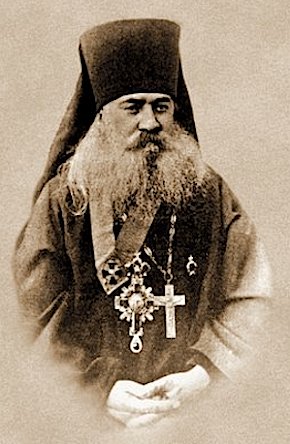
The image stored with this entry is instead a photograph from the life, taken at Optina in the 1890s by an unknown photographer and preserved in the monastery's archive: the schema-archimandrite in klobuk and mantle, with the pectoral cross and panagia-like medallion of his office and hands folded in his lap. It follows the precedent of Moses of Optina in this collection, where a pre-1900 lithograph portrait is stored on the same footing — such images are documentary portraits, not icons, and are labelled as such.
Disputed questions
- Isaac I and Isaac II. He must be distinguished from Isaac (Bobrakov), "Isaac the Younger" (1865–1938), the last superior of Optina, who governed the monastery through its suppression, was arrested repeatedly and shot on 8 January 1938, and is numbered among the new-martyrs. Russian sources call them Isaac I and Isaac II of Optina, and the two are constantly confused; only the elder belongs to this day.
- The glorification dates. The 1996 local act is dated 13 June by the OCA and 26 July by the Russian sources; both are recorded above rather than harmonised.
- The secular biography rests almost entirely on the monastery's own nineteenth-century literature and on the Orthodox Encyclopedia article, and the years before 1847 are thinly documented.