
Moses of Optina
Our Venerable Father Moses of Optina, Schema-Archimandrite and Superior of the Optina Hermitage
Venerable · b. 15 January 1782, at Borisoglebsk in the Yaroslavl province, baptised Timothy — d. 16 June 1862, at the Optina Hermitage
Commemorated 16 June — Repose at Optina
Moses (Putilov) — Timothy in the world, born at Borisoglebsk in 1782 — was the superior who made Optina what it became. Formed at Sarov, where he knew St Seraphim, and then for ten years among the hermits of the Roslavl forests, heirs of the school of Paisius Velichkovsky, he was brought out of the woods in 1821 by Bishop Philaret of Kaluga to build the skete of St John the Forerunner beside the Optina monastery. From 1825 until his death in 1862 he governed the whole house as superior: he raised its buildings, its library, its lands and its numbers, and — the decisive act — he received the elders Leonid and Macarius, shielded them from the opposition their eldership provoked, and put himself under their direction while remaining their abbot. From that arrangement the Optina eldership grew, and through it a century of Russian religious life. He reposed on 16 June 1862; his relics were found incorrupt, and he was glorified with the Optina elders in 2000.

Family and flight to Sarov
Timothy Ivanovich Putilov was born on 15 January 1782 at Borisoglebsk in the Yaroslavl province, the son of a merchant, Ivan Grigoryevich, and his wife Anna Ivanovna, who taught their children the Scriptures and church singing at home rather than send them to the schools. Three of the sons became monastics of note; one of them, Anthony (Putilov), was Moses's lifelong companion and afterwards head of the Optina skete under him.
At twenty-two Timothy and his younger brother Jonah left for Sarov without their father's blessing — the father had refused it — and were received there; the blessing came later, in the father's illness. At Sarov, in the years around 1805–1809, Timothy worked in the bakery and attended the ailing abbot Nazarius, and met the hermit Seraphim, whose memory he carried the rest of his life.
The Roslavl forests
About 1811 he went to the hermits living in the pine forests near Roslavl in the Smolensk country — solitaries in the tradition of St Paisius Velichkovsky, keeping the Jesus Prayer and the patristic reading he had transmitted. He remained there ten years, in real hardship: wolves and bears, robbers, and the storms of an unsheltered forest. There he was tonsured Moses by the elder Athanasius, the name given, the tradition says, for his hospitality and love of strangers. He copied patristic texts, and acquired in that decade the formation that made him fit to govern others.
The building of the Optina skete
In 1821 Philaret (Amfiteatrov), bishop of Kaluga — himself a friend of the hermit tradition — invited the Roslavl fathers to found a skete in the pine wood beside the Optina monastery. Moses came on 6 June 1821 with his brother Anthony and two companions, and they cleared the forest by hand and built the cells and the wooden church of St John the Forerunner. In December 1822, over his own request to be left in simple monastic rank, Philaret ordained him priest and appointed him spiritual father of the community.
Superior of Optina, 1825–1862
In 1825, at forty-three, he was made superior of the whole monastery — some forty brethren, and substantial debts. He held the office for thirty-seven years. Under him Optina was rebuilt and enlarged: churches, cells, a guest-house, the mills and the farm land, and above all the library, which became the base of the great Optina publishing enterprise that put the Greek and Slavonic fathers into Russian.
His personal austerity was extreme and his charity notoriously imprudent: he employed the poor at work the monastery did not need, bought from struggling traders at prices above the market, and kept the gates open to pilgrims in numbers the house could barely feed. Reproached for it, he answered that if ninety-nine failed to pay, God would send the hundredth to pay for all.
The eldership
The act for which the Church remembers him is the reception of the elders. When Leonid (Leo) came to Optina in 1829 and Macarius after him, the practice of starchestvo — the open disclosure of thoughts to a spiritual father, and the direction of laypeople as well as monks — met heavy resistance, denunciations to the diocese and hostile attention from the authorities. Moses stood between the elders and the pressure, and made a distinction that became Optina's constitution: the superior governs the house, the elder governs souls. He himself went to Leonid as a disciple, submitting his own conscience to a monk under his obedience. Out of this arrangement came the succession of Optina elders — Leonid, Macarius, Ambrose, Anatole, Joseph, Barsanuphius, Nectarius — that drew the Russian nineteenth century, Kireevsky and Gogol and Dostoevsky among them, to a forest monastery in the Kaluga province.
Repose, relics and glorification
He reposed on 16 June 1862, in his eighty-first year, after a short final illness; his last words were of the Gospel of the coming of the Son of Man. He was buried at Optina, and when his brother Anthony's grave was opened beside him some years later the workmen found the body of Moses incorrupt notwithstanding the wet ground. His relics rest in the Kazan church of the monastery.
He was glorified as a local saint of the Optina synaxis in 1996, and by the Jubilee Council of the Russian Orthodox Church in August 2000 for general veneration.
Feast and commemoration
June 16 (church date; Old Calendar civil June 29), his repose. Russian usage and the OCA; not in the Greek or Antiochian menaia. He is also commemorated with the whole company of the Optina elders in their synaxis (October 11), and among the saints of the Kaluga land.
Hymns
Apolytikion — Tone 4 (common of a monastic saint)
A dweller of the wilderness and an angel in the body wast thou shown to be, O God-bearing Father Moses: by fasting, vigil and prayer thou didst receive heavenly gifts, and thou healest the sick and the souls of them that run to thee with faith. Glory to him who gave thee strength, glory to him who crowned thee, glory to him who works healings through thee for all.
Iconography
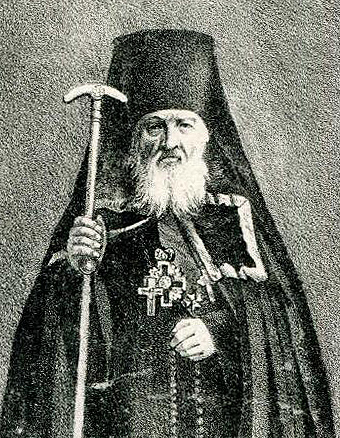
As a nineteenth-century Russian saint glorified in our own time, Moses is painted in the established manner of the Optina elders: an aged monk in the black mantle and klobuk or in the great schema, a long white beard, one hand blessing and the other holding a scroll — the scroll usually inscribed with a sentence of his on trust in Providence or on the receiving of strangers. In the group icon of the synaxis of the Optina elders he stands in the first rank beside Leonid and Macarius, often with the monastery and its skete depicted below the company; where the icon is proper to him alone, the wooden church of St John the Forerunner in its clearing is his attribute.
The stored image is not an icon but a portrait from the life: the lithograph published at his death in 1862 by the A. I. Prokofiev press in Moscow, and captioned as the superior of Optina, Archimandrite Moses, "reposed the 16th of June 1862". It shows him seated in klobuk and mantle, holding his staff, with the pectoral cross and the decorations of his office — the physiognomy from which all the later painted icons derive.
Disputed questions
- Founder or refounder? Moses did not found Optina, an ancient house; he built its skete and refounded its life. The formula "founder of the Optina skete", which the calendars use, is accurate in that restricted sense and should not be read as making him the founder of the monastery.
- Two brothers, two saints. His brother Anthony (Putilov) (†1865, kept August 7) was head of the skete under him and is glorified with the Optina elders; the two are constantly confused in secondary accounts, and the details of the skete's building belong to both.
- The date of glorification. Local glorification 1996, general 2000. Because his service and akathist are modern compositions in copyright, this entry gives no proper hymn text, as the repository's policy on modern translations requires.