
Isaac of Dalmatia
Our Venerable and Confessing Father Isaac, Founder and First Abbot of the Monastery of the Dalmatians at Constantinople
Venerable · Confessor · d. c. 383
Commemorated 30 May — Repose at the monastery outside the walls of Constantinople, 3 August — Kept with his successors Dalmatus and Faustus, the fathers of the Dalmatian monastery
Isaac (died c. 383) was a Syrian ascetic who left the desert for the capital in the crisis year 378 in order to stand in the road before the Arian emperor Valens as he rode out against the Goths, and to demand of him three times that the churches be given back to the Orthodox — foretelling, when he was refused, that the emperor would not come back but would perish by fire. Valens had him flung into a thorny ravine and then held under guard; within weeks he was dead in a burning farmhouse after the catastrophe at Adrianople, and the monk who had prophesied it was released a vindicated man. Under Theodosius the Great Isaac became the conscience and the spiritual father of Constantinople, and the monastery raised for him outside the walls by the officer Saturninus was the first great monastic house of the city — known ever after by the name of Isaac's successor Dalmatus, whence Isaac's own epithet "of Dalmatia". He is honoured as venerable and confessor on May 30, and again on August 3 with the fathers of his monastery.

Origins and the desert
The synaxarion makes Isaac a Syrian by birth, one of that great generation of Semitic ascetics who filled the hinterland of Antioch and Mesopotamia with cells and enclosures in the middle of the fourth century. He was tonsured and pursued his struggle "in the desert" — the notices do not localise it further, and the later Russian tradition that he was a disciple of Antony the Great is a pious inference from his stature rather than a transmitted fact. What the sources do convey is the type: a solitary of the older, harsher school, with no office in the Church, no learning to appeal to, and no reason to be listened to by anyone except the authority of a life lived wholly for God. That is the man the historians place, without explanation, in the road outside Constantinople in the summer of 378.
The confrontation with Valens
The emperor Valens (364–378) had governed the East for fourteen years as a convinced supporter of the Arian party. Orthodox bishops were deposed and exiled, their congregations dispossessed, and the churches of the great cities handed to the homoian clergy; the persecution was administrative rather than bloody, but for the Nicene faithful of the East it was the bitterest phase since Constantius. In 378 the Goths, settled south of the Danube after the disaster of 376, were ranging through Thrace within reach of the capital itself, and Valens marched out of Constantinople to meet them.
Isaac came up from his solitude, and — the account is consistent in Theodoret, in Sozomen and in the synaxarion — pushed through the imperial column, took hold of the emperor's bridle, and cried out to him: "Open the churches to the Orthodox, and God will fight for you." Valens rode on. The monk ran alongside and repeated the demand, and repeated it a third time. The emperor, provoked past patience, ordered him thrown into a place from which he would not come out: the sources describe a deep pit choked with thorns and mire beside the road. Isaac was pulled from it — the received account says by three angels, and the saint himself is quoted as saying so — and overtook the column again.
The second word he spoke was sharper than the first. If the churches were restored, Isaac told him, the emperor would return victorious; if not, he would be defeated, taken, and burned alive, and would not see the city again. Valens, unnerved but unmoved, gave the monk into the custody of two of his officers, Saturninus and Victor, with orders that he be held until the emperor came back to deal with him — a sentence that turned, in the event, into the guarantee of Isaac's safety and the occasion of his fame, for it made the two men witnesses.
The fulfilment
On 9 August 378 the Roman field army was destroyed by the Goths at Adrianople. Valens disappeared in the rout. The report that reached Constantinople — and that the Church has always read as the fulfilment of Isaac's word — was that the wounded emperor was carried into a farmhouse or barn, that the Goths, not knowing whom they had cornered, set the building alight, and that he was burnt to death in it with those who had brought him there. No body was ever recovered.
Saturninus and Victor set Isaac free, and the city received him as a prophet. It is worth saying plainly what the tradition asks the reader to notice: the monk did not foretell a victory, he foretold a judgement, and he staked his own life on it in the open road, before an army, against an emperor. The confessor's title he bears rests on that morning and on the pit.
Theodosius, and the monastery outside the walls
Theodosius the Great (379–395) came east as the Nicene answer to Valens, and Saturninus and Victor — now his men — brought Isaac to him. The emperor received the old ascetic with reverence, and the tradition credits Isaac's counsel with a share in the two acts that reversed the Arian settlement: the expulsion of the heretical clergy from the churches of the capital and the restitution of the churches to the Orthodox. The Second Ecumenical Council met at Constantinople in 381, and the synaxaria place Isaac in the city among the ascetics who supported its confession against the Arians and the Pneumatomachi; he was not a bishop and did not subscribe, but the monastic constituency he headed was one of the forces that made the Council's verdict stick in the streets.
Isaac wished to go back to the desert. Saturninus and Victor would not let him, urging that the city needed him more than the wilderness did; Saturninus gave land in the Psamathia quarter outside the walls, near the Golden Gate, and built there the monastery of which Isaac became the first abbot. This house is, on the tradition's own reckoning and on the best historical evidence, the earliest monastery of Constantinople — the beginning of the coenobitic life inside the capital, and the parent of the whole Byzantine urban monasticism that followed. Isaac governed it as a father of monks and, no less, as a resource for the city: the notices insist on his care for laypeople who came for counsel and for the poor who came for bread.
Repose, and the name of Dalmatus
In great old age Isaac laid the government of the house on his disciple Dalmatus, a former officer of the second schola of the imperial guard who had entered the monastery with his son Faustus. Isaac then reposed, by the common reckoning about 383, on the thirtieth of May, and was buried in his own monastery.
The house he founded came to be called, from his successor, τὰ Δαλμάτου — "the monastery of Dalmatus," or "of the Dalmatians." Its abbots held the primacy among the monasteries of Constantinople and bore the title of archimandrite and exarch of the monks of the city; Dalmatus himself broke a forty-eight-year enclosure in 431 to lead the monks of the capital in procession against Nestorius, and the monastery stood for the Council of Ephesus. Its later abbots recur through Byzantine history — it is still the great house of the city in the eighth and ninth centuries, when John of Kathara knew it. Isaac is commemorated together with Dalmatus and Faustus on August 3 as the three fathers of that monastery, and it is from the monastery's borrowed name that he is universally styled, a little misleadingly, "Isaac of Dalmatia."
Veneration and later cultus
Isaac was kept from the first in the Synaxarion of Constantinople and passed with it into every Byzantine calendar; the Menaion of May 30 gives him a full office with canon, kathismata and stichera, celebrating the ascetic and the man who withstood a king.
The house he founded outlived him by five centuries and produced further saints of its own. Four and a half centuries after Isaac, its abbot Hilarion the New of Dalmatia (†845, commemorated June 6) governed Dalmatou through the whole of the second Iconoclasm and was imprisoned, starved, flogged and exiled by Leo V and Theophilos for the holy icons — so that the founder who defied Valens and the abbot who defied the iconoclasts belong to a single continuous history of one Constantinopolitan monastery, kept in the calendar on May 30, August 3 and June 6.
His most extraordinary afterlife is Russian. Peter the Great was born on 30 May 1672, Isaac's day, and took the saint of his birthday as his own patron and, by extension, a patron of the dynasty and of the new capital. The successive churches of St Isaac of Dalmatia in St Petersburg — a wooden chapel, then Matarnovi's church, then Rinaldi's, and finally the vast granite and gilt cathedral of Auguste de Montferrand (1818–1858), one of the largest domed churches in the world — carry the name of an obscure fourth-century Syrian solitary into the middle of imperial Russia. There is no more improbable dedication in Christendom, and no better illustration of how a Byzantine synaxarion entry can become a national monument.
Feast and commemoration
May 30 (church date; New Calendar civil May 30, Old Calendar civil June 12) is the day of Isaac's repose and his principal feast, kept alike by the Greek, Antiochian, Slavic and American calendars; the Menaion assigns the day to him alone among the saints of May 30, and his is the only proper office of the day. He is commemorated again on August 3 (Old Calendar civil August 16) with Dalmatus and Faustus as one of the three fathers of the Dalmatian monastery. In the Russian Church the day carries the additional weight of the patronal feast of St Isaac's Cathedral in St Petersburg.
Because the day falls late in May, it lies in the Pentecostarion or shortly after it depending on the year, and in some years coincides with a Saturday of the departed; whatever belongs to the movable cycle takes precedence over the fixed commemoration.
Hymns
Apolytikion — Tone 8
With the streams of thy tears thou didst make the barren desert to bring forth, and with sighs from the depths thou didst render thy labours fruitful a hundredfold; thou becamest a beacon shining upon the world by miracles, O Isaac our father: intercede with Christ God that our souls may be saved.
Kontakion — Tone 2
Thou didst leave the silence of the desert and stand in the road before an emperor, crying, Give back the churches of the Orthodox to God; and being cast into the pit of thorns thou wast not silenced, but didst foretell the fire that took him. Wherefore, O confessor Isaac, father of the monks of the City, pray that we too may fear God and not men.
Original translation from the Greek
Iconography
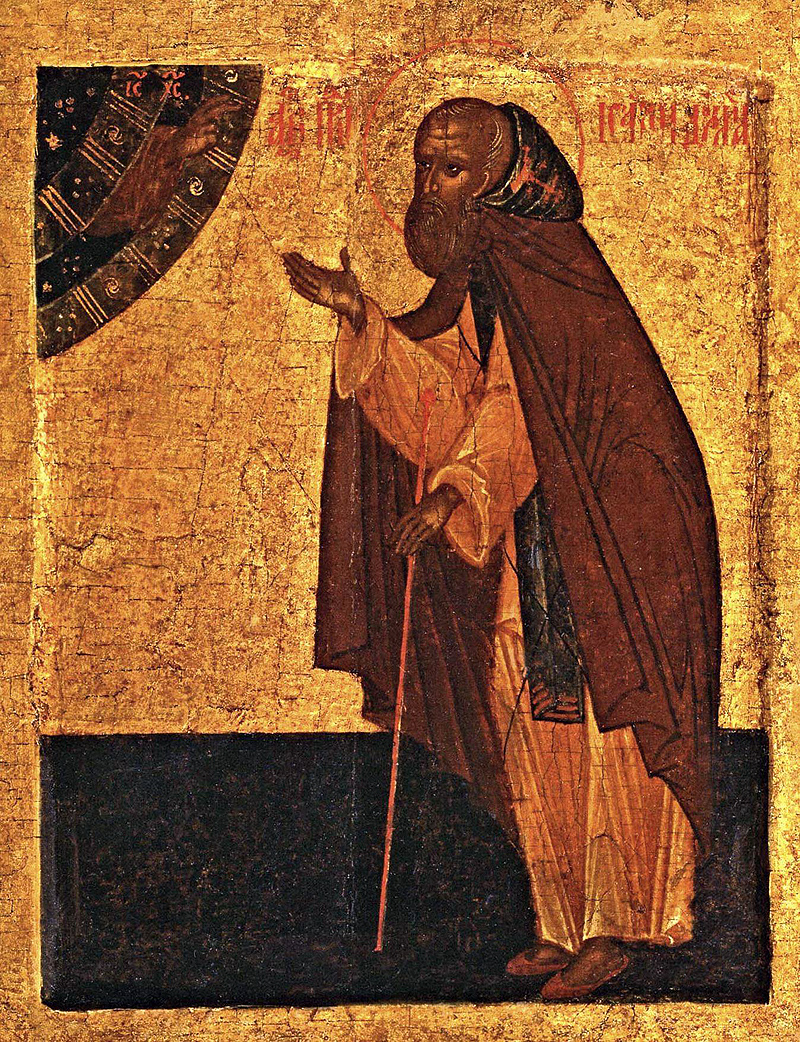
Isaac is painted as an aged monastic: long white or grey beard, the cowl of the great schema drawn back or covering the head, in dark mantle over a lighter tunic, and most often standing in profile, bowed forward with the right hand open in supplication toward the segment of heaven in the upper corner from which the blessing hand of Christ emerges. That composition — the ascetic in prayer beneath the opened heaven, sometimes with a scroll or a staff — is the standard Russian type, and the staff carries an appropriateness of its own for a saint whose memory is a walk into an army. The narrative scenes proper to him, found in Russian menologion cycles and in the painted programme of St Isaac's Cathedral, are two: Isaac seizing the bridle of Valens, and Isaac drawn out of the thorny pit by angels; occasionally he is shown handing his staff to Dalmatus.
The stored image is a 17th-century Russian panel icon of exactly the standard type: the saint in the dark cowl and mantle, bent forward on a gold ground, holding a slender red staff and lifting his open right hand toward the starry segment of heaven with the blessing hand of Christ and the monogram ΙС ХС, the Cyrillic inscription naming Isaac of Dalmatia written in red beside his head.
Disputed questions
- The year of repose, and the Isaac who opposed Chrysostom. The synaxaria and the calendars give 383. But Palladius, in his Dialogue on the Life of John Chrysostom, names an Isaac who was the head of the Syrian monks resident at Constantinople and one of Chrysostom's most damaging accusers at the Synod of the Oak in 403 — and a number of scholars identify him with the founder of the Dalmatian house, which would push Isaac's death past 406 and make the date 383 worthless. The identification is not certain: the name is common, Palladius's Isaac is a partisan intriguer of a kind hard to reconcile with the ascetic of the pit, and the hagiographic tradition knows nothing of the affair. The repository records the traditional 383 while noting that the historical Isaac may have lived a generation longer and may have a much less edifying chapter in his life than the synaxarion transmits.
- "Of Dalmatia." Isaac was Syrian and never, so far as anything is recorded, set foot in Dalmatia. The epithet is an accident of the monastery's later name, itself taken from his successor Dalmatus; "Isaac of the Dalmatou monastery" is what the Greek actually says.
- The March 22 commemoration. The OCA's life of the saint adds a commemoration on March 22 alongside May 30. That date is not in the Greek synaxaria consulted for this entry, which give May 30 and August 3, and the repository does not record it as a feast pending verification of what lies behind it.
- Three angels, or none. The deliverance from the thorny pit is told with angels in the hagiographic recension and without them in the ecclesiastical historians, who simply have Isaac escape and resume his protest. The repository reports the tradition and marks the difference.
- Not to be confused with Isaac the Syrian of Nineveh (January 28), the seventh-century bishop and ascetic writer, nor with Isaac the Syrian abbot of Spoleto (April 11/12), nor with Isaac the Recluse of the Kiev Caves.