
John Kochurov
The Holy Hieromartyr John Kochurov, Archpriest of Chicago and Tsarskoye Selo, Protomartyr of the Russian Revolution
Hieromartyr · New Martyr · Priest · b. 13 July 1871, Bigildino-Surky, Ryazan province — d. 31 October 1917, Tsarskoye Selo
Commemorated 31 October — Martyrdom at Tsarskoye Selo, the first priest slain in the Russian revolution
John Kochurov (1871–1917), archpriest, was a missionary of the American land before he was the first priest-martyr of the Russian revolution. For twelve years he served Saint Vladimir's parish in Chicago, where he raised the Holy Trinity Cathedral that still stands, laboured beside the future patriarch Tikhon, and brought hundreds of Uniates into Orthodoxy. Returned to Russia in 1907, he taught a decade in the schools of Narva and came in 1916 to Saint Catherine's cathedral at Tsarskoye Selo. There, on 31 October 1917 — days after the October coup, and the day after he had led a procession praying for the ceasing of the fratricide — he was seized by Red Guards, dragged to the airfield, and shot and beaten to death. The Church of Russia glorified him in 1994; his memory binds the Church of America, which he helped build, to the New Martyrs of the Church that sent him.
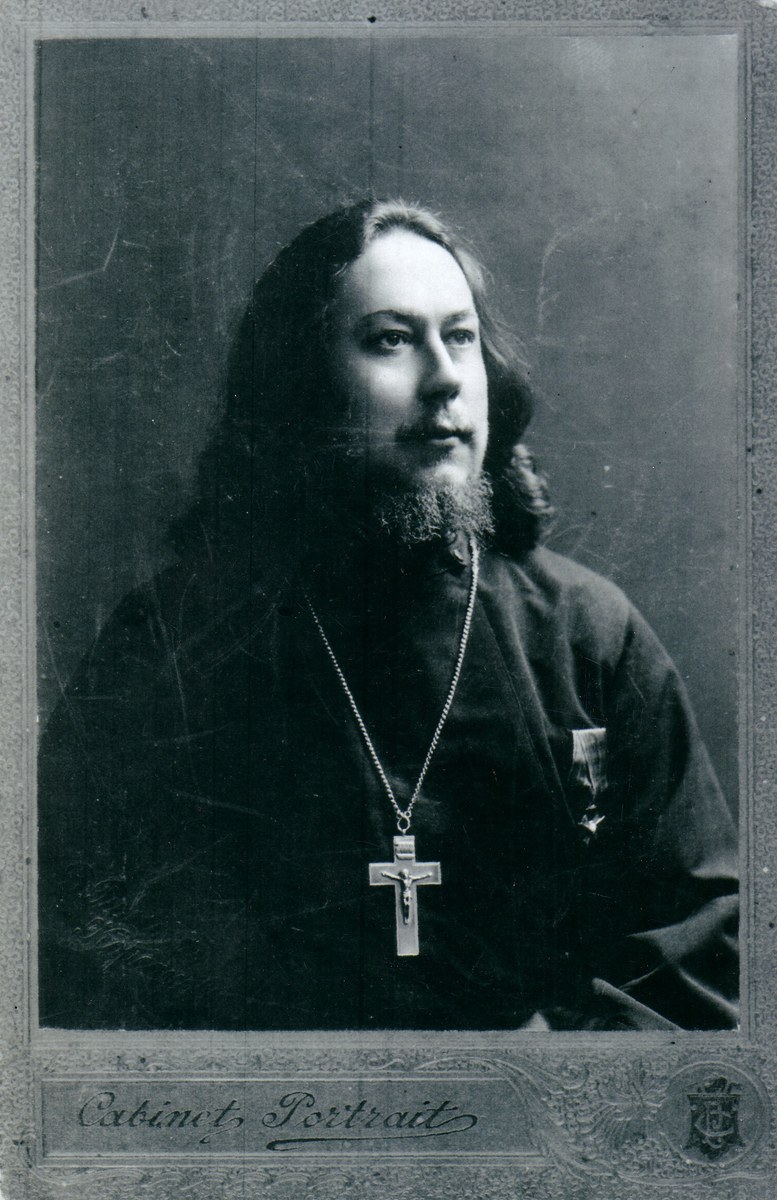

Ryazan and the American mission
John Alexandrovich Kochurov was born on 13 July 1871 in the village of Bigildino-Surky in Ryazan province, a priest's son; he passed through the Ryazan seminary with distinction and the Saint Petersburg Theological Academy, and on graduating volunteered for the American mission. Ordained priest on 27 August 1895, he was sent to Saint Vladimir's church in Chicago, a poor and scattered parish which he served twelve years and left transfigured: he paid off its debts, preached and catechized across the Midwest, received hundreds of Uniate and other converts, and built the Holy Trinity cathedral (designed by Louis Sullivan, consecrated by Bishop Tikhon in 1903) — still the cathedral of the Midwest diocese of the Orthodox Church in America. He was a founder of the mission's translation and publishing labours, was elevated archpriest in 1906, and helped prepare the first All-American Sobor of 1907.
Narva and Tsarskoye Selo
Returning to Russia in July 1907, he taught the law of God in the schools of Narva for nine years, decorated for his teaching. In November 1916 he was assigned to Saint Catherine's cathedral at Tsarskoye Selo, the imperial town outside Petrograd, and had served there scarcely a year when the October revolution broke. As Bolshevik and loyalist forces fought for the town, the clergy led a cross-procession through the streets — 30 October 1917 — with litanies for the ceasing of the internecine slaughter, and Father John preached, calming the terrified people.
Martyrdom
The next day, 31 October, Red Guards entering the town seized the priests. Father John was beaten, dragged half-alive along the railway ties to the Tsarskoye Selo airfield, and there shot before jeering onlookers; he died of his wounds within hours. He was forty-six. The Church buried him beneath Saint Catherine's cathedral (destroyed 1939; the site is now marked again), and his death was reported to the All-Russian Council then in session, which saw in him the first of the host to come: the protomartyr of the clergy in the Russian revolution. Patriarch Tikhon, who had known him in America, wrote to his widow of his crown. The first memorial liturgy for the New Hieromartyrs was served for him on 31 March 1918.
Glorification
The Church of Russia glorified John Kochurov among the New Martyrs on 4 December 1994; the Orthodox Church in America keeps him as one of her own builders, with Alexander Hotovitzky, his fellow-missionary and fellow-martyr.
Feast and commemoration
October 31 (church date; Old Calendar civil November 13) — the day of his martyrdom — and among the New Martyrs and Confessors of Russia on their movable synaxis. The OCA lectionary appoints him the hieromartyr's readings recorded in the entry's record.
Hymns
Troparion — Tone 1
Zealot of the apostles' labours and namesake of the grace of God, thou didst plant the vineyard of Christ in a far country, and water it at the last with thine own blood: O hieromartyr John, first of the priests of Russia to drink the cup of the new persecutors, entreat the Master of the vineyard to save our souls.
Original translation from the Slavonic
Appointed readings
Epistle — Hebrews 13:7–16
7Remember them which have the rule over you, who have spoken unto you the word of God: whose faith follow, considering the end of their conversation. 8Jesus Christ the same yesterday, and to day, and for ever. 9Be not carried about with divers and strange doctrines. For it is a good thing that the heart be established with grace; not with meats, which have not profited them that have been occupied therein. 10We have an altar, whereof they have no right to eat which serve the tabernacle. 11For the bodies of those beasts, whose blood is brought into the sanctuary by the high priest for sin, are burned without the camp. 12Wherefore Jesus also, that he might sanctify the people with his own blood, suffered without the gate. 13Let us go forth therefore unto him without the camp, bearing his reproach. 14For here have we no continuing city, but we seek one to come. 15By him therefore let us offer the sacrifice of praise to God continually, that is, the fruit of our lips giving thanks to his name. 16But to do good and to communicate forget not: for with such sacrifices God is well pleased.
Gospel — John 10:9–16
9I am the door: by me if any man enter in, he shall be saved, and shall go in and out, and find pasture. 10The thief cometh not, but for to steal, and to kill, and to destroy: I am come that they might have life, and that they might have it more abundantly. 11I am the good shepherd: the good shepherd giveth his life for the sheep. 12But he that is an hireling, and not the shepherd, whose own the sheep are not, seeth the wolf coming, and leaveth the sheep, and fleeth: and the wolf catcheth them, and scattereth the sheep. 13The hireling fleeth, because he is an hireling, and careth not for the sheep. 14I am the good shepherd, and know my sheep, and am known of mine. 15As the Father knoweth me, even so know I the Father: and I lay down my life for the sheep. 16And other sheep I have, which are not of this fold: them also I must bring, and they shall hear my voice; and there shall be one fold, and one shepherd.
Iconography
John is painted as a priest new-martyr: dark-bearded and vigorous, in priestly phelonion and epitrachelion with the pectoral cross, holding the cross of martyrdom, sometimes with Holy Trinity cathedral in Chicago or Saint Catherine's at Tsarskoye Selo behind him; in composite icons he stands among the New Martyrs of Russia and, in American icons, among the Saints of North America. As he died in 1917, photographs of him survive; painted icons are post-1994 works in copyright. The stored image is a 1916 photograph of the archpriest — taken the year before his martyrdom — stored per the §50 ruling as a labelled lifetime portrait. A free-licensed painted icon remains the eventual want and is listed among the upgrade-wanted icons.