
John of Kronstadt
Our Righteous Father John of Kronstadt, Wonderworker
Righteous · Wonderworker · Priest · b. October 19, 1829, Sura, Archangel province — d. December 20, 1908, Kronstadt
Commemorated 20 December — His repose at Kronstadt (1908)
John of Kronstadt (1829–1908) was the most celebrated Russian pastor of his age — a married parish priest of the naval city of Kronstadt, near Saint Petersburg, who for over half a century served the daily Liturgy, gave himself without reserve to the poor and the outcast, and became known across the Russian Empire as a wonderworker whose prayers healed the sick and to whom thousands came for confession and counsel. From his cathedral of Saint Andrew he founded a great House of Industry for the destitute, drew crowds so vast that he introduced a form of general confession aloud, and made frequent Communion the heart of his teaching; his spiritual diary, My Life in Christ, became a classic of Orthodox devotion. He reposed on December 20, 1908, and was glorified by the Russian Orthodox Church Outside Russia in 1964 and by the Moscow Patriarchate in 1990.

Origins and formation
He was born Ivan Ilyich Sergiev on 19 October 1829 in the far-northern village of Sura, in Archangel province, the son of a poor village sexton, and was named John in honour of John of Rila. The family's poverty was extreme, but their piety was deep, and the boy grew up close to the village church and unusually tender toward the sufferings of others. His early schooling was a torment — he could not master his lessons, until, the tradition (and his own recollection) records, one night of desperate prayer was answered by a sudden opening of his mind, after which he rose rapidly to the head of his class. He was sent to the seminary at Archangel and then, on scholarship, to the Theological Academy of Saint Petersburg, from which he graduated in 1855. As a student he dreamed of missionary work in distant China, but came to see that the unbelief and misery of his own country offered mission enough for a lifetime.
Priest of Kronstadt
On graduating he married Elizabeth Nesviteva, daughter of a priest of Kronstadt — the fortified naval island-city guarding the approach to the capital — and was ordained deacon on 10 December and priest on 12 December 1855, being appointed to Saint Andrew's Cathedral in Kronstadt, where he would serve for the whole of his life. By mutual consent he and his wife lived together as brother and sister, in celibate marriage, so that he might give himself wholly to his ministry; they had no children.
Kronstadt in those years was a place of exile and squalor as well as a naval base: to it the authorities banished vagrants, labourers, and petty criminals, who lived with their families in dugouts and hovels on the edge of the town, sunk in drink and despair. The young Father John went to them — not to administer a rite in five minutes and leave, but to sit for hours in their shacks, talking, weeping, encouraging, treating each as a priceless soul and a brother. He gave away his money, his shoes, and his coat, so habitually that his stipend was for a time paid directly to his wife lest he leave himself nothing. For years the respectable clergy and townsfolk thought him a fool or a fanatic; slowly the poor he served, and then the whole city, and then the empire, came to see him as a saint.
The daily Liturgy, general confession, and frequent Communion
The centre of John's life and teaching was the Eucharist. He served the Divine Liturgy daily, with an intensity of prayer that awed those who saw him, and he laboured to draw the Russian people — who then, by long custom, communed only once or a few times a year — back to frequent Communion and to sincere repentance. So many came to him for confession that individual confession became impossible, and he introduced a practice extraordinary in the Orthodox world: a general confession, in which the great crowd would call out their sins aloud together, weeping, before he gave absolution — scenes of collective repentance that observers described as overwhelming. Communicants at his Liturgy were numbered in the thousands. His preaching and his person converted drunkards, reconciled enemies, and recalled the lapsed; and his reputation as a man of prayer spread until the sick and the troubled came to Kronstadt from every corner of Russia, and letters and telegrams begging his prayers arrived by the sackful from across the empire and beyond.
Wonderworker and pastor of the empire
John became, in his own lifetime, the acknowledged wonderworker of the Russian Church — the accounts of healings worked through his prayer, in person and at a distance, are innumerable and were attested by great numbers of witnesses, believers and sceptics alike. He was sought by the poorest peasants and by the imperial family: he was at the deathbed of the emperor Alexander III at Livadia in 1894. Yet his fame never turned him from the poor. Out of his work in Kronstadt he founded the House of Industry (the Dom Trudolyubiya) — a great institution that gave the destitute not alms only but work, a workshop, a school, a refuge, a church, and dignity — one of the most remarkable Christian social works of the age, imitated across Russia. The immense sums that flowed to him he poured out on charity as fast as they came.
Writer
John was also a writer of enduring influence. His spiritual diary, My Life in Christ (Moya zhizn' vo Khriste) — a collection of the reflections, prayers, and insights he set down over years — became one of the best-loved works of modern Orthodox spirituality, translated into many languages and read far beyond Russia; and his sermons and eucharistic writings shaped a generation. In his last years he was troubled by the rising unbelief, revolutionary agitation, and moral dissolution he saw gathering in Russia, and he preached and wrote against them with a prophetic urgency, warning of the judgment he feared was coming upon his country — a warning the events of 1917 were felt to confirm.
Repose and glorification
John of Kronstadt reposed on 20 December 1908 at Kronstadt, worn out by a lifetime's labours, and was buried in the convent he had founded in Saint Petersburg (the Ioannovsky Monastery on the Karpovka), where his tomb became a place of pilgrimage. Under the Soviet persecution his veneration was driven underground within Russia but flourished in the emigration. He was glorified by the Russian Orthodox Church Outside Russia in 1964, and, as the persecution eased, by the Moscow Patriarchate in June 1990 — one of the first saints canonised by the Russian Church as it emerged from the Soviet era — his relics being uncovered in the restored monastery on the Karpovka. His veneration is now universal in the Russian tradition and is kept by the OCA and widely beyond it.
Feast and commemoration
December 20 (church date; Old Calendar civil January 2), the day of his repose in 1908 — kept, like the martyrdom of Ignatius the God-bearer with which it shares the day, within the forefeast of the Nativity. The feast is principal in the Russian Orthodox Church (Moscow Patriarchate and ROCOR) and is kept by the Orthodox Church in America; the Greek and Antiochian calendars commemorate him more locally. His birth and name-day, 19 October, is also observed in some places.
Iconography
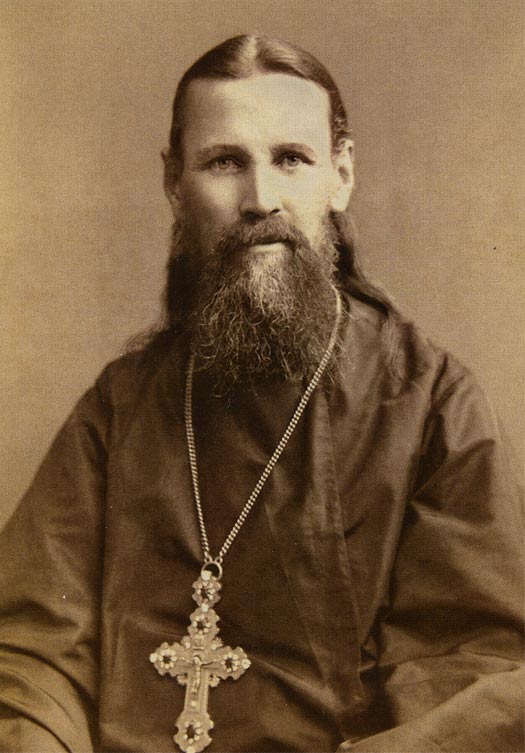
As a saint of the twentieth century, John of Kronstadt is depicted from life: his icons — all of them modern — show a spare, ascetic face with a broad forehead, a long, thin, greying beard, and penetrating eyes, vested as a priest in the phelonion and epitrachelion and often holding a chalice (for the Eucharist that was the heart of his life) or a Gospel-book or scroll; the pectoral cross of the parish priest is a constant. Because every painted icon of him is a living artist's copyrighted work, none is stored here. The stored image is instead a lifetime photograph of the 1890s — Father John in his priest's cassock with the jewelled pectoral cross, the long beard and searching gaze that his icons would afterward render — a public-domain historical portrait of the saint as his contemporaries knew him.