
John of Moscow
The Blessed John, Fool-for-Christ and Wonderworker of Moscow, called Big-Cap
Fool for Christ · Righteous · Wonderworker · b. mid-16th century, near Vologda — d. 1589, at Moscow
Commemorated 3 July — Repose at Moscow (1589)
Blessed John (died 1589), called Bolshoi Kolpak, "Big-Cap," was a fool-for-Christ of the reign of Theodore Ioannovich and the regency of Boris Godunov. Born near Vologda and a water-carrier in a saltworks in his youth, he took up the folly for Christ's sake first at Rostov and then at Moscow, going barefoot and half-naked through the hardest frosts, hung about with heavy iron chains and crosses and wearing on his head the great iron cap that gave him his name. He spoke without fear to anyone, the tsar and the regent included, and he foretold the Time of Troubles and the coming of the Poles. He asked to be buried at the Protection church on the moat — the cathedral of St Basil the Blessed — and was; his relics were found there in 1672.

The saltworks
He was born in the north, on the outskirts of Vologda, in the middle of the sixteenth century. In his youth he worked at a saltworks, carrying water — the heaviest and least regarded labour in a hard industry. It is the one detail of his early life the Life preserves, and it preserves it for a reason: the saint, it says, joined to that work a strict rule of fasting and prayer, so that the ascetic discipline was already complete before the folly began. Among the Russian holy fools, whose earlier lives are usually a blank, this is a rare and telling notice: the podvig grew out of a working man's piety, not out of a sudden vocation.
The folly, at Rostov and at Moscow
He moved to Rostov, and there began the folly for Christ's sake — юродство, the deliberate assumption of the appearance of madness, so that the world's honour should be impossible and the world's judgement of no account. From Rostov he came to Moscow, and it is at Moscow that the tradition fixes him.
He went about the city barefoot and almost naked in the severest frost. He wore chains under what clothing he had, weighted with heavy iron crosses; and on his head he carried a great iron kolpak, a cap or pointed hood of such weight that it became his name — Ioann Bolshoi Kolpak, John Big-Cap. Some accounts add that he pierced his fingers with iron rings, and that he had the habit of staring into the sun, which he called "learning to look at the Sun of righteousness."
Speaking to Boris Godunov
The particular gift of the Russian fools was the licence to say what no one else could say, and John used it. He spoke the truth to everyone without fear, whatever their position. To Boris Godunov — regent, and after 1598 tsar, and a man whose right to either was the great open question of the age — he would say, in the riddling manner of the fools: "Clever head, sort out the things of God. God waits a long time. Yes — but it hurts."
He foretold the great misfortunes coming upon Russia — the Time of Troubles, the famine, the dynastic collapse and the incursion of the Poles — saying that "in Moscow there will be many devils, visible and invisible." The prophecy was remembered because it came true within twenty years of his death, and it is the principal reason his cult took hold so quickly.
Repose
Before his death he indicated the place where he wished to be buried: at the church of the Protection of the Mother of God on the Moat, the church raised by Ivan the Terrible for the taking of Kazan and known ever afterwards as the cathedral of St Basil the Blessed — the great fool-for-Christ of the previous generation, buried there in 1557.
Preparing himself, he did what the Life says with great economy: he took off the chains he had worn under his clothes, and poured water over himself three times. Just before his repose he received the gift of healing, and the sick who came to him were cured. He died in 1589.
He was buried where he had asked. At his burial, according to the chronicle tradition, a violent thunderstorm broke over Moscow and several men were struck; his funeral was attended by the patriarch Job. In Moscow he was venerated at once as a great wonderworker and seer.
On 12 June 1672 his relics were found resting under a crypt in one of the chapels of the cathedral of St Basil the Blessed, and a chapel of the cathedral was dedicated to him. His Service and Life survive in seventeenth-century manuscript copies.
Feast and commemoration
July 3 (church date; New Calendar civil July 3, Old Calendar civil July 16), the day of his repose. Russian usage; kept also by ROCOR and the OCA, and entered in the Greek lists as Ἅγιος Ἰωάννης τῆς Μόσχας, διὰ Χριστὸν σαλός. His shrine is in the cathedral of the Protection on the Moat (St Basil's) on Red Square, where a chapel bears his name. The finding of his relics on 12 June 1672 is recorded in the Life but is not kept as a separate feast.
Hymns
Troparion — Tone 8
Having made thyself a fool for Christ's sake, thou didst set at nought the wisdom of this world; barefoot in the frost and bound with iron thou didst walk the streets of the great city, rebuking the mighty without fear and foretelling the sorrows to come. O blessed John, entreat Christ our God that our souls may be saved.
Original translation from the Slavonic
Iconography
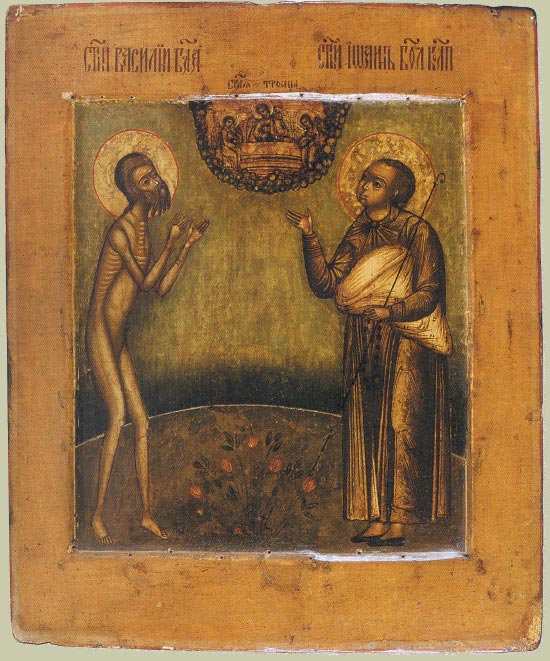
John is painted in a way that distinguishes him sharply from the other Moscow fools. Where Basil the Blessed is shown naked, gaunt and emaciated, John is shown clothed — in a long shirt or under-robe to the ankles — and carrying his two attributes: the heavy chains slung over the shoulder or about the body, and above all the great iron cap, held in the hands or worn on the head, which is his invariable identifying mark and the origin of his name. He is bearded, but young or middle-aged rather than old. His hand is raised in address or in prayer, and he is frequently painted in conversation with Basil the Blessed, the two Moscow fools facing each other across the panel with the Holy Trinity or the Protection in a cloud above them, since they share the same cathedral.
The stored image is a Russian panel icon of exactly that composition, inscribed Стый Василiй Бла[женный] and Стый Iоаннъ Бол[ьшой] Кол[пакъ]: Basil naked at the left with hands raised, John at the right in a pale robe holding the great cap against his body with the chain slung across it, the Trinity in a cloud between them, and a flowering meadow at their feet. The Commons file page gives no date for the panel; the ochre border, the exposed and worn ground and the drawing place it in the seventeenth or eighteenth century, well within the period for which a faithful photographic reproduction may be stored here, but the absence of a museum attribution is recorded rather than glossed over, and a firmly dated image would be preferable.
Disputed questions
- The date of his death. The Life gives 1589, but the transmission is not firm and the OCA prints the year with a query. Other Russian sources give 1590. The commemoration on July 3 is not in doubt.
- Vologda or Rostov? He is called in some lists "of Vologda," from his birthplace, and in others "of Rostov," from the town where he began the folly; the Moscow epithet is from the place of his labour and his repose, and is the one that has prevailed.
- Not to be confused with the fools-for-Christ of Moscow of neighbouring generations — Basil the Blessed (August 2), in whose cathedral he lies, and Maximus (November 11 and August 13) — nor with the two fools-for-Christ Michael and Thomas of Solvychegodsk, of the same northern region, whom the Greek lists commemorate on this same July 3 and of whom nothing beyond their names is transmitted.