
Job of Moscow
Our Father among the Saints Job, the First Patriarch of Moscow and All Russia
Patriarch · Confessor · Wonderworker · b. 1530s, at Staritsa near Tver — d. 19 June 1607, at Staritsa
Commemorated 5 April — Arrival of the relics in Moscow, 1652, 19 June — Repose at the Dormition monastery of Staritsa
Job was the first Patriarch of Moscow and All Russia, raised to that dignity in 1589 by Patriarch Jeremias II of Constantinople, and the last great churchman of the house of Rurik's Muscovy. Born at Staritsa of a tradesman's family, he rose through the northern monasteries to the metropolitan throne, and as patriarch organised the new Russian patriarchate, canonised a company of Russian saints, and sent missions to Siberia and Georgia. In the Time of Troubles he refused to acknowledge the pretender known as the False Dmitri, and for that refusal was stripped of his patriarchal vesture in the Dormition Cathedral by the pretender's men and driven into exile at Staritsa, where he died blind on 19 June 1607. His relics, found incorrupt, were carried to Moscow in 1652, and he was glorified by the Russian Church in 1989.

Staritsa: John, and then Job
He was born in the 1530s at Staritsa, a small town on the upper Volga in the country of Tver, into a family of the townsmen — traders, not gentry. His baptismal name was John. He was given as a boy to the Dormition monastery of his native town, and was schooled there; the monastery's superior, Herman, the future archbishop of Kazan, tonsured him with the name Job and formed him. He became in time the archimandrite of that same house.
The rise through the great monasteries
From Staritsa his advancement was rapid and entirely within the pattern of the age, in which the tsar's eye fell on able monastic administrators and moved them from house to house. He was made archimandrite of the Simonov monastery in Moscow (1571), then of the Novospassky (1575) — both of them houses under the immediate patronage of the court. In 1581 he was consecrated bishop of Kolomna, in 1586 translated to the archbishopric of Rostov, and in the same year, on the deposition of Metropolitan Dionysius, was raised to the throne of Metropolitan of Moscow and All Russia.
The hand behind these promotions was in large part that of Boris Godunov, and the association would define Job's whole public life. It is fair neither to reduce him to Godunov's creature nor to pretend the connection did not exist: Job owed him his elevation, supported his election to the throne in 1598, and remained loyal to his house to the end — which is precisely what destroyed him.
The establishment of the Patriarchate, 1589
The greatest event of his life was not of his own contriving. Patriarch Jeremias II of Constantinople, travelling in Russia to raise alms in the aftermath of his own troubles, was persuaded — with a good deal of pressure from the Muscovite government — to consent to the erection of the Russian Church into a patriarchate. On 26 January 1589, in the Dormition Cathedral of the Kremlin, Jeremias installed Job as the first Patriarch of Moscow and All Russia. The act was confirmed by the Eastern patriarchs in council at Constantinople in 1590 and again in 1593, which gave Moscow the fifth place in the order of the patriarchal thrones.
As patriarch Job did the work of organising a new patriarchate: he multiplied the sees, raising metropolitanates at Novgorod, Kazan, Rostov and Krutitsy and creating new bishoprics; he pressed the printing of service books; he sent clergy to the newly opened lands of Siberia and into Georgia, and worked at the return of the Orthodox of the western Russian lands after the union of Brest (1596). He also presided over a notable series of glorifications: among others Basil the Blessed, the fool-for-Christ of Moscow, and Joseph of Volotsk, and the Kazan hierarchs Gurias and Barsanuphius; and in 1596 he established the joint feast of the three First Hierarchs of Moscow — Peter, Alexis and Jonah — from which the present Synaxis of the Hierarchs of Moscow (October 5) descends. He was himself added to that synaxis by the Moscow Patriarchate in 2005.
The Time of Troubles and the deposition
Tsar Boris died in 1605 while the pretender who claimed to be the murdered tsarevich Dmitri was advancing on Moscow. Job would not have him. He had already anathematised the pretender by name from the ambo, declaring him to be the runaway monk Grigory Otrepiev; he refused to release the people from their oath to Boris's son Feodor; and when the city went over, he refused to recognise the new sovereign.
The retribution was public and deliberately humiliating. On a day in June 1605 the pretender's partisans broke into the Dormition Cathedral during the Liturgy, seized the old patriarch at the altar, stripped him of the patriarchal vesture and clothed him in a simple monastic habit, dragged him from the church and out of the city, and sent him under guard to his first monastery at Staritsa. The tradition relates that he laid his patriarchal panagia before the icon of the Mother of God of Vladimir and prayed there as they came for him. A new "patriarch," the Greek Ignatius, was installed in his place.
The last act: the rite of repentance, 1607
Job lived on at Staritsa in the monastery where he had been tonsured, and there went blind. After the pretender's fall, when Hermogenes had become patriarch and the country was still disintegrating, the two hierarchs agreed upon an extraordinary act. In February 1607 the aged, sightless Job was brought back to Moscow, and in the Dormition Cathedral the assembled people, having handed him a written confession of their perjuries and rebellions, heard a prayer of absolution read over the whole nation, which Job and Hermogenes gave jointly. It is one of the strangest scenes in Russian church history — a deposed patriarch recalled not to his throne but to forgive the city that had deposed him — and it was his last public act. He returned to Staritsa and died there on 19 June 1607.
Relics and glorification
He was buried by the west doors of the Dormition church of the Staritsa monastery, and healings were reported at the grave. In 1652 Tsar Alexei Mikhailovich, on the proposal of Metropolitan (soon Patriarch) Nikon, ordered the relics of three wronged hierarchs brought to Moscow — Philip from Solovki, Hermogenes, and Job from Staritsa. Job's body was found incorrupt and fragrant, and the relics reached Moscow on 5 April 1652 and were laid in the Dormition Cathedral of the Kremlin, where they remain. Particles were kept back at Staritsa and at Tver, set in altar crosses.
His veneration was local and long unofficial. The Russian Orthodox Church glorified him in 1989, at the Local Council held for the four-hundredth anniversary of the Patriarchate of Moscow — the same council that glorified Patriarchs Hermogenes and Tikhon in the same context — and appointed his memory to the day of his repose, with a second commemoration on the day the relics came to Moscow.
Feast and commemoration
June 19 (church date; Old Calendar civil July 2), the day of his repose in 1607 — his principal feast, appointed at the glorification of 1989.
A second commemoration, the arrival of his relics in Moscow on 5 April 1652, is kept on April 5. He is also named among the hierarchs of the Synaxis of the Hierarchs of Moscow (October 5) in the expanded list adopted by the Moscow Patriarchate in 2005, and in the synaxes of the saints of Tver and of Moscow.
He is a saint of the Russian Church; the Greek books do not know him. The day's service everywhere belongs to the Apostle Jude, and the Russian books add Job's own propers.
Hymns
Apolytikion — Tone 5
First-enthroned among the patriarchs of the Russian land, and first also in suffering for the truth, thou wast stripped of thy throne but not of thy confession, O holy father Job; and being deprived of the light of thine eyes, thou didst see the more clearly the will of God. Intercede with Christ God that our souls may be saved.
Iconography
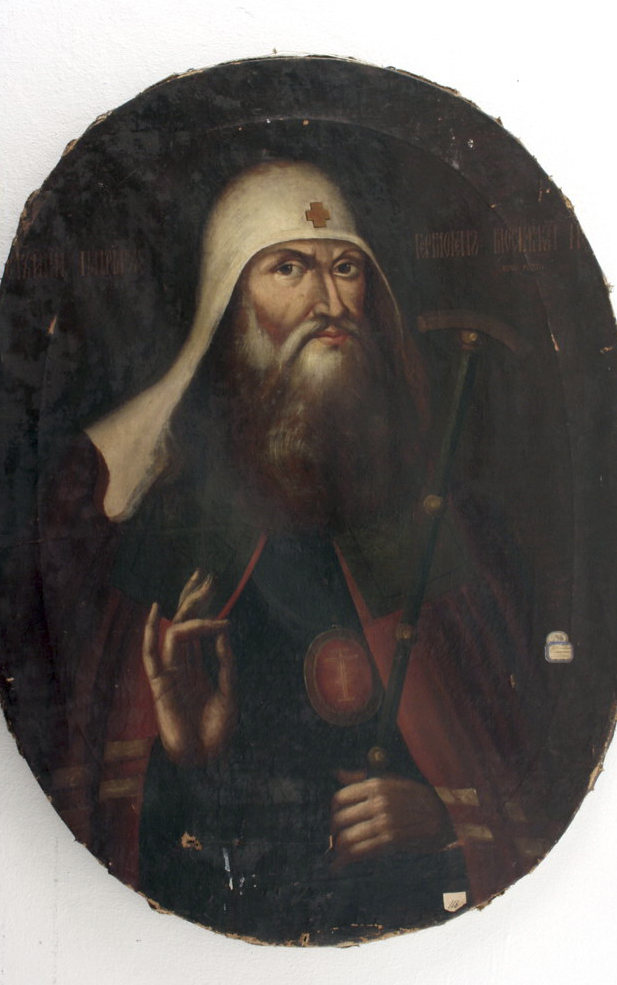
Job is painted as a Russian patriarch of the seventeenth century: an old man with a long grey beard tapering to a point, in the white klobuk surmounted by a cross — the mark of the first hierarch — the sakkos and omophorion, blessing with the right hand and holding the Gospel or the patriarchal staff. In icons written since the glorification the attribute most often added is the panagia laid before the Vladimir icon of the Theotokos, the gesture of his deposition. He appears also among the ranks of the Moscow hierarchs and of the saints of Tver.
The stored image is a Russian parsuna of the seventeenth or eighteenth century — a panel portrait in the transitional manner between icon and portrait that Muscovy developed for its tsars and prelates — showing the patriarch bust-length in an oval, in the white klobuk with its red cross, blessing, and holding the crozier, with a Cyrillic inscription naming him patriarch of all Russia. It is a portrait rather than an icon, which suits a man who was painted from life long before he was glorified; the panel is far out of copyright and the photograph is a flat reproduction of it.
Disputed questions
- Job and Boris Godunov. The unfriendly tradition, going back to the polemics of the Troubles themselves, makes Job simply Godunov's instrument, and points to his part in the election of 1598 and to the official inquiry into the death of the tsarevich Dmitri at Uglich, whose findings the Church endorsed. The favourable tradition points to what he did when loyalty cost him everything. Both are recorded here; the Church's judgement, expressed in the glorification of 1989, rests on the confession of 1605 and not on the politics of 1598.
- Confessor or hierarch only. He was not martyred, and the Russian Church styles him svyatitel, hierarch. He is nevertheless classed here as a confessor as well, since the substance of his sanctity is a refusal under coercion that cost him his throne, his liberty and his sight.
- Not to be confused with the other Russian saints of the name — Job of Pochaev (†1651, October 28), the abbot of the Pochaev Lavra; Job of Anzersk (†1720, March 6), the Solovki hermit; and Job the Long-Suffering, the patriarch of the Old Testament (May 6). The name was common among Russian monastics of the period.
- Not to be confused with the two other Moscow patriarchs of the Troubles whose relics travelled with his in 1652: Philip of Moscow, martyred under Ivan the Terrible, and Hermogenes of Moscow, starved to death in 1612.