
Silvanus of the Kiev Caves
Our Venerable Father Silvanus the Schemamonk, of the Far Caves of Kiev
Venerable · Wonderworker · d. 13th–14th century
Commemorated 10 June — Commemoration of the schemamonk of the Far Caves, 28 August — Synaxis of the venerable fathers of the Kiev Caves whose relics repose in the Far Caves
Silvanus was a schemamonk of the Far Caves of the Monastery of the Caves at Kiev, who laboured there in the thirteenth and fourteenth centuries. His notice preserves a single miracle, and it is a striking one: robbers who broke into the monastery garden were held fast on the spot by his prayer and could not move for three days, until they repented, whereupon he released them. He is commemorated on June 10, again with all the fathers of the Far Caves on August 28, and with the whole company of the Caves on the Second Sunday of Great Lent. He is not the twentieth-century Athonite elder Silouan, with whom his name is often confused.

The Far Caves
The Kiev Caves Lavra grew from the two cave-systems in the bluff above the Dnieper: the Near Caves, associated with St Anthony, and the Far Caves, associated with St Theodosius. By the thirteenth century both were burial-labyrinths and the dwelling of recluses and schemamonks, and it is to the second of them that Silvanus belongs. The Caves Paterikon and the later Lavra registers list well over a hundred fathers of the Caves by name, most of them with a notice of two or three lines fixing one virtue or one miracle, and Silvanus is one of these.
He is called schemamonk (схимник) — that is, he had been clothed in the great schema, the highest monastic degree, which in the Caves tradition usually meant seclusion in a cell in the cave-passages, unbroken prayer, and withdrawal from the common offices of the monastery. Nothing is transmitted of his origin, his family, his age, or the year of his repose.
The robbers in the garden
The one episode preserved is this. Thieves came by night into the monastery garden — the Lavra's gardens on the hillside above the caves fed the community, and were a standing temptation to the poor of the city and the passing traffic of the Dnieper. Silvanus, at prayer, became aware of them, and prayed; and the men were fixed where they stood, unable to move from the spot or to lift what they had gathered. So they remained, the notice says, for three days, until they came to repentance; and then, at the saint's word, they were loosed and let go.
The point of the notice is not the punishment but the release: the immobility is a constraint imposed until repentance, and the saint's prayer both binds and unbinds. It is the form the Caves Paterikon gives to a whole family of stories about theft from the monastery, of which the best-known are those of St Theodore and St Basil and of the treasure of the Varangians; the constraint of thieves by prayer is a recognised charism in that literature, and it is the whole of what the tradition knows about Silvanus.
Relics and commemorations
His relics rest, incorrupt and venerated, in the Far Caves, among the fathers whose bodies line those passages — the ordinary term of a Caves father's life and the ground of his cultus, since the labyrinth itself is the shrine. He is therefore commemorated three times over: on his own day, June 10; with the fathers of the Far Caves on August 28; and with all the venerable fathers of the Caves on the Second Sunday of Great Lent, the movable commemoration of the whole company of the Lavra (that rule belongs to the movable calendar and is recorded here in prose only, not in this entry's frontmatter).
Feast and commemoration
June 10 (church date; Old Calendar civil June 23), a Russian and Ukrainian local commemoration, kept in the Moscow Patriarchate's and the Ukrainian calendars and passing from them into the OCA's calendar for North America; the Greek and Antiochian books do not carry him on this day, whose Greek commemorations are the martyrs and ascetics listed with Timothy of Prusa. On June 10 he shares the day in the Russian books with the Finding of the Relics of Basil of Ryazan and with John of Tobolsk. His two further commemorations — the Synaxis of the Fathers of the Far Caves on August 28, and all the Caves fathers on the Second Sunday of Great Lent — are the ones on which he is in practice most often remembered, since the Lavra keeps them with a full festal office while June 10 is a simple day.
Hymns
Troparion — Tone 8 (common of a venerable monastic)
In thee, O Father, the image of God was preserved unimpaired: for taking up the cross thou didst follow Christ, and by thy deeds thou hast taught us to despise the flesh, which passeth away, and to care for the soul, which is immortal. Wherefore, O venerable Silvanus, thy spirit rejoiceth with the angels.
Original translation from the Slavonic
Kontakion — Tone 2 (composed on the notice)
Thieves in the night thou didst bind, not with cords but with prayer, and didst loose them when they had repented, O father Silvanus; wherefore bind thou our thieving thoughts, and loose us when we turn to Christ.
Iconography
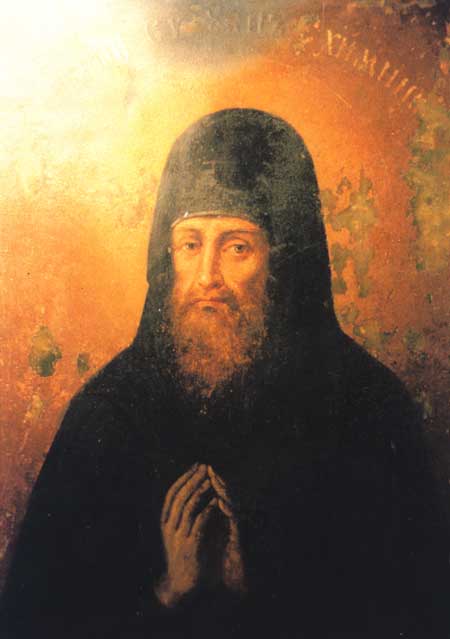
Silvanus is painted in the manner of the fathers of the Caves: a monastic of middle age in the black rason and the pointed schema-cowl (koukoulion) of the great schema, the hands crossed on the breast or joined before him in prayer, the face gaunt and the beard brown or dark rather than white. In the great composite icons of all the venerable fathers of the Kiev Caves — the type that fills a panel with ranked half-figures of the Near and Far Caves fathers about the Dormition church — he stands in the Far Caves register, named by a small inscription. Where his miracle is shown, the robbers are painted immobilised in the garden, one bent under a load he cannot lift.
The stored image is a Lavra panel icon of exactly this type — a bust-length portrait of the saint in the schema-cowl, the hands raised together before the breast in prayer, against a gold ground darkened with age and flaking at the edges, with the inscription СИЛУАНЪ СХИМНИКЪ ("Silvanus the Schemamonk") running round the halo. The inscription was read from the stored file and matches the saint; the painting is in the later Lavra manner — softly modelled flesh and a naturalistic face, of the eighteenth or nineteenth century — though the Commons file description dates the work only as "soon after the fourteenth century." The date given in the entry's record records that discrepancy honestly rather than adopting either claim. Public domain as a faithful reproduction of a pre-1900 two-dimensional work.
Disputed questions
- Not to be confused with Silouan the Athonite (1866–1938, commemorated September 24), the Russian elder of the Monastery of St Panteleimon on Mount Athos whose writings were published by Archimandrite Sophrony. The two share a name in its Slavonic form — Силуан — and are constantly confused in English, where both are written "Silouan"; they are separated by six centuries and by everything else. This entry uses the form Silvanus for the Caves father, as the Slavonic-derived English calendars do, to keep the two apart.
- Not to be confused with the early martyrs of the same root name — Silvanus of Emesa and Silvan of Gaza — nor with the Apostle Silvanus (Silas) of the Seventy.
- Not to be confused, in particular, with Silvanus of Pisidia, the fourth-century martyr who cried out at the tribunal of Bianor and had his tongue cut out for it. The two are commemorated on the same day, July 10, in the Russian and OCA calendars, which makes this the likeliest of all the Silvanus confusions; they are separated by ten centuries and by everything else.
- The century. The Lavra's registers place him "in the thirteenth and fourteenth centuries" without a year, and the modern calendars follow. Wikidata records him with the wide bracket c. 1300–c. 1400. He is indexed here under the fourteenth century as the later and likelier terminus; the uncertainty is real.
- Whether the Far Caves notice is early. The short notices of many Caves fathers, Silvanus among them, are not in the medieval Paterikon but in the later Lavra compilations of the seventeenth century, when the relics in the passages were catalogued and named. The story of the robbers may accordingly be considerably younger than the saint.