
Basil of Ryazan
Our Father among the Saints Basil, Bishop of Ryazan and Murom, the Wonderworker
Bishop · Wonderworker · d. 1295
Commemorated 10 June — Finding of the relics and their transfer to the Dormition cathedral of Ryazan (1609), 3 July — Repose at Ryazan (1295)
Basil was bishop of Murom and then of Ryazan in the second half of the thirteenth century, in the generation after the Mongol conquest, and is the chief hierarch-saint of the Ryazan land. His life is remembered for one thing above all: slandered by his own people at Murom and driven out, he spread his episcopal mantiya upon the water of the Oka, stood upon it holding the Murom icon of the Mother of God, and was carried against the current to Ryazan, where he was received as bishop. He reposed on 3 July 1295. On 10 June 1609, in the Time of Troubles, his relics were uncovered by Archbishop Theodoret of Ryazan and translated into the Dormition cathedral of the Ryazan kremlin, and that day became his second feast. He is invoked in Ryazan against the perils of travel and of drowning.

Bishop of Murom
Basil appears in the record as bishop of Murom, a city on the Oka in the old Murom-Ryazan principality, at a date not exactly fixed but in the years after the Mongol invasion of 1237 — the generation in which the ruined dioceses of the north-east were being put back together and in which a bishop's work was as much the physical rebuilding of his see as its teaching. Nothing is transmitted of his origins.
What the tradition transmits is the slander. The account — which the Russian sources ascribe to the working of the evil spirit against a holy bishop — says that the citizens of Murom were brought to rise against their own hierarch, accusing him of conduct unbecoming an archpastor: in the fuller Russian versions, of consorting with a woman, the appearance having been contrived to look like guilt. The charge was believed, and the city moved to be rid of him.
The mantiya on the Oka
Basil asked for a night's delay, and spent it in prayer — the accounts have him at the church of Saints Boris and Gleb and before the icon of the Mother of God of Murom. At dawn he went down to the Oka, took off his mantiya (the bishop's mantle), spread it on the water, and stood upon it, holding the icon in his hands. A wind took him, and he was carried upstream, against the current, and after some hours came to land at Ryazan — in the account's fuller form he was borne first to Borisov-Glebov and then to Ryazan itself, and the see he was received into is the older city on the Oka, Staraya Ryazan, and afterwards Ryazan-Pereslavl, the city now called Ryazan, to which the see was transferred as the old capital lay waste after the Mongol sack.
He was received there as a bishop vindicated by God. The two sees were joined in his person, and he is styled from that time Bishop of Ryazan and Murom. The icon he carried remained at Ryazan and was thereafter called the Murom icon of the Mother of God — the palladium of the diocese, and the reason that the traditional image of Basil is inseparable from it.
Repose
He reposed on 3 July 1295, and was buried at Ryazan, in the church of Saints Boris and Gleb in Staraya Ryazan. The Ryazan people held him from the first as, in the phrase of the old accounts, their constant intercessor and helper in sorrows and travail, and particularly as a protector on journeys and against drowning — an intercession that follows directly from the manner of his coming to them.
The finding of the relics, 10 June 1609
About 1540 the monk Erasmus Ermolaev — better known as Ermolai-Erasmus, the author of the Tale of Peter and Fevronia of Murom — composed an Account of Basil, Bishop of Ryazan and Murom, which is the literary foundation of the cultus and the source of the narrative as later hagiography received it.
The uncovering of the relics followed in the Time of Troubles. On 10 June 1609, under Archbishop Theodoret of Ryazan (in the see 1605–1617), the saint's relics were taken up from the old burial at Borisoglebsk and translated into the cathedral of the Dormition — afterwards the church of the Nativity of the Theotokos — in the kremlin of Ryazan-Pereslavl. The translation was the effective glorification of the saint: from 1609 his memory was kept as a feast of the Ryazan church on that day, in addition to the day of his repose, and it is this event, not his life, that the June 10 commemoration celebrates. The OCA's calendar accordingly heads the day "Finding of the Relics of Saint Basil, Bishop of Ryazan."
Feast and commemoration
June 10 (church date; Old Calendar civil June 23) — the Finding of the Relics, kept as a feast of the Ryazan diocese and in the general Russian calendar, and carried by the OCA; July 3 (Old Calendar civil July 16) — his repose, his principal feast. He is also commemorated in the Synaxis of the Saints of Ryazan, which is kept on this same June 10 and in which he stands first. The Greek and Antiochian calendars do not keep him. On June 10 in the Russian books his commemoration falls with those of Silvanus of the Kiev Caves and John of Tobolsk, the day's principal Greek commemoration being Timothy of Prusa.
Hymns
Troparion — Tone 4 (common of a hierarch)
O God of our fathers, who dealest ever with us according to Thy gentleness: take not Thy mercy from us, but by the prayers of Thy hierarch Basil, guide our life in peace.
Original translation from the Slavonic
Kontakion — Tone 8 (composed on the tradition)
Borne upon thy mantle against the stream, and bearing in thy hands the image of the Mother of God, thou didst come to Ryazan a bishop justified by heaven, O father Basil; wherefore be thou a guide to all who travel, and a helper to those who are in peril of the waters.
Iconography
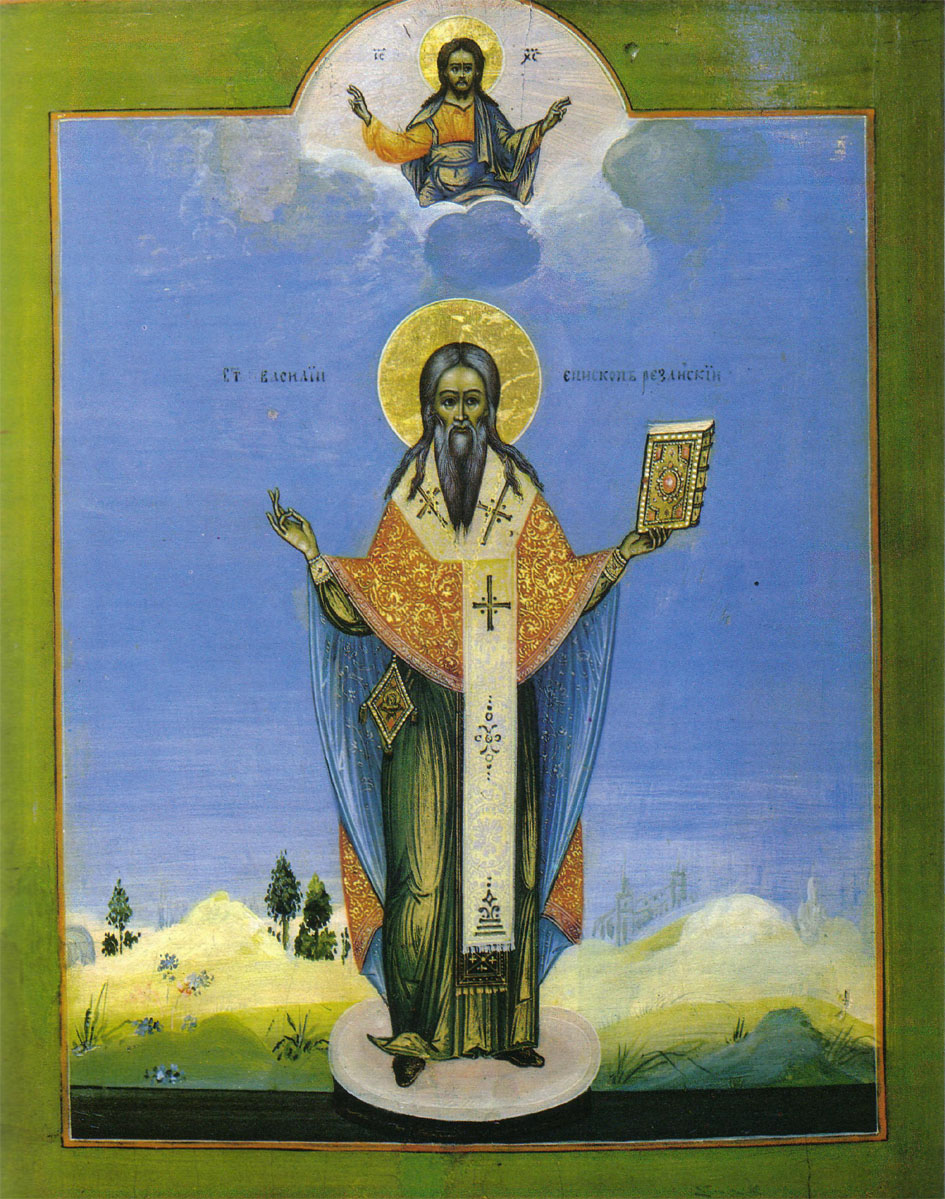
Basil is painted as a hierarch — an elderly bishop with a long grey beard divided at the point, in phelonion, epitrachelion and crossed omophorion, blessing with the right hand and holding the Gospel in the left — and his distinguishing attribute is the one the Ryazan tradition never omits: he is shown standing upon his mantiya on the water, holding the Murom icon of the Mother of God, with the Oka beneath him and the towers of a city on the far bank. The mural of the saint sailing on his mantle with the icon in hand is the standing Ryazan image of him, and the diocese's churches repeat it.
The stored image is a Russian panel icon of about 1850, formerly in the Ryazan collections: the bishop stands full-length on a green ground before a low landscape with churches in the distance, in a green under-robe and gold-figured phelonion with the white omophorion and epigonation, the right hand blessing and the left holding the jewelled Gospel, with Christ blessing from a cloud above; the inscription in Slavonic runs across the field at the level of the halo — СТ[ЫЙ] ВАСИЛIЙ ЕПИСКОПЪ РЯЗАНСКIЙ ("Holy Basil, Bishop of Ryazan") — and was read from the stored file to confirm the identification. It is a "presentation" type rather than the narrative mantiya type, and public domain as a faithful reproduction of a nineteenth-century two-dimensional work.
Disputed questions
- Two feasts, and which is primary. July 3 is the day of his repose (1295) and is his principal feast; June 10 is the finding and translation of the relics (1609). This entry ranks July 3 primary and June 10 as translation-of-relics, per the project's constitution, and is authored on the June 10 day because that is where the sweep reached him first.
- The date of his episcopate at Murom. Neither his consecration nor the year of the expulsion is transmitted. The chronology rests entirely on the death-date of 1295 and on the sixteenth-century Account.
- The historicity of the mantiya voyage. The episode is first written down some two and a half centuries after the events, by a literary author of the Muscovite sixteenth century who was writing hagiography and not chronicle, and the surviving Ryazan chronicle materials for the 1290s do not carry it. Russian church historians have long treated the narrative as a hagiographical elaboration of a real translation of the see from Murom to Ryazan; the tradition treats it as an event and paints it as one. Both positions are recorded here.
- Which "Ryazan." Basil's Ryazan was Staraya Ryazan, destroyed by Batu in 1237 and never rebuilt; the see moved to Pereslavl-Ryazansky, which took the name Ryazan in 1778 and is the modern city. Descriptions that place his relics "in Ryazan" mean the latter.
- Not to be confused with the many other hierarch-Basils of the calendar — above all Basil the Great (January 1), and among the Russians the hieromartyrs of the twentieth-century persecution who bear the name. His nearest namesake-confusion in the Russian calendar is with the several princes Basil of Ryazan of the chronicles, who are not saints.