
John of Uglich
The Right-believing Prince John of Uglich, in monasticism Ignatius, Wonderworker of Vologda
Prince · Venerable · Wonderworker · b. c. 1477, at Uglich — d. 19 May 1523, at the Saviour-Priluki monastery near Vologda
Commemorated 19 May — Repose in prison at Priluki, after monastic tonsure
John of Uglich (c. 1477 – 19 May 1523) was a prince of the house of Moscow who spent thirty-two years in prison for no fault of his own and was numbered among the saints for the manner in which he bore it. He was the elder son of Andrew Vasilyevich the Great, appanage prince of Uglich; when Andrew was arrested in 1491 by his brother the Grand Prince Ivan III, the two boys were taken with him, and John — a child of about fourteen — passed the whole of the rest of his life in confinement, first at Pereslavl-Zalessky and then in the Saviour-Priluki monastery near Vologda, in chains. He is remembered as having accepted it without bitterness, giving himself to prayer and to the services of the monastery that was also his prison; shortly before his death he was tonsured into the great schema with the name Ignatius, and he died at about forty-six. He was buried beside Demetrius of Priluki, and healings were reported at his tomb.
.jpg)
The house of Uglich
John was born about 1477 at Uglich on the Volga, the elder son of Prince Andrew Vasilyevich, called Bolshoy, "the Great" or "the Elder" — the appanage prince of Uglich and the younger brother of the Grand Prince Ivan III of Moscow. It was a pious court: Andrew was the patron who asked Paisius of Uglich to found the Protection monastery outside the town in 1464, and Paisius stood in a close spiritual relation to the prince's household. John and his younger brother Demetrius grew up in it, and the notices say of John simply that from his youth he was "devout and God-fearing" — a formula, but the formula is all that survives of his childhood.
The politics that destroyed the family were the politics of the gathering of Russia. Ivan III was extinguishing the appanages one by one, and the independent principality of Uglich stood in the way. In 1491 Andrew was summoned to Moscow, arrested, and imprisoned; he died in captivity in 1493. His two sons, who had committed nothing, were arrested with him: the state could not leave a rival line at liberty.
Thirty-two years in prison
The boys were first held at Pereslavl-Zalessky and afterwards moved north to the Saviour-Priluki monastery on the Vologda river, three versts from Vologda — a monastery used, as monasteries in that age were, as a place of honourable and permanent detention. They were kept in irons. John was about fourteen when the doors shut on him and forty-six when he died: thirty-two years, the whole of his adult life, in a cell.
What the tradition preserves is his interior response, and it preserves it because the monks who shared the house observed it and handed it down. He is remembered as bearing the injustice without complaint or resentment against those who had inflicted it, treating the confinement as the monastic obedience he had never been free to choose; he kept the monastery's cycle of prayer, and the brethren came to regard the prisoner as one of themselves. This — patience under an unmerited and unending punishment, without the consolation of a cause — is the substance of his sanctity, and it is why the Russian Church numbered him not with the passion-bearers, who were killed, but with the venerable and the right-believing princes.
Tonsure and repose
As his last illness came on, he asked for the monastic habit and was tonsured into the great schema by the abbot, receiving the name Ignatius. The tonsure of a dying man was a common Russian practice, but in his case it completed something: the state of life that had been imposed on him for thirty-two years he now accepted as a vow. He died on 19 May 1523, still in his chains, and was buried in the monastery's cathedral church of the Saviour, beside the relics of the founder, Demetrius of Priluki (†1392).
Miracles and healings were reported at the grave, and the local veneration followed quickly. His younger brother Demetrius was never released; he remained at Priluki after John's death and died there some time after 1540, and he is not numbered among the saints — a distinction the sources make plainly, and one worth keeping, since it shows that the Church was canonising a particular man's response and not the family's misfortune.
Feast and commemoration
May 19 (church date; Old Calendar civil June 1) — the day of his repose — in Russian and OCA usage. He is a local saint of the Vologda land, named in the Synaxis of the Saints of Vologda, and his veneration is bound to the Saviour-Priluki monastery where he died and lies. The day is shared with Cornelius of Komel, the greater Vologda saint of the same date, so that the diocese keeps two of its own on one day. No proper service is transmitted: he is sung with the common of a venerable father, and in some Vologda usage with the common of the right-believing princes. The day always falls within the Pentecostarion.
Hymns
Troparion — Tone 8 (common of a venerable father)
In thee, O Father, that which was made after the image of God was preserved unimpaired; for taking up the Cross thou didst follow Christ, and by thy deeds thou hast taught us to despise the flesh, which passeth away, and to care for the soul, which is immortal. Wherefore, O venerable Ignatius, thy spirit rejoiceth with the angels.
Original translation from the Slavonic
Iconography
He is painted in two registers of dress, according to which name is being commemorated. As Prince John he appears young, in the princely shuba and cap, with the cross in his hand; as the schema-monk Ignatius he appears in the dark mantle and the pointed koukoulion of the great schema, and it is in this form that he is most often shown, since it is the form in which he died. Where the story is told rather than the person presented, the fetters are shown — held in his hands or lying at his feet — as the attribute of his thirty-two years, in the same way that chains are the attribute of Demetrius of Priluki beside whom he lies. In the composite icons of the Synaxis of the Saints of Vologda he stands among the monastic ranks.
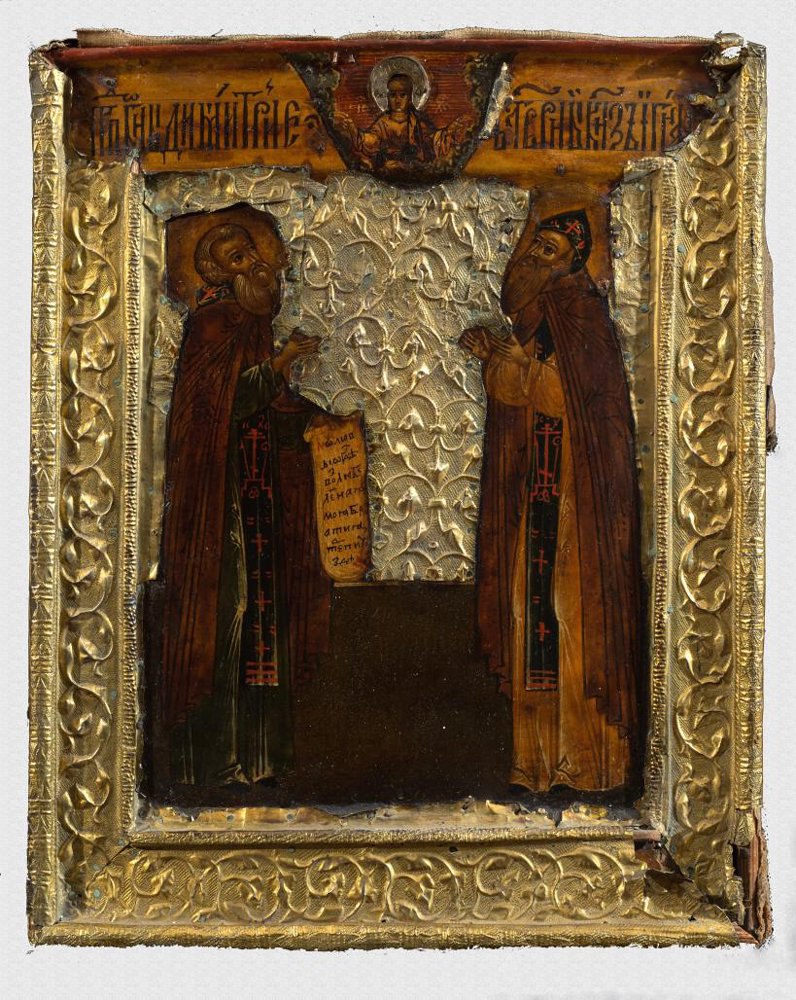
The stored image is a Russian icon of the middle of the seventeenth century in the State Historical Museum at Moscow, in a damaged repoussé silver riza: two standing monastic figures in mantle and schema, hands raised towards the Mother of God of the Sign in the arc above, an open scroll between them, and their names written across the top field — the inscription is abraded, and the identification of the pair as Demetrius of Priluki and Prince John (Ignatius) rests on the museum's catalogue rather than on what can now be read. It is the characteristic Vologda pairing: the founder of the Priluki monastery and the prince buried at his side.
Disputed questions
- The uncle's name. The OCA account states that the brothers "were thrown into prison by their uncle John," which is correct but confusing in English: the uncle was Ivan III of Moscow, whose name is the same as the saint's own. Russian accounts avoid the collision by calling the prisoner Ioann Andreyevich and the Grand Prince Ivan Vasilyevich.
- His name in the calendars. He appears as John, Prince of Uglich and as Ignatius of Priluki or of Vologda, sometimes in a single day-list twice over. The two names are one man: John in the world, Ignatius in the schema. He is not Ignatius of Lomsk (†1591), another Vologda venerable, nor any of the earlier hierarchs of the name.
- The date of his birth is given as 1477 or 1478, and his age at death correspondingly as forty-five or forty-six; the calculation depends on the year of the arrest, which is put at 1491 or 1492.