
John of Zedazeni
Our Venerable Father John of Zedazeni, leader of the Thirteen Syrian Fathers of Georgia
Venerable · Wonderworker · d. c. 560s, at Zedazeni
Commemorated 7 May — Repose at Zedazeni, kept with his twelve disciples
John of Zedazeni was a Syrian monk, formed in the ascetic tradition of Antioch, who in the middle of the sixth century came into Georgia with twelve chosen disciples and settled on the mountain of Zedazeni above the old capital of Mtskheta — the very height that had carried the idol of the god Zaden overthrown two centuries before at the preaching of Saint Nina. From that mountain he sent his disciples out singly across Kartli and Kakheti, where each founded the monastery or took the see with which his name is still joined; and the company came to be remembered as the Thirteen Syrian Fathers, the founders of organised monasticism in Georgia and the second evangelisation of the country after Nina. John himself remained in his cave on the mountain, working healings, and reposed there about the 560s.

The Syrian ascetic
The Georgian tradition makes John a Syrian by birth and gives him his monastic training in the ascetic world of Antioch and Mesopotamia — the country of the stylites and the recluses, where the most extreme forms of Christian asceticism had been invented and where a monk's authority was personal and charismatic rather than institutional. He is said to have been early tonsured and to have withdrawn into the wilderness, and to have received from God the gifts of healing the sick and casting out demons, on the strength of which disciples gathered to him. The Georgian Life attaches him to the discipleship of Symeon the Stylite, which places him squarely in the Antiochian orbit; the chronology of that attachment is one of the difficulties of his biography (see below).
The sending into Georgia
The tradition assigns the mission to a vision. The Most Holy Theotokos appeared to John and bade him take twelve monks and go to Georgia, "the land enlightened by Nina, the equal of the Apostles," to strengthen the Christian people there. The choice of twelve, and of a leader with them, is plainly meant to be read against the Apostles; the Georgian Church has always understood the coming of the Syrian Fathers as an apostolic sending.
The twelve, as the tradition names them, are: Abibus of Nekresi, Anthony of Martqopi, David of Gareji, Zenon of Iqalto, Thaddeus of Stepantsminda, Jesse (Ise) of Tsilkani, Joseph of Alaverdi, Isidore of Samtavisi, Michael of Ulumbo, Pyrrhus of Breti, Stephen of Khirsa, and Shio of Mgvime. Each is remembered by the place he made his own, and each has his own day in the Georgian calendar; of the twelve, only Shio (May 9) has yet an entry in this collection.
Word of their coming preceded them. King Parsman of Kartli and the Catholicos Evlavios (Eulabius) went out to meet them and received them with honour — an important detail, for it marks the mission as one welcomed by the Georgian Church rather than imposed on it, and explains how so many of the fathers ended as bishops of Georgian sees.
Zedazeni
For his own dwelling John chose the bare mountain north-east of Mtskheta on which had stood the sanctuary of the idol Zaden — hence Zedazeni, "the place of Zaden." The choice was deliberate and polemical: the monk's cell was set where the demon had been worshipped. The mountain had no water; John prayed, and a spring was given, which became a place of healing and is shown to this day. Around him a small monastery grew, with a church and a scattering of cells among the rocks, while he kept to a cave for prayer.
Of his life there the Life keeps a handful of scenes, and their character is that of the Syrian desert transplanted: a bear that came to the spring was rebuked and tamed and afterwards kept watch over the place; a man brought to him paralysed and speechless rose up and spoke; and the sick came in numbers from the villages below. His authority was not administrative. When his disciples were ready he did not organise a congregation of houses under himself but sent them away, each to the place shown him, and let the monastic movement in Georgia grow by dispersion — Gareji into the desert of Kakheti, Mgvime into the gorge above Mtskheta, Nekresi and Alaverdi and Tsilkani into episcopal sees. That decision, more than any single foundation, is why Georgian monasticism dates itself from him.
Repose and relics
John lived on the mountain into great age. The account of his end has him receive the Holy Mysteries, see the heavens opened, and give up his soul in the presence of his brethren, about the 560s. They buried him first in the church at the foot of the mountain; afterwards — the tradition says following an earthquake, and in obedience to a wish he had expressed — they took up the body and carried it to the cave where he had prayed, and during the translation many sick and demon-possessed were healed at the relics. The monastery of Zedazeni kept them, and kept his memory as its founder; his grave in the cave church remains a place of pilgrimage.
Feast and commemoration
7 May (church date; Old Calendar civil 20 May), kept in the Georgian Church and, on the same day, by the Russian Church and the Orthodox Church in America, which list him as "Saint John Zedazeni with his twelve disciples." The Georgian calendar also keeps a collective commemoration of the Thirteen Syrian Fathers, in addition to the several days of the individual fathers; the placing of that collective feast was not verified for this entry and is left to be established. On the same 7 May the Church keeps the Sign of the Cross which appeared over Jerusalem, the martyr Acacius the Centurion and Nilus of Sora. From the Antiochian point of view the day has a particular interest: the monastic tradition that John carried into Georgia was the tradition of the Syrian and Antiochian ascetics, and the Georgian Church's monastic pedigree therefore runs back through Zedazeni to the mountains behind Antioch.
Hymns
Troparion — Tone 8 (common of a venerable father)
By the torrent of thy tears thou didst make the barren mountain to blossom, and by thy sighings from the depths thou didst bear fruit an hundredfold in thy labours; thou wast a beacon to the land of Georgia, shining forth in wonders, O our father John. Intercede with Christ God for the salvation of our souls.
Original translation from the Greek
Iconography
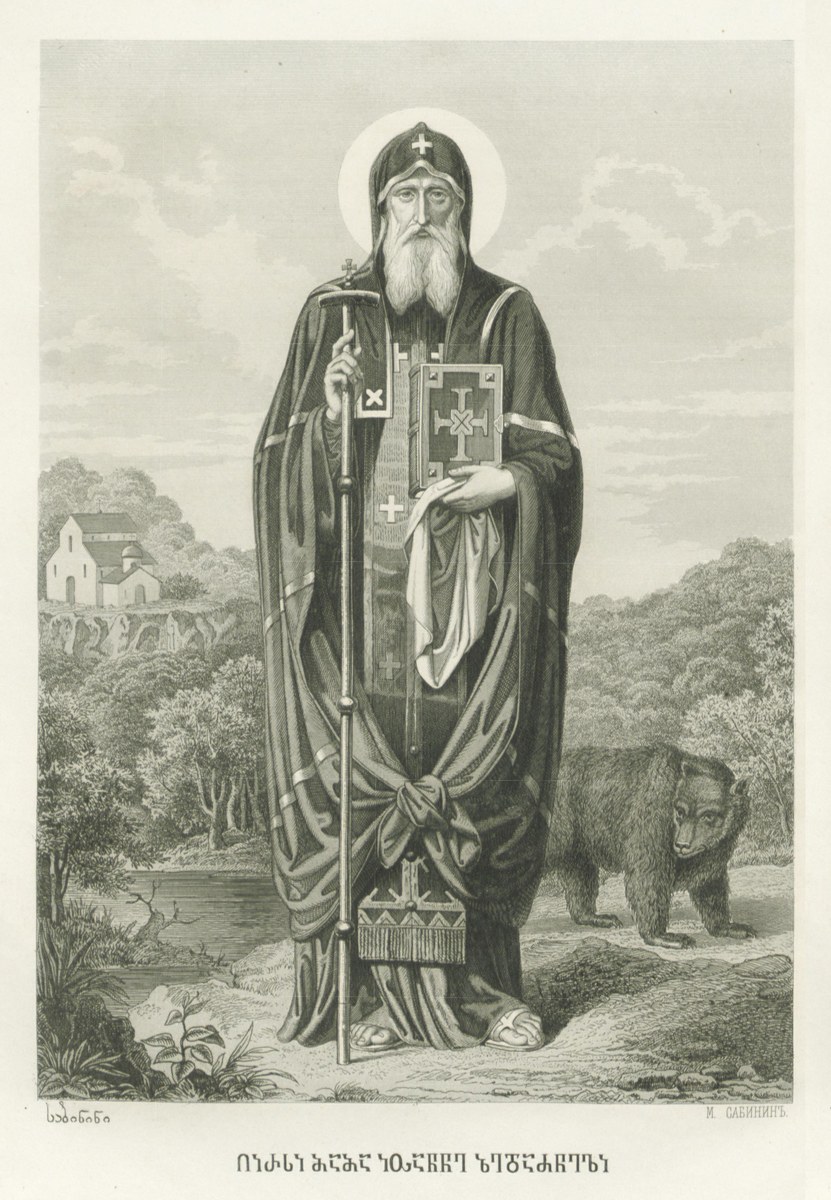
John of Zedazeni is painted in the Georgian manner as an aged monastic father, in the dark mantle and cowl, with a long white beard, standing or seated and blessing, and holding a scroll; his particular attributes are the mountain of Zedazeni with its church shown small beside or beneath him, and, in fuller compositions, the bear he tamed at the spring. He appears most often not alone but at the head or in the centre of the group of the Thirteen Syrian Fathers, a composition much painted in Georgia: the fathers ranged in two files or in an arc, each named in Georgian script, with John central and larger, sometimes with a model of a church in his hands as founder. The scene of his sending — the Theotokos appearing to him and the twelve setting out — is also found. Frescoes of the Fathers survive in Georgian churches, but no pre-1900 image identifiable specifically as John of Zedazeni was located in a licence-clean reproduction for this collection; the searches made under his Georgian and English names returned nothing of him.
The stored image is the plate of Sabinin's lives of the Georgian saints (c. 1882) — the father of the Thirteen Syrian Fathers of Georgia at prayer.
Disputed questions
- The chronology of the mission. The reign of King Parsman and the pontificate of the Catholicos Evlavios place the arrival of the Fathers in the second quarter or middle of the sixth century, and John's repose in the 560s or thereabouts. This does not sit easily with the tradition that he was a disciple of Symeon the Stylite: Symeon the Elder died in 459, nearly a century too early, and Symeon the Younger of the Wondrous Mountain, whose life fits the century better, was himself still young when the Fathers are said to have set out. Either the discipleship is a later attachment of a famous name, or the two Symeons have been confused, or the dating of the mission needs to be moved. The Georgian sources themselves do not resolve it, and the Life as we have it is later than the events.
- Syrians or Assyrians? The Fathers are called in Georgian asureli, which is rendered in English both "Syrian" and "Assyrian." The word denotes their coming from the Syro-Mesopotamian lands within the Antiochian sphere and should not be taken as an ecclesiastical designation, and certainly not as evidence that they came from outside the Chalcedonian communion; the Georgian Church received them as Orthodox monks, and several were made its bishops.
- The number and the names. That the company was thirteen — John and twelve — is constant in the tradition, but the lists of the twelve vary slightly in the manuscripts and in modern retellings, and some accounts speak of a larger body of followers from whom the twelve were chosen. The list given above is the one commonly received.