
Shio of Mgvime
Our Venerable Father Shio of Mgvime, one of the Thirteen Syrian Fathers of Georgia
Venerable · Wonderworker · d. c. 560s–570s, at Mgvime near Mtskheta
Commemorated 9 May — Repose in the well of Mgvime
Shio was one of the Thirteen Syrian Fathers who came into Georgia in the sixth century from the ascetic tradition of Antioch under the leadership of John of Zedazeni, and he became the greatest monastic founder among them. Sent out from Zedazeni to make his own place, he settled in the barren caves of Sarkineti in the gorge north-west of Mtskheta, where the tradition says he was fed by a dove; the conversion of a hunting nobleman, Evagre, and then the patronage of King Parsman, turned the hermitage into the great lavra of Shiomgvime, "the cave of Shio," which at its height numbered some two thousand monks and gave Georgian monasticism its first written rule. Shio ended his life in the extremity of ascetic self-effacement: his last fifteen years were spent walled into a pit or well, where he received the Holy Gifts lowered to him and where he died with the words, "O Lord, receive the soul of thy servant." He is commemorated on May 9.

From Antioch to Georgia
Shio — the Georgian form of Simeon — was born, the Life says, of noble and pious parents in Antioch, and was their only child; they raised him in the Scriptures, and he had read the whole of them, together with the writings of the fathers, while still young. When he heard of the great ascetic John, who was living in the mountains near the city, he went out to him secretly and begged to be received. John, unwilling to divide a son from his parents, sent him home; but when the parents themselves, being persuaded by their son's resolve, gave away their wealth and entered monastic life — the father to a monastery, the mother to a convent — Shio returned, distributed what remained, and was tonsured. He labored beside his teacher for some twenty years, in obedience so complete that the Life makes it the ground of everything that followed.
When the Theotokos, in the tradition of the Thirteen, appeared to John and sent him with twelve chosen disciples to strengthen the young Church of Kartli, Shio was among them. The company came to Mtskheta, venerated the Robe of the Lord and the Living Pillar in the cathedral, and settled on the mountain of Zedazeni; and after a time John sent his disciples out singly across Kartli and Kakheti, each to the place appointed him. Shio's lot was the wilderness of Sarkineti — "the iron place" — a waterless limestone gorge of caves some ten miles from the capital, west of the Mtkvari.
The wilderness of Sarkineti
He found a cave, and lived in it as the desert fathers had lived: in unbroken prayer, with no provision made for food. The Life relates that a dove brought him what he needed day by day — the Georgian tradition sets the marvel deliberately beside the ravens that fed Elijah at the brook Cherith and the bird that fed Paul of Thebes — and that he was assaulted by demons in the manner of Antony, and prevailed. He dug a well in the rock; a spring rose at his prayer where there had been none.
The hermitage was discovered, as such hermitages are, by a hunter. Evagre, a nobleman of the court and, in some recensions, a chief officer of the king, was hunting in the gorge when he saw a partridge or dove fly down to a man in the rocks and settle in his hand. Evagre came near, spoke with the ascetic, and was so pierced that he abandoned rank and household and remained as Shio's disciple — becoming himself a saint of the Georgian Church, Evagre of Shiomgvime. The lord's disappearance brought King Parsman into the gorge to look for him; and the king, having found what had taken him, came away a patron. He endowed the place royally, and a lavra grew where the caves had been.
The lavra of Shiomgvime
The monastery — Shiomgvime, the Cave of Shio — became the largest monastic settlement of early Christian Georgia. The tradition speaks of some two thousand monks gathered there in Shio's lifetime, living partly in the church community and partly in the honeycomb of cells cut into the cliffs, and it credits Shio with writing a rule for them, one of the foundation documents of Georgian monasticism. From Shiomgvime the pattern of organised cenobitic life spread through Kartli, and the monastery remained for centuries one of the chief spiritual and literary centres of the country, its abbots numbered among the great men of the Georgian Church. The upper church of the Theotokos, cut and built in the sixth century, still stands over the founder's grave.
The well, and the repose
Having set the monastery in order, Shio did what the founders of the Egyptian and Syrian deserts had done before him: he withdrew from what he had built. He appointed a superior over the brotherhood, took leave of them, and shut himself into a deep pit — the Georgian sources call it a well or cistern — in which he passed his last fifteen years in darkness and silence. Food was let down to him, and the Holy Gifts were brought and given him from above; he saw no one and spoke to no one but for the brief necessary word. The Life attributes many wonders to him from that pit: healings, the discernment of hearts, and the sight of things at a distance.
Knowing his end, he asked for the Communion of the Holy Mysteries, received it, and lifting up his hands said, "O Lord, receive the soul of thy servant." The brotherhood drew up his body and buried it in the church he had built, and the tomb became a place of healing. The date is not transmitted precisely; the mission of the Thirteen Fathers is placed in the middle of the sixth century, and Shio's repose accordingly in the 560s or 570s. His feast is May 9.
Relics
The Georgian chronicles relate that in a later invasion the relics were carried off into Persia, and that a plague or a series of calamities fell upon the country that held them, so that they were brought back to Shiomgvime and re-enshrined. The tradition of the theft and the compelled restoration is common to the Georgian sources and is reported by the modern synaxaria; the surviving accounts do not fix the century. The relics rest in the monastery, which — after ruin under the Persians in the sixteenth century, restoration, suppression in the Soviet period, and reopening at the end of the twentieth century — is a functioning monastery of the Georgian Orthodox Church today.
Feast and commemoration
Shio is commemorated on May 9 (church date; New Calendar civil May 9, Old Calendar civil May 22), the day of his repose, kept by the Georgian Orthodox Church, and carried into the Russian and OCA calendars from the Georgian usage; he is also commemorated with the whole company on the collective feast of the Thirteen Syrian Fathers. In Georgia his day belongs to the monastery of Shiomgvime, whose patronal celebration it is. The Greek and Antiochian calendars do not generally list him — a Georgian local saint of Antiochian formation, whose feast has not passed into the universal Byzantine calendar — and the day is elsewhere held by the Prophet Isaiah, Christopher of Lycia and the translation of the relics of Nicholas the Wonderworker to Bari.
Hymns
Troparion — Tone 8 (common of a venerable father)
In thee, O Father, the image of God was preserved unimpaired, for taking up the Cross thou didst follow Christ; and by thy deeds thou hast taught us to despise the flesh, for it passeth away, but to care for the soul, which is a thing immortal. Wherefore, O venerable Shio, thy spirit rejoiceth with the angels.
Original translation from the Georgian
Iconography
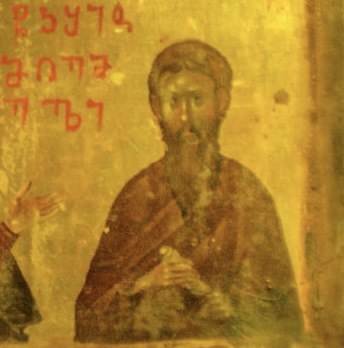
Shio is painted as an aged monastic ascetic: emaciated, in the schema or a plain dark mantle, with long white hair and a long white beard, holding a scroll or blessing. Two attributes distinguish him. The first is the dove or bird bringing him food, shown at his shoulder or hovering with a morsel in its beak. The second is the cave or the pit: he is often shown emerging from, or standing before, a dark rock opening, and in narrative scenes he is depicted within the well, receiving the Holy Gifts lowered to him from above. In Georgian church programmes he stands in the company of the Thirteen Syrian Fathers, in the row of the founders, beside John of Zedazeni; at Shiomgvime itself he is painted with the monastery in his hands as its founder, and the frescoes of the monastery's chapels — repainted in the modern period over older layers — give him with Evagre and John. The stored image is a 14th-century Georgian image of the ascetic: the cowled elder half-length, hand before the breast, the red asomtavruli letters of his name legible in the upper corner — an inscription-verified medieval witness, where the modern chapel repaintings could not be verified.
Disputed questions
- Name and identity. Shio is the Georgian form of Simeon; the saint is styled Mghvimeli, "of the cave," from his monastery, and is sometimes met in English as Shio the Anchorite or Sio. He is not to be confused with the other Syrian Fathers, each of whom has his own day and his own place — John of Zedazeni their leader (May 7), David of Gareji, Anthony of Martqopi, Joseph of Alaverdi, Shalva and the rest.
- Chronology of the Thirteen. Georgian tradition sets the mission of the Thirteen Syrian Fathers in the reign of King Parsman (Pharsman) VI and of the Catholicos Eulavios, in the middle of the sixth century; the identification of which Parsman, and the exact years, are debated among Georgian historians, and this entry follows the traditional placement without pressing it. The saint's repose is therefore given as "c. 560s–570s."
- The bird. The Life says a dove; some retellings say a partridge, and some, following the Elijah parallel closely, a raven. All three appear in the manuscript tradition.
- Not to be confused with Shio the New, the hieromonk of David-Gareji martyred with the monks David, Gabriel and Paul by Dagestani raiders at the end of the 17th century and commemorated June 1 — a namesake of eleven hundred years later, whose epithet "the New" exists precisely to distinguish him from this Shio.