
John the Fool-for-Christ of Ustyug
The Blessed John, Fool-for-Christ and Wonderworker of Ustyug
Fool for Christ · Wonderworker · b. mid-15th century, at Pukhovo near Old Ustyug — d. 29 May 1494, at Ustyug
Commemorated 29 May — Repose of the fool-for-Christ of Great Ustyug
John of Ustyug (†29 May 1494) is the second of the two great fools-for-Christ of Great Ustyug in the Russian north, and one of the purest examples of the type: a young man of peasant stock who fasted from childhood, went barefoot and in rags through the Ustyug winters, slept on dung-heaps, prayed the nights through in a hut beside the city's Dormition cathedral, and bore the mockery of the town as his ascetic labour. He died young, and his tomb by the cathedral at once became a place of healing; the Russian Church honours him as a wonderworker and as an intercessor in the wars and invasions of the northern lands. He is the direct successor in that city of Procopius of Ustyug (†1303), the first Russian holy fool, with whom he is venerated as one of the Ustyug wonderworkers.

Origins and childhood fasting
John was born in the village of Pukhovo, near Old Ustyug on the river Sukhona in the Vologda north, to pious parents named Savva and Maria. The Life makes his asceticism begin before any choice of state in life: as a child he ate nothing at all on Wednesdays and Fridays, and on the other days took only bread and water. This is the ordinary opening of the Russian iurodivyi Lives, but it is also the thing that distinguishes them from mere eccentricity — the folly is built upon a fast kept long before there was anyone to see it.
The family afterwards moved to the town of Orletsa (Orlets) on the river Yug, some forty versts from Ustyug. There John's father died, and his mother in time received the tonsure at the local Holy Trinity monastery with the name Natalia. Her son, left free, went to Ustyug.
The folly for Christ
At Ustyug John first took up the discipline of silence, and then the far harder one of folly for Christ's sake — the deliberate assumption of the appearance of madness, so that the world's esteem should be lost and with it the last root of vainglory. A hut was built for him beside the cathedral of the Dormition in the city, and there he passed his nights in unbroken prayer. By day he went about the streets of Ustyug barefoot the whole year round, in a single ragged garment, in the summer dust and in the cold of a northern winter, resting where he could — on the refuse-heaps and dung-heaps of the town — and receiving the abuse, blows and derision of the townspeople and their children without answering them.
The most remembered of his feats is of a piece with this. Coming into a house, he was seen — the account says, to the terror of the household — to lie down in the mouth of the hot stove, among the burning coals and ashes, and to rise from it unhurt: a sign given in the idiom of folly, at once absurd and unanswerable, and the kind of thing the Russian Lives report of the fools because it could not be explained away as sanity.
Repose and wonders
John died on 29 May 1494, still a young man — his contemporaries reckoned him not yet thirty. He was buried beside the Dormition cathedral at Ustyug, and a church was afterwards raised over his relics, so that the hut of his vigils and the place of his burial became one shrine. The Life records that the gift of wonderworking was granted him, and the healings at his tomb — of the possessed, the paralysed and the blind — were collected in the sixteenth century, when his Life was compiled (by tradition in 1554, by a priest of the Ustyug cathedral). He is invoked in the north as a healer of many sicknesses and as a defender of the city in the invasions of enemies, and his memory is kept locally with the other Ustyug wonderworkers — Procopius the Fool-for-Christ, and the hierarchs of Perm and Ustyug.
Feast and commemoration
May 29 (church date; New Calendar civil May 29, Old Calendar civil June 11) — the day of his repose. The commemoration is Russian (Moscow Patriarchate and the calendars derived from it, including the OCA), and local in origin to the Vologda north; it is not kept in Greek or Antiochian usage. He has also a local commemoration among the Ustyug wonderworkers and in the synaxis of the saints of Vologda.
Because Orthodox Pascha falls between April 4 and May 8, this day always stands within the Pentecostarion, and in any given year the movable commemoration falling upon it takes precedence over the fixed.
Hymns
Troparion — Tone 4 (common of a fool-for-Christ)
Thou didst hear the Apostle crying, *We are fools for Christ's sake*, and didst make his word thy whole life; naked and mocked thou didst walk the streets of thy city, and in the ashes of the furnace thou wast not burned, for the fire of the Spirit was within thee. O blessed John, pray to Christ God that our souls may be saved.
Original translation from the Slavonic
Kontakion — Tone 8
From thy childhood thou didst fast, and in thy youth thou didst cast away the honour of men; thou hadst a hut for thy cell and the dung-heap for thy bed, and the city that laughed at thee now runs to thy tomb for healing. Rejoice, O blessed John, boast of Ustyug and helper in the day of invasion.
Original translation from the Slavonic
Iconography
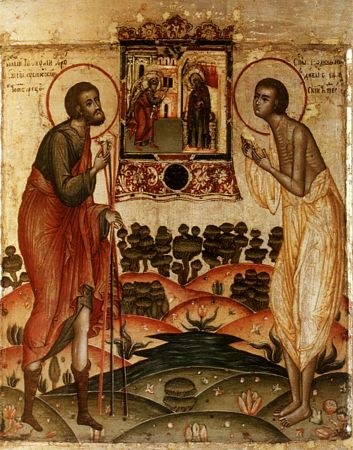
John is painted after the manner of the Russian holy fools: a young man, beardless or with the first down of a beard, bare-headed, barefoot, and clothed only in a shirt or a short ragged garment — sometimes nearly naked with a cloth about the loins — with his hands raised in prayer or one hand extended toward Christ, who blesses from a segment of heaven in the upper corner. His youth is the mark that separates him from the older bearded fools, and the city walls and the domes of the Dormition cathedral of Ustyug are commonly shown behind him. He appears with Procopius of Ustyug in the paired and group icons of the Ustyug wonderworkers, where the two fools flank the city, and in the vita-icons with border scenes of his childhood fast, his hut, the mockery of the townspeople, the stove, and the healings at his tomb.
No pre-1900 icon of him has been secured for this collection. A Wikimedia Commons media search in Russian for Иоанн Устюжский икона returned a single unrelated file (a panel of Panagias in the Tula museum) — but the paired Procopius-and-John icon below, found by the Wikidata channel, supplies what the name-search missed; the Menologion of Basil II, the ordinary first resort for minor saints, covers only September to February and in any case antedates him by five centuries.
The stored image is an 18th-century icon of the prayer of Procopius and John of Ustyug together — the two fools-for-Christ of the town in one frame, John identified by the pairing the Ustyug tradition always paints.
Disputed questions
- Not to be confused with Andrew the Fool-for-Christ of Constantinople (feast October 2), the Scythian-born salos of the tenth century to whom the vision of the Protecting Veil at Blachernae is ascribed — a different man, a different country, and five centuries earlier.
- Not to be confused with the Righteous John of Ustyug, the converted Tatar tax-collector Buga, baptised at Ustyug about 1262 and commemorated with his wife Maria (feast July 16), who was married, died in old age, and was buried at the church of the Ascension. The two share a city and a name and nothing else: the one is a righteous layman and convert of the thirteenth century, the other a fool-for-Christ of the fifteenth. Russian day-lists sometimes carry the pair as "John and Maria of Ustyug," which invites the error, and the fool's own mother was also named Maria.
- Not to be confused with Procopius of Ustyug (†1303, feast July 8), the German merchant of Novgorod who became the first fool-for-Christ of the Russian land and the patron of the same city. John is his imitator and his successor at Ustyug, and the two are painted together; but the deeds and dates are quite distinct, and the older literature occasionally transfers episodes from Procopius' Life to John's.
- The extent of the record. Outside the Russian Life of 1554 and its derivatives, this entry rests on the Slavic synaxarial notice as carried in the OCA calendar. The fuller hagiographic tradition — the named witnesses of the stove episode, the roll of posthumous miracles, and the date of the church raised over the relics — could not be verified from an independent source at authoring time and is reported here only in the form the notice gives.