
Procopius of Ustyug
The Holy and Righteous Procopius, Fool-for-Christ and Wonderworker of Great Ustyug
Fool for Christ · Wonderworker · d. 1303
Commemorated 8 July — Repose at Great Ustyug, 1303
Procopius of Ustyug (†1303) is the first fool-for-Christ of the Russian land and the patron of Great Ustyug in the far north. By the tradition of his Life he was a wealthy merchant "of the Varangians" — a Hanseatic German of the Latin confession — who came trading to Novgorod, was overcome by the beauty of Orthodox worship, was received into the Church, gave away everything he had, and, to escape the honour his conversion had won him, went east into the wilderness and settled at Ustyug, where for some forty years he lived on the cathedral porch in rags, sleeping on dunghills, taking food only from the honest poor, and carrying three wooden pokers in his hand. In 1290 his prayer before the icon of the Annunciation in the Dormition cathedral was held to have turned aside a rain of burning stones from the city. He foretold the birth of Stephen of Perm, and died in a summer snowfall on the night of July 8, 1303. The Council of Moscow of 1547 glorified him — the first of the Russian holy fools to be canonised.

The Varangian merchant at Novgorod
The Life says only that Procopius came "from the west, from the Latin tongue, of the German land," and calls him of the Varangians; his name in the world is not transmitted. He was a merchant, and a rich one, of the Hanseatic trade, and he came with his goods to Novgorod the Great in the second half of the thirteenth century. What held him there was not commerce. The Life dwells on the effect on him of the Orthodox churches of Novgorod: the beauty of the buildings, the ringing of the bells, the singing, the reverence of the people at the services. He abandoned the confession in which he had been raised and was received into the Orthodox Church.
Seeking instruction, he went out to the Khutyn monastery on the Volkhov, then in the first generation after its founder Barlaam of Khutyn, and put himself under the elder Varlaam Prokshinich, a disciple of the founder. There he was taught the Scriptures and the lives of the ascetics, and there he read of the folly for Christ's sake — the ascetic feigning of madness practised by Symeon of Emesa and Andrew of Constantinople. He distributed his whole fortune, part to the poor and part to the building of churches, and took up that life.
Flight to Ustyug and the labour of folly
The Novgorodians honoured him for what he had done, and the honour drove him away. The Life is explicit that he fled Novgorod to escape praise — the standard and the sincere motive of the iurodivyi. He went east and north through the forests, mocked and beaten along the road as he intended to be, until he came to Ustyug on the Sukhona, then a small frontier town of the northern trade, and stayed there.
His asceticism at Ustyug is the classic form of the type, and the details are those the Russian north remembered longest. He lived on the porch of the cathedral of the Dormition, exposed to the northern winter; he slept on the bare ground and on dunghills; he wore rags in all seasons and went barefoot; he prayed the nights through at the doors of the churches, and by day played the madman in the streets and bore the blows and the derision of the townspeople. He begged his bread, but would take nothing from the rich or the dishonest, only from the poor who lived by their own labour, and often ate nothing for days. In his left hand he carried three wooden pokers (kochergi); the townsfolk learned to read them, for when he held them upright the harvest would be good and when he carried them downward the year would be lean. He is also remembered for sitting on a stone by the river and praying for those who went out in the boats.
The cloud of burning stones, 1290
The great event of his life, and the foundation of his cult, is set in 1290, thirteen years before his death. For a week Procopius went through Ustyug weeping and calling the people to repentance, fasting and prayer, warning that the wrath of God was coming upon the city; and for a week he was ignored. Then a black cloud came over Ustyug, the day turned to night, and thunder and lightning broke over the town without ceasing. The people ran into the cathedral of the Dormition, where they found Procopius already lying on his face before the icon of the Annunciation, weeping and praying for the city.
The Life relates that myrrh flowed from the icon of the Mother of God, in such quantity that the vessels of the church were filled from it, and that at once the cloud withdrew; and that twenty versts from the town, in the Kotovalsky forest, a rain of burning stones fell and shattered the trees, harming no one. The place, the tradition says, was still bare and scorched long afterwards. The event is kept in the Russian calendar on this same day as the Miracle of the Annunciation Icon of the Mother of God at Ustyug, and it made Procopius, who had been a beggar and a laughing-stock, a prophet in his city.
The prophecy of Stephen of Perm
The other episode always told of him is small and famous. A child of three named Maria, the daughter of a townsman, was being carried past the cathedral to the evening service, and Procopius bowed to the ground before her and said to the people standing by that here went the mother of Stephen, the great teacher and bishop of Perm. The bystanders thought it more of his madness. Maria grew up, married Symeon, a pious deacon of the Ustyug cathedral, and bore Stephen of Perm, the apostle of the Zyrians and the maker of their alphabet — and the prophecy was remembered.
Repose
By the account of the Life an angel announced to Procopius the day of his death. On the night of July 8, 1303, he went out to the monastery of his friend Symeon (called Cyprian in some redactions), knelt before its gates, gave thanks at length to God for the whole of his life, then went to the end of the bridge, folded his hands crosswise on his breast and gave up his spirit in prayer. That summer night snow fell over Ustyug — the Life says to the depth of two fathoms in drifts — and covered his body; it melted by evening without harming the crops. He was found four days later at the bridge, uncorrupted, and was carried into the town and buried by the cathedral, at the spot he had himself pointed out. A cross of wood was set there, then one of stone, and then a chapel.
Cultus and canonisation
Healings at the grave began early. A wooden church over the relics is recorded in 1495, after miracles at the tomb had made the local veneration general; the account of his deeds and posthumous wonders was written in the 1550s, and a fuller redaction in the mid-seventeenth century, which numbers twenty-eight miracles and includes the deliverance of Ustyug in the Time of Troubles. The Council of Moscow of 1547, in the great canonisations conducted under the metropolitan Macarius, glorified him for the whole Russian Church and fixed his feast on July 8 — the first formal canonisation of a Russian fool-for-Christ, and the act which made the iurodivyi a recognised category of Russian sanctity.
He remains the patron of Veliky Ustyug, whose cathedral of St Procopius the Righteous stands beside the Dormition cathedral on the river bank, and is invoked in the north against fire, storm and famine, and by those in peril on the water.
Feast and commemoration
July 8 (church date; Old Calendar civil July 21), the day of his repose in 1303, fixed for the whole Russian Church by the Council of 1547. The commemoration is Russian and is not kept in Greek or Antiochian usage. In Russia the day is dominated by the appearance of the Kazan Icon of the Mother of God, and Procopius is kept alongside it and alongside the Great Martyr Procopius whose name he bore. At Veliky Ustyug his own feast is the principal day of the city, and he is commemorated locally with the other Ustyug and Vologda wonderworkers — John the Fool-for-Christ, Stephen of Perm, and the hierarchs of Perm and Ustyug — in the synaxis of the saints of that region.
Hymns
Troparion — Tone 4
Enlightened by divine grace, O God-wise one, and setting thy whole mind and heart unswervingly upon the Creator and away from this vain world, by chastity and by much patient endurance thou didst finish well the course of this temporal life and didst keep the faith unstained. Wherefore after thy death also the brightness of thy living was made manifest, for thou pourest out an inexhaustible fountain of wonders upon them that come with faith to thy holy tomb, O all-blessed Procopius: pray thou to Christ our God, that our souls may be saved.
Original translation from the Slavonic
Kontakion — Tone 4
By folly for Christ's sake thou didst pass untouched through the tollhouses of the air upon the hands of angels, and didst attain unto the royal throne, receiving from Christ our God, the King of all, the gift and the grace of healings. For by thy many wonders and by a fearful sign thou didst astonish thy city of Great Ustyug; and obtaining mercy for thy people, thou didst by prayer draw forth myrrh from the honoured image of the most holy Theotokos, and didst grant cures to the sick. Wherefore we entreat thee, O wonder-bearing Procopius: pray thou unceasingly to Christ our God, that He grant us the forgiveness of our sins.
Original translation from the Slavonic
Iconography
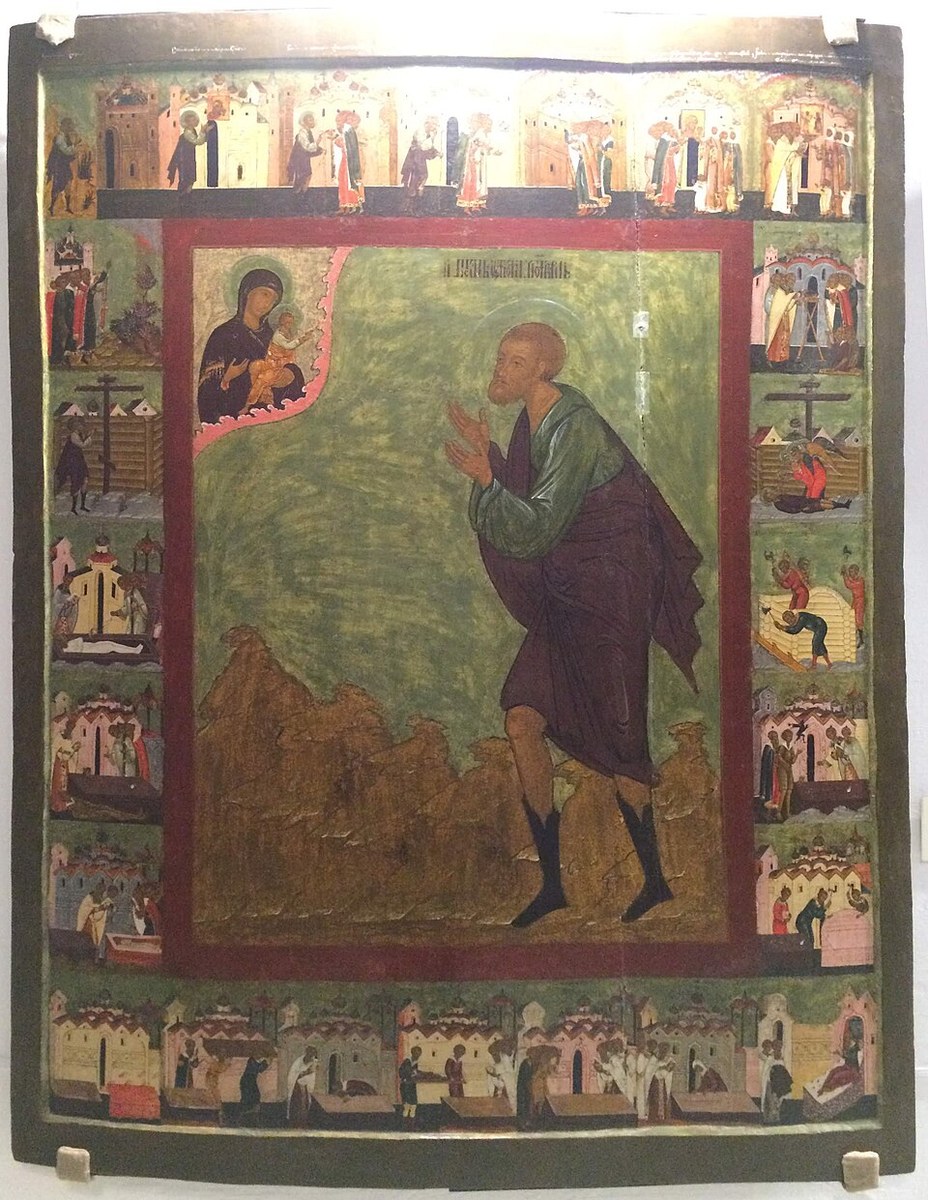
Procopius is shown as a middle-aged or elderly man with a short, sparse, wedge-shaped beard and thin fair hair, barefoot and half-clothed: a ragged mantle thrown over one shoulder and the body otherwise bare, in the manner of the Russian holy fools. His constant attribute is the bundle of three pokers carried in the left hand, and his constant setting is the town of Ustyug — its walls, its towers and the domes of the Dormition cathedral. He is nearly always painted in prayer toward the Mother of God, who appears with the Child in a segment of heaven in the upper corner, an allusion to the Annunciation icon and the deliverance of 1290; a stone or rocky ground beneath his feet recalls the burning stones and the stone by the river on which he sat. He appears with John the Fool-for-Christ of Ustyug in the paired and group icons of the Ustyug wonderworkers.
The stored image is the great vita-icon of 1602 from the cathedral of Procopius the Righteous at Veliky Ustyug, the gift of the Stroganov magnate Nikita Stroganov: the saint stands full-length in the centre field, barefoot on rocky ground, in a dark red mantle over a green undergarment, his hands raised toward the Mother of God with the Child in the cloud at the upper left, with twenty-four border scenes of his life running round the panel — his coming to Novgorod, the distribution of his goods, his journey and his mockery, the prayer before the Annunciation and the cloud of stones, the prophecy over the child Maria, the snowfall and his death on the bridge, the finding of the body, and the healings at the tomb.
Disputed questions
- His origin and name in the world. The Life says "from the Varangians" and "of the German land," which is all that is certain in the tradition. The identification with a patrician family of Lübeck, and specifically with a Hanseatic merchant named Jacob Potharst, was proposed by the church historian S. Lyashevsky in the twentieth century; it rests on inference and is not supported by any medieval source. It is reported here as a modern conjecture, not as a fact.
- The event of 1290. The description in the Life — a darkening, thunder without cease, a rain of stones falling in a forest twenty versts off, and scorched ground afterwards — has been read by Russian writers since the nineteenth century as the memory of a meteorite fall near Ustyug. The reading is plausible and is not part of the hagiographic tradition itself.
- The composition of the Life. The surviving redactions are late — the earliest, of the 1550s, is two and a half centuries after the events — and are visibly composite and out of chronological order. Nothing about Procopius is attested by a contemporary source. The Life's own preface admits that it was assembled from what had been written down piecemeal and from the church records.
- Not to be confused with Procopius the Great Martyr of Caesarea in Palestine (†303), who is commemorated on this same July 8 and after whom this Procopius was named at his reception into the Orthodox Church. Russian day-lists carry the two together; Greek and Antiochian usage knows only the martyr. Distinguish also Procopius the Reader (November 22) and Prokopius of Decapolis (February 27). Russian local usage adds a third Procopius to this day, the Righteous Procopius of Ustyansky (seventeenth century, Vazhsky district), whose relics were found incorrupt and whose identity the tradition itself does not explain; he is a distinct and purely local commemoration.
- Not to be confused with John the Fool-for-Christ of Ustyug (†1494, May 29), the second holy fool of the same city, who took Procopius as his model and is venerated with him as one of the Ustyug wonderworkers; the older literature sometimes transfers episodes between the two Lives.