
John the Forerunner
The Holy Glorious Prophet, Forerunner and Baptist John
Prophet · Martyr · b. c. 5 BC (six months before the Nativity of Christ) — d. c. 29–32 (beheaded)
Commemorated 7 January — Synaxis of the Forerunner, the day after Theophany, 24 February — First and Second Findings of the Precious Head, 25 May — Third Finding of the Precious Head, 24 June — Nativity of the Forerunner, 29 August — Beheading of the Forerunner — a strict fast day, 23 September — Conception of the Forerunner
John the Forerunner and Baptist of the Lord — son of the priest Zachariah and the righteous Elizabeth, kinsman of Christ, desert ascetic, preacher of repentance at the Jordan, and the one found worthy to baptize the incarnate God — is honoured by the Orthodox Church above every saint except the Theotokos. The Lord himself pronounced the verdict the Church repeats: "among them that are born of women there hath not risen a greater." Last and greatest of the prophets, he pointed to the Lamb of God with his finger, rebuked a king, was beheaded for righteousness' sake, and — the tradition sings — went as forerunner even to those in Hades. His cycle of six fixed feasts, from his Conception (September 23) to the Findings of his Head, structures the whole liturgical year, and every Tuesday of the week is dedicated to him.
.jpg)
Origins and early life
Everything begins where the New Testament itself begins its narrative: in the household of the priest Zachariah and the righteous Elizabeth, an aged and childless couple of priestly descent on both sides, "both righteous before God" (Luke 1:6). To Zachariah, burning incense in the sanctuary at the hour of his course's service, the archangel Gabriel appeared at the right side of the altar of incense and announced that his prayer was heard: Elizabeth would bear a son, to be called John — "the Lord is gracious" — who would be great before the Lord, would drink neither wine nor strong drink, would be filled with the Holy Spirit from his mother's womb, and would go before the Messiah "in the spirit and power of Elias, to make ready a people prepared for the Lord" (Luke 1:17). Zachariah doubted and was struck mute until the fulfilment; the Church keeps the annunciation and conception that followed as the feast of September 23, the opening act of the Gospel drama and the first feast of the Forerunner's cycle in the church year. The whole narrative, told from the parents' side, is set out in the entry for Zachariah and Elizabeth; the present entry follows the son.
The unborn John's first prophetic act is recorded by Luke: when the Virgin Mary, newly bearing the incarnate Word, greeted Elizabeth in the hill-country of Judah, "the babe leaped in her womb" — the six-month-old child in the womb recognising and worshipping his Lord in the womb of the Virgin, as the hymnography of the Conception and Visitation loves to sing. At his birth, which the Church feasts on June 24, the neighbours would have named him for his father; Elizabeth insisted on John, the mute Zachariah wrote "His name is John," and, his tongue loosed, prophesied over the child: "And thou, child, shalt be called the prophet of the Highest: for thou shalt go before the face of the Lord to prepare his ways" (Luke 1:76).
Of John's childhood Luke says only: "And the child grew, and waxed strong in spirit, and was in the deserts till the day of his shewing unto Israel" (Luke 1:80). The tradition, resting on the Protoevangelium of James, fills the silence with tragedy: at the massacre of the innocents Herod sought the wonder-child too; Elizabeth fled with the infant into the wilderness, where a mountain opened to hide them; Zachariah, refusing to betray his son's hiding place, was slain in the temple; Elizabeth reposed forty days after; and the orphaned child was nourished in the desert, the synaxaria say, by the ministry of an angel until his showing to Israel.
Prophetic vocation
The Church reads John as the hinge of the two Testaments — "the seal of the prophets," as the doxastikon of the Conception calls him: the last of the old prophetic line and the first herald of the New Covenant, the only prophet who pointed to the Messiah not across centuries but with his finger. Two Old Testament prophecies define him, and both are applied to him by the Gospels themselves. Isaiah's "voice of one crying in the wilderness: Prepare ye the way of the Lord, make his paths straight" (Isaiah 40:3) is quoted of John by all four evangelists; the Forerunner accepted it as his own self-description, answering the priests and Levites from Jerusalem with nothing but "I am the voice" (John 1:23) — the voice, as the Fathers gloss it, of the Word. Malachi's closing oracle supplies the second: "Behold, I send my messenger, and he shall prepare the way before me" (Malachi 3:1) — words the Lord quotes expressly of John (Matthew 11:10). Since the Greek of "messenger" is angelos, this verse became the warrant for the most striking of his icon types, the winged John, "Angel of the desert": a man whose life was angelic in the flesh and whose office was an angel's, to be sent before the face of the Lord.
Christ's own estimate of him is the Church's: "Among them that are born of women there hath not risen a greater than John the Baptist" (Matthew 11:11), and again, "a prophet? yea, I say unto you, and more than a prophet" (Matthew 11:9). On these words rests the whole edifice of his veneration — greatest born of women, more than a prophet, ranked in the Church's prayer immediately after the Mother of God.
The desert life
John's asceticism is described by the evangelists with the economy of an icon: "the same John had his raiment of camel's hair, and a leathern girdle about his loins; and his meat was locusts and wild honey" (Matthew 3:4). In the rough hair garment the tradition saw the mantle of Elijah, whose spirit and power John bore and whose successor in the desert he was; in the diet, the utter renunciation of the sated life of the cities. He drank neither wine nor strong drink, as Gabriel had foretold, and the Church's ascetics of every generation — hermits, stylites, hesychasts — have looked to him as the founder and patron of their way: the first monk before monasticism, the "rule of them that live in the desert," as his hymns name him. The wilderness of Judea and the lower Jordan valley were his dwelling from childhood to his showing; the Byzantine monastery of the Prodromos beside the Jordan, and the hundreds of Prodromos monasteries across the Orthodox world, keep the memory of that habitation.
The baptism of repentance
Luke dates the opening of John's public ministry with imperial precision: in the fifteenth year of Tiberius Caesar — about the year 28/29 — "the word of God came unto John the son of Zacharias in the wilderness. And he came into all the country about Jordan, preaching the baptism of repentance for the remission of sins" (Luke 3:1–3). Crowds came out from Jerusalem, Judea, and the whole Jordan region to confess their sins and be baptized. His preaching, preserved by the synoptics, is the most bracing in the New Testament: "O generation of vipers, who hath warned you to flee from the wrath to come? Bring forth therefore fruits worthy of repentance... now also the axe is laid unto the root of the trees." To the crowds he preached the sharing of coats and food; to publicans, exactness without extortion; to soldiers, violence to no man and contentment with their wages (Luke 3:10–14) — a moral realism the Church has always noted: the Forerunner sent no man out of his station, but demanded righteousness within it.
When the people mused whether he himself were the Christ, his answer defined his office and his humility at once: "I indeed baptize you with water; but one mightier than I cometh, the latchet of whose shoes I am not worthy to unloose: he shall baptize you with the Holy Ghost and with fire" (Luke 3:16). His baptism was a baptism of repentance, preparing and prefiguring but not yet conferring the Spirit — the distinction the apostle Paul later drew for John's disciples at Ephesus (Acts 19:1–5).
The Baptism of Christ
The summit of John's ministry, and the event from which his title "Baptist" derives, is the Lord's own coming to the Jordan. John, recognising him, "forbad him, saying, I have need to be baptized of thee, and comest thou to me?" — and yielded at the word "suffer it to be so now: for thus it becometh us to fulfil all righteousness" (Matthew 3:14–15). His hand upon the head of the incarnate God, the heavens opened, the Spirit descending as a dove, the voice of the Father bearing witness to the Son: John stood at the centre of the first open manifestation of the Holy Trinity, which the Church keeps as the great feast of Theophany (January 6) and which makes him for ever "the Baptist." He bore witness afterward in the words that entered the Liturgy itself: "Behold the Lamb of God, which taketh away the sin of the world" (John 1:29) — the first man to name the Messiah as the sacrificial Lamb, and, as the fourth Gospel adds, an eyewitness confessor of the Trinity: "I saw the Spirit descending from heaven like a dove, and it abode upon him... and I saw, and bare record that this is the Son of God" (John 1:32–34).
"He must increase"
John's greatness, the Fathers insist, is crowned by his self-effacement. When his own disciples grew jealous that "all men come to him" — to Jesus, baptizing beyond Jordan — John answered with the words that the Church takes as the motto of his whole existence: "He that hath the bride is the bridegroom: but the friend of the bridegroom, which standeth and heareth him, rejoiceth greatly because of the bridegroom's voice: this my joy therefore is fulfilled. He must increase, but I must decrease" (John 3:29–30). He had already pointed his best disciples away from himself: Andrew the First-called and (by ancient reading) John the Theologian left the Forerunner for the Lamb at his own word (John 1:35–40), so that the apostolic company itself is in part the Forerunner's gift to Christ.
From prison he sent two disciples to ask, "Art thou he that should come, or do we look for another?" (Matthew 11:3) — a question the Fathers generally read not as a wavering of the Baptist's own faith but as his last act of teaching, sending his disciples to see the Messiah's works with their own eyes; and it was in answering it that the Lord turned to the crowds and pronounced the praise of John quoted above. The exegetical question is noted under Disputed questions.
The rebuke of Herod Antipas, imprisonment and beheading
Herod Antipas, tetrarch of Galilee and Perea, had taken Herodias, the wife of his living brother Philip, in defiance of the Law. John, for whom the king's sin was as open to rebuke as the publican's, told him to his face: "It is not lawful for thee to have thy brother's wife" (Mark 6:18). For this he was bound and imprisoned — in the fortress of Machaerus east of the Dead Sea, as Josephus records — for Herod "feared John, knowing that he was a just man and an holy, and observed him; and when he heard him, he did many things, and heard him gladly" (Mark 6:20), while Herodias nursed her grievance.
Her moment came at Herod's birthday banquet. The daughter of Herodias — Salome, as Josephus names her — danced before the company and pleased Herod, who swore with an oath to give her whatever she asked, to the half of his kingdom. Prompted by her mother, she asked for the head of John the Baptist on a platter. "And the king was exceeding sorry; yet for his oath's sake, and for their sakes which sat with him, he would not reject her" (Mark 6:26): the executioner was sent, the greatest of the prophets was beheaded in the prison, the head given to the girl and by the girl to her mother, and the body buried by John's disciples, who "went and told Jesus" (Matthew 14:12). The Church keeps the day, August 29, with the ambivalence proper to it: a feast of the Forerunner's perfected witness, and a strict fast in grief at the drunken oath, the dance, and the murder of righteousness. The tradition adds that Herodias, not content, pierced the holy tongue with a needle and buried the head separately in an unclean place, that it might not be reunited with the body — the seed of the long history of the Head told below; and the historical record adds its own postscript, for Josephus reports that the destruction of Herod's army by Aretas was regarded by the Jews as God's vengeance for John, and Herod and Herodias ended in deposition and exile.
John died, as the Fathers observe, not formally for the confession of Christ's name but for the truth of God's law — yet the Church has never hesitated to count him martyr, the protomartyr of the Gospel order in all but title, whose death for righteousness was death for the Word himself who is Righteousness. His martyrdom preceded the Cross, and thereby — in the tradition's bold reading — continued his office beyond the grave.
Forerunner even in Hades
The Byzantine tradition, fixed in the troparion of the Beheading, teaches that John's death was itself a forerunning: descending to the dead before the Lord's own descent, "thou didst preach even to those in Hades the God who appeared in the flesh, who takes away the sin of the world and grants us great mercy." As he had prepared the living for the Messiah's coming, so he went ahead to prepare the imprisoned dead for the Descent of Christ into Hades; the icon of the Resurrection (the Anastasis) accordingly often shows John standing among the dead at the broken gates, still pointing to Christ, scroll in hand, the herald's office unbroken by death. The Church's theology of the saint is compressed in this image: there is no moment of sacred history, from the womb to Hades to the judgement, where the Forerunner is not found going before.
Relics and translations
The disciples buried John's body at Sebaste in Samaria, where his tomb was venerated beside those of the prophets Elisha and Obadiah. Under Julian the Apostate (c. 362) pagans broke open the tomb, burned the bones, and scattered the ashes; monks of the monastery of Abba Philip in Jerusalem, mingled with the crowd, rescued what portions they could, and these passed to Jerusalem and thence to Alexandria, where in 395 Theophilus of Alexandria deposited them in the great church built for the Forerunner on the site of the temple of Serapis. Sebaste's ruined shrine, and the relics diffused from the rescue, seeded the Forerunner's cultus across the whole Christian world.
The history of the Precious Head is kept in the calendar itself, in two feasts of finding. The received tradition runs thus. Herodias buried the head in an unclean place; the pious Joanna, wife of Herod's steward Chuza, recovered it and hid it in an earthen vessel on the Mount of Olives. In the fourth century a monk digging a foundation found it — the First Finding — and it passed, through a chain of keepers the synaxaria trace with sorrowing candour (including an Arian priest who exploited it), to the city of Emesa in Syria. There, hidden in a cave and revealed by the Forerunner himself in a vision to the archimandrite Marcellus — identified in the tradition with the abbot of the Akoimetoi kept on December 29 — it was found again in 452 — the Second Finding, kept with the First on February 24 — and enshrined in the church of Emesa, whence it was translated to Constantinople. In the iconoclast troubles the head was carried away to Comana of Cappadocia and hidden; after the restoration of the icons it was found a third time, about 850, and returned with imperial honours to Constantinople — the Third Finding, kept on May 25. After the sack of 1204 the Western claimants multiply: Amiens in Picardy has claimed the face of the Forerunner since the Fourth Crusade, Rome's San Silvestro in Capite keeps a rival head-relic, and the entry asserts none of the competing identifications as certain (see Disputed questions).
Of particular weight for the Antiochian tradition: in Damascus itself, in the great Umayyad Mosque — built over the basilica of St. John the Baptist — the shrine of the head of the Forerunner stands to this day within the prayer hall, venerated by Christians and Muslims alike (who honour him as the prophet Yahya); whatever the archaeology of that particular relic, it is the most visible monument of the Forerunner's cultus in the patriarchate of Antioch's own city.
The right hand — the hand laid on the head of Christ — was preserved, tradition says, by the evangelist Luke's city of Antioch; the deacon Job brought it from Antioch to Constantinople in 956, and Constantine Porphyrogenitus's court celebrated its reception. After the fall of the City it passed to the Knights of St. John — to Rhodes, then Malta — and in 1799 was given to the emperor Paul of Russia and kept at Gatchina; the Russian Church keeps a feast of this translation on October 12 (a jurisdiction-specific feast, to be treated at that day). Carried out of Russia after the revolution, the hand is venerated today in the monastery church of Cetinje in Montenegro.
Veneration and liturgical prominence
No saint's veneration is woven so deeply into the daily fabric of Orthodox worship. In the Church's fixed order of intercession the Forerunner stands immediately after the Theotokos and above the apostles: at the dismissal of every service where saints are named, the priest asks the prayers "of the honourable, glorious prophet, forerunner and baptist John" directly after those of the Mother of God; at the proskomedia, when the nine ranks of saints are commemorated on the fifth prosphoron, the first particle of the nine is taken in his honour, before all prophets, apostles and hierarchs alike. In the week of the Octoechos, each day of which is dedicated to a mystery or a rank of sanctity, Tuesday belongs to the Forerunner: every Tuesday of the year, in the absence of a greater feast, the canons and hymns of the day are his — a weekly commemoration accorded otherwise only to the angels, the Cross, the apostles and Nicholas, and the Theotokos.
In the Deesis — the "supplication" composition at the heart of the iconostasis and of Byzantine art — the Forerunner stands at Christ's left as the Theotokos stands at his right, the two great intercessors of the human race turned toward the enthroned Lord with hands raised in prayer. The theology is exact: the greatest born of women and the greatest of women flank the God-man, the Old Covenant's last voice and the New Covenant's first dwelling-place, praying for the world. Every extended Deesis tier, on every iconostasis in the Orthodox world, repeats this placement daily before the eyes of the faithful.
The fixed calendar carries a full cycle of his feasts — Conception (September 23), Nativity (June 24), Synaxis (January 7), the two feasts of the Findings of the Head (February 24 and May 25), and the Beheading (August 29) — so disposed around the year that, with the Theophany, scarcely a season lacks him; the details and ranks are treated under Feast and commemoration. Only of Christ, the Theotokos, and the Forerunner does the Church celebrate conception, nativity and death; the parallelism of the three infancy feasts (Conception September 23 / December 9 / March 25; Nativity June 24 / September 8 / December 25) is ancient and deliberate, the Forerunner's dates running half a year before his Lord's, as Luke's sixth-month synchronism requires.
Beyond the Byzantine world his cultus is universal: the Latin West keeps his Nativity and Beheading as ancient feasts; whole nations (the Maronites, the Knights of St. John, countless cities) took him as patron; and Islam venerates him as the prophet Yahya, so that his Damascus shrine is a place of shared honour. Among the apocryphal-adjacent curiosities, the Mandaeans of Mesopotamia hold him — polemically against Christianity — as the true prophet; the fact is recorded here only as evidence of the breadth of his ancient fame.
Hymnographic and literary legacy
The Forerunner's hymnography is among the richest of any saint. For the Conception, the canon in the Menaion is the work of John of Damascus; the sticheron cycle at vespers of the feast dramatises the dialogue of Gabriel and Zachariah in the sanctuary with a vividness the entry's Hymnography section samples. The Nativity and the Beheading each carry full festal services with canons ascribed to John of Damascus, Andrew of Crete and others; the Beheading's great doxastikon "Again Herodias rageth" is one of the most dramatic compositions in the Octoechos-Menaion corpus. Patristic encomia on him form a library of their own — homilies of John Chrysostom, Gregory the Theologian's oration on Baptism, Theodore the Studite's encomium on the Third Finding among many — and the Fathers' favourite titles (voice of the Word, friend of the Bridegroom, seal of the prophets, angel of the desert) all passed from the pulpit into the service books. In Byzantine and Slavic devotion he received akathists, paracleses, and the standing dedication of the Tuesday canons of the Octoechos in all eight tones.
Feast and commemoration
The Forerunner's fixed cycle comprises six feasts, all kept universally in the Byzantine rite:
- June 24 — Nativity (Old Calendar civil July 7). Kept here as his primary feast: it is the oldest and most solemn of his own celebrations, a full festal service with vigil rank in wide usage, celebrated nine months after the Conception and six months before the Nativity of Christ, and the feast by which East and West alike have honoured him since at least the fourth century. (An argument could be made for January 7 or August 29 as his principal day; the Synaxis is by nature an appendage of Theophany, and the Beheading, for all its solemnity, commemorates the persecutors' deed with fasting — the Nativity is the feast that is purely and festally his. The choice is recorded here per the repository's one-primary rule.)
- September 23 — Conception (Old Calendar civil October 6) — the present day; the annunciation of Gabriel to Zachariah and the conceiving of the Forerunner by the aged Elizabeth. One of only three conceptions on the Church's calendar (with the Theotokos, December 9, and the Annunciation itself, March 25). In some Greek usage the day also commemorates the parents; the Slavic books keep the parents chiefly on September 5.
- January 7 — Synaxis (Old Calendar civil January 20). On the day after Theophany the Church gathers (synaxis) in honour of the minister of the Baptism, per the general rule that the chief secondary person of a great feast is honoured the following day.
- February 24 — First and Second Findings of the Head (Old Calendar civil March 9); May 25 — Third Finding (Old Calendar civil June 7): the relic-feasts whose history is given above.
- August 29 — Beheading (Old Calendar civil September 11). A feast of the highest solemnity kept, uniquely, as a strict fast day whatever the day of the week — abstention from meat, dairy, fish, wine and oil in strict practice — in grief for the murder of the greatest of the prophets; liturgical colour red where colour sequences are appointed.
To these the Russian tradition adds October 12, the translation of the right hand from Malta to Gatchina (1799) — jurisdiction-specific, to be treated when that day is authored. In the weekly cycle of the Octoechos every Tuesday is dedicated to the Forerunner, whose canons in the eight tones stand in the Octoechos beside those of the Cross, the apostles and the Theotokos; and in every dismissal and at every proskomedia he is commemorated in the place of honour after the Theotokos, as described above. No movable feasts attach to him.
Hymns
Troparion — Tone 4
Rejoice, O barren one, that hadst not borne until now: for behold, thou hast conceived the lamp of the Sun, who is to enlighten all the world, that lay sick with blindness. Dance, O Zachariah, and cry out with boldness: the one to be born is the Prophet of the Most High.
Original translation from the Greek
Kontakion — Tone 1
Zachariah the great rejoiceth with splendour, with Elizabeth his all-glorious yokefellow, for she hath worthily conceived John the Forerunner, whom the Archangel announced with rejoicing, and whom we men honour as is due, an initiate of the grace of God.
Original translation from the Greek
Appointed readings
Epistle — Galatians 4:22–31 (Conception, September 23)
22For it is written, that Abraham had two sons, the one by a bondmaid, the other by a freewoman. 23But he who was of the bondwoman was born after the flesh; but he of the freewoman was by promise. 24Which things are an allegory: for these are the two covenants; the one from the mount Sinai, which gendereth to bondage, which is Agar. 25For this Agar is mount Sinai in Arabia, and answereth to Jerusalem which now is, and is in bondage with her children. 26But Jerusalem which is above is free, which is the mother of us all. 27For it is written, Rejoice, thou barren that bearest not; break forth and cry, thou that travailest not: for the desolate hath many more children than she which hath an husband. 28Now we, brethren, as Isaac was, are the children of promise. 29But as then he that was born after the flesh persecuted him that was born after the Spirit, even so it is now. 30Nevertheless what saith the scripture? Cast out the bondwoman and her son: for the son of the bondwoman shall not be heir with the son of the freewoman. 31So then, brethren, we are not children of the bondwoman, but of the free.
Gospel — Luke 1:5–25 (Conception, September 23)
5There was in the days of Herod, the king of Judæa, a certain priest named Zacharias, of the course of Abia: and his wife was of the daughters of Aaron, and her name was Elisabeth. 6And they were both righteous before God, walking in all the commandments and ordinances of the Lord blameless. 7And they had no child, because that Elisabeth was barren, and they both were now well stricken in years. 8And it came to pass, that while he executed the priest’s office before God in the order of his course, 9According to the custom of the priest’s office, his lot was to burn incense when he went into the temple of the Lord. 10And the whole multitude of the people were praying without at the time of incense. 11And there appeared unto him an angel of the Lord standing on the right side of the altar of incense. 12And when Zacharias saw him, he was troubled, and fear fell upon him. 13But the angel said unto him, Fear not, Zacharias: for thy prayer is heard; and thy wife Elisabeth shall bear thee a son, and thou shalt call his name John. 14And thou shalt have joy and gladness; and many shall rejoice at his birth. 15For he shall be great in the sight of the Lord, and shall drink neither wine nor strong drink; and he shall be filled with the Holy Ghost, even from his mother’s womb. 16And many of the children of Israel shall he turn to the Lord their God. 17And he shall go before him in the spirit and power of Elias, to turn the hearts of the fathers to the children, and the disobedient to the wisdom of the just; to make ready a people prepared for the Lord. 18And Zacharias said unto the angel, Whereby shall I know this? for I am an old man, and my wife well stricken in years. 19And the angel answering said unto him, I am Gabriel, that stand in the presence of God; and am sent to speak unto thee, and to shew thee these glad tidings. 20And, behold, thou shalt be dumb, and not able to speak, until the day that these things shall be performed, because thou believest not my words, which shall be fulfilled in their season. 21And the people waited for Zacharias, and marvelled that he tarried so long in the temple. 22And when he came out, he could not speak unto them: and they perceived that he had seen a vision in the temple: for he beckoned unto them, and remained speechless. 23And it came to pass, that, as soon as the days of his ministration were accomplished, he departed to his own house. 24And after those days his wife Elisabeth conceived, and hid herself five months, saying, 25Thus hath the Lord dealt with me in the days wherein he looked on me, to take away my reproach among men.
Iconography
Pre-modern icons of the Forerunner are among the most abundant of any saint, and his physiognomy is the most fixed in the whole canon: emaciated, wild-haired, with a long dishevelled beard and great grieving eyes; clad in the camel-hair melote, often with a green or ochre himation over it; the flesh ascetically darkened. The principal types:
- The Deesis figure — John at Christ's left, in three-quarter turn, hands raised in supplication, mirroring the Theotokos: the type of every iconostasis tier, from the Hagia Sophia great Deesis mosaic to the village churches of today.
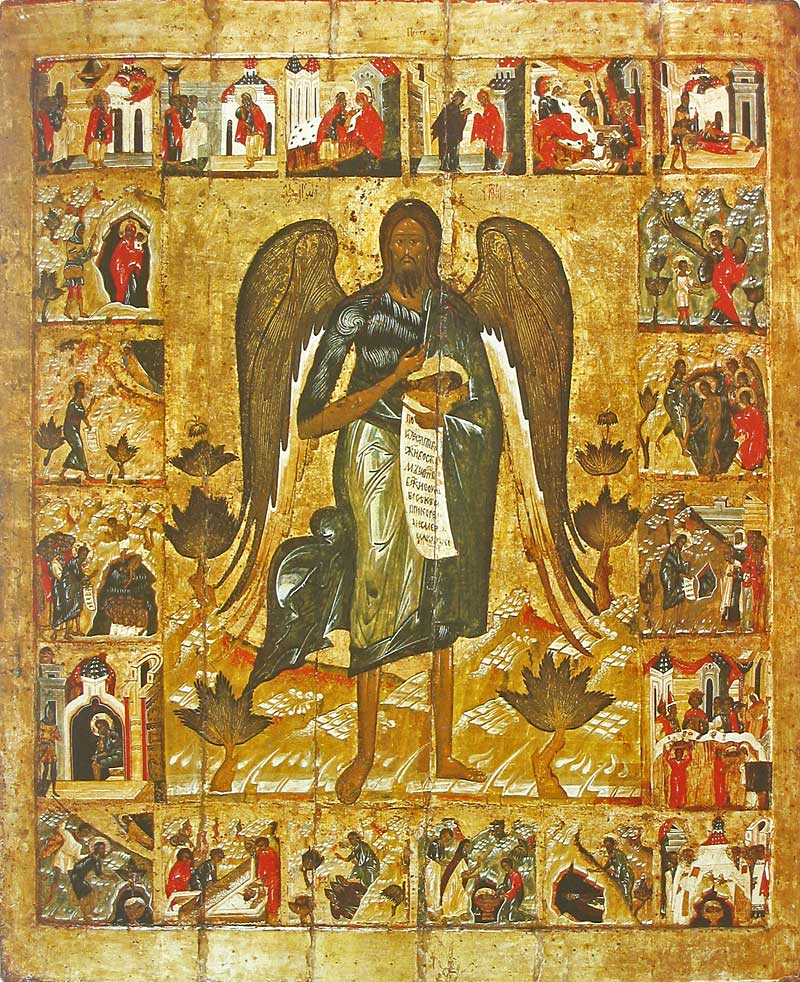
- The Angel of the Desert — the winged Forerunner, standing in the wilderness with the wings of Malachi's "messenger," holding an unrolled scroll ("Repent ye: for the kingdom of heaven is at hand") and frequently a chalice or dish bearing his own severed head, which he contemplates; at his feet, the axe laid to the root of the tree (a Russian development of the sixteenth–seventeenth centuries built on older Byzantine winged examples).
- The Baptism (Theophany) — John on the bank, hand on the Lord's head, in the festal icon of January 6.
- Narrative and vita icons — the Conception (Gabriel and Zachariah at the altar), Nativity of the Forerunner, Beheading (often with the head on the platter as a second moment within the icon), the Findings of the Head, and full hagiographic cycles in border scenes.
The stored primary icon is a Yaroslavl vita icon of c. 1551 (Yaroslavl Museum-Preserve, from the church of Nicholas Nadein): the winged Angel of the Desert full-length at centre, twenty border scenes of his life around. The variant is the Forerunner panel of the Vysotsky chin (c. 1387–1395), the Deesis tier painted in Constantinople for the Vysotsky monastery of Serpukhov, now in the Russian Museum — Byzantine art of the highest rank showing the Deesis type in its purest form.
Disputed questions
- Chronology. The Gospel synchronisms place his conception c. 6–5 BC, his birth six months before Christ's, the opening of his ministry in the fifteenth year of Tiberius (AD 28/29), and his death during the Lord's ministry — c. 29–32 on the usual reckonings; Josephus requires only that it precede Antipas's defeat by Aretas (36). The frontmatter's dates are conventional within these limits.
- The motive of the execution. The Gospels give Herodias's vengeance and the banquet oath; Josephus (Antiquities 18.5.2) gives Antipas's fear that John's mass following would issue in sedition, and names Machaerus as the place. The two accounts are complementary rather than contradictory — a court's public reason and a household's private one — and both are recorded.
- The question from prison (Matthew 11:3). Patristic exegesis divides: the majority (Chrysostom, Jerome, the Byzantine tradition generally) read John's question as asked for his disciples' sake, the herald of the Trinity at Jordan being incapable of doubt; some ancient and many modern interpreters allow a real perplexity — expectation of a Messiah of judgement meeting the works of mercy. The Church's hymnography follows the first reading, and this entry records the division.
- The Qumran hypothesis. Modern scholarship has asked whether John's desert years, priestly parentage, and baptismal practice connect him with the Essene community at Qumran. The evidence is circumstantial (proximity, shared Isaiah 40:3 proof-text, ablutions); no source places him in the community, and his once-for-all baptism of repentance differs in kind from Qumran's repeated washings. Recorded as an open scholarly question with no bearing on the Church's tradition.
- The head-relics. Constantinople (via Emesa and Comana), Amiens, Rome (San Silvestro in Capite), and Damascus all have historic claims to the Precious Head or portions of it; the medieval sources cannot be reconciled with documentary certainty, and the entry presents the Byzantine tradition of the three Findings as the tradition the calendar itself canonises, without adjudicating the surviving relics' authenticity.
- Classification. The calendars style John prophet (and martyr in substance, his Beheading being kept as a martyr's feast with a fast); this entry types him [prophet, martyr] accordingly. The term forefather was considered and rejected: the forefathers are the righteous ancestors of Christ according to the flesh, and John, the Lord's kinsman and contemporary, has no place in the genealogy — he closes the prophets, not the forefathers. protomartyr is likewise not applied: though his death preceded every Christian martyrdom, the tradition reserves the title for Stephen (and Thecla among women), and the calendars never apply it to John.
- Not to be confused with the many sainted Johns of the calendar — the Theologian, Chrysostom, Climacus, of Damascus, and dozens more; the epithets Forerunner (Prodromos) and Baptist are his alone.