
Nativity of the Forerunner
The Nativity of the Honourable and Glorious Prophet, Forerunner and Baptist John
On June 24 the Church keeps the Nativity of the Honourable and Glorious Prophet, Forerunner and Baptist John — the birth of the child promised to the aged priest Zachariah by the archangel Gabriel at the altar of incense, borne by the barren Elizabeth, and named by his mute father on a writing-tablet: "His name is John." It is one of only three birthdays the Orthodox Church celebrates — those of Christ, of the Theotokos, and of the Forerunner — and one of the five great feasts of the fixed calendar that stand outside the Twelve. Kept with an all-night vigil, it falls exactly six months before the Nativity of Christ, because Luke's Gospel says that Gabriel came to the Virgin "in the sixth month" of Elizabeth's conceiving (Luke 1:26); the whole architecture of the Church's year is built on that one verse. The day's hymns turn on a single reversal: a womb long barren bears fruit, and a tongue long silent is loosed, and both together announce that God is about to be born of a Virgin. The Forerunner's full Life is given in his own entry, John the Forerunner; this file treats the feast.

The promise in the sanctuary
Luke opens his Gospel not at Nazareth but in the temple at Jerusalem, in the priestly course of Abia, with an old man swinging a censer. Zachariah the priest and his wife Elizabeth, of the daughters of Aaron, were "both righteous before God, walking in all the commandments and ordinances of the Lord blameless" (Luke 1:6) — and childless, and past the age of children. In Israel that was reckoned a reproach; the Church reads it, as it reads Sarah and Hannah before, as the ground God prepares for a work that will be manifestly his own. When the lot fell to Zachariah to burn incense within the sanctuary while the whole multitude prayed outside, Gabriel stood at the right side of the altar of incense and told him that his prayer was heard: Elizabeth would bear a son, whose name was to be John — Yohanan, "the Lord is gracious" — who would be great in the sight of the Lord, drink neither wine nor strong drink, be filled with the Holy Spirit from his mother's womb, and go before the Messiah "in the spirit and power of Elias" (Luke 1:17).
Zachariah asked for a sign, pleading his own age and his wife's, and received one that was also a rebuke: "thou shalt be dumb, and not able to speak, until the day that these things shall be performed, because thou believest not my words" (Luke 1:20). The people waiting outside marvelled that he tarried so long, and when he came out and could not pronounce the blessing but only beckoned, they perceived that he had seen a vision. He finished the days of his ministration and went home; and Elizabeth conceived, and hid herself five months, saying, "Thus hath the Lord dealt with me in the days wherein he looked on me, to take away my reproach among men" (Luke 1:25). That conception is itself a feast, kept on September 23 — the first feast of the church year's Forerunner cycle — and the whole scene in the sanctuary is dramatised in the stichera of that day, which the entry for Zachariah and Elizabeth sets out in full.
The sixth month, and the Visitation
The hinge of the whole calendar is a single phrase. "And in the sixth month the angel Gabriel was sent from God unto a city of Galilee, named Nazareth" (Luke 1:26): the same archangel, six months after the sanctuary, to a virgin in an obscure town — and the sign he gives her is Elizabeth: "behold, thy cousin Elisabeth, she hath also conceived a son in her old age: and this is the sixth month with her, who was called barren. For with God nothing shall be impossible" (Luke 1:36–37). Everything the fixed calendar does with these two births follows from that verse and nothing else.
Mary rose in those days and went into the hill country, into a city of Juda, and entered the house of Zachariah and saluted Elizabeth. What follows is the first act of the Forerunner's prophetic office, performed before he had drawn breath: "when Elisabeth heard the salutation of Mary, the babe leaped in her womb; and Elisabeth was filled with the Holy Ghost" — and cried out the words the Church has said ever since, "Blessed art thou among women, and blessed is the fruit of thy womb. And whence is this to me, that the mother of my Lord should come to me?" (Luke 1:41–43). The six-month child recognises and worships the Lord conceived a few days before, and his mother is given the confession by the Spirit; the Magnificat answers her. The Byzantine hymnographers never tire of this: the Forerunner "leaped before he was born," "prophesied from the womb," "used his mother's tongue because he had not yet his own." The doxastikon of the day's aposticha, ascribed to Kassia the Nun, sets the two women face to face in a dialogue of paired titles — thou bearest the King, and I the soldier; thou the Lawgiver, and I his herald; thou the Word, and I the voice.
The birth, the naming, and the loosing of the tongue
"Now Elisabeth's full time came that she should be delivered; and she brought forth a son. And her neighbours and her cousins heard how the Lord had shewed great mercy upon her; and they rejoiced with her" (Luke 1:57–58). On the eighth day they came to circumcise the child, and would have called him Zachariah after his father, as the custom of the family required. Elizabeth refused: "Not so; but he shall be called John." They objected that no one in her kindred bore that name, and made signs to the father — a small detail that has been read since antiquity as evidence that Zachariah had been left deaf as well as dumb. He asked for a writing-tablet, and wrote the five words on which the whole icon of the feast turns: "His name is John." And they marvelled all.
Then, immediately, "his mouth was opened, and his tongue loosed, and he spake, and praised God" (Luke 1:64). The silence imposed for unbelief ended in the moment of obedience: the father accepted the name the angel had given, and the punishment fell away with the doubt. Fear came on all that dwelt round about, and these sayings were noised abroad through all the hill country of Judaea, and the people asked one another, "What manner of child shall this be?"
Zachariah, filled with the Holy Spirit, prophesied — the canticle the Church sings at Matins as the Benedictus (Luke 1:68–79). It falls in two halves. The first blesses "the Lord God of Israel; for he hath visited and redeemed his people, and hath raised up an horn of salvation for us in the house of his servant David" — the promise to Abraham, the oath, the deliverance from enemies, the service "in holiness and righteousness before him, all the days of our life." Only then does the old priest turn to the eight-day-old child in the room: "And thou, child, shalt be called the prophet of the Highest: for thou shalt go before the face of the Lord to prepare his ways; to give knowledge of salvation unto his people by the remission of their sins… to give light to them that sit in darkness and in the shadow of death, to guide our feet into the way of peace." Two verses of it — 1:68 and 1:76 — became the prokeimenon of the feast, sung before the Gospel, so that the day's liturgy quotes Zachariah's first sentence back at him.
Luke closes the infancy of John in one line, and the Church has left the silence standing: "And the child grew, and waxed strong in spirit, and was in the deserts till the day of his shewing unto Israel" (Luke 1:80). What later tradition fills into that silence — Herod's search for the wonder-child, Elizabeth's flight into the wilderness with the infant, the mountain that opened to hide them, the murder of Zachariah between the temple and the altar — comes from the Protoevangelium of James and the synaxaria, and is treated in the saint's own entry and in that of Zachariah and Elizabeth rather than here; the feast of June 24 stops where Luke stops.
Why June 24 — the arithmetic of the year
The Church keeps only three birthdays: the Nativity of Christ on December 25, the Nativity of the Theotokos on September 8, and this one. Of the three, John's alone is dated by an explicit scriptural interval, and the interval fixes it: the Annunciation is on March 25; Gabriel came to the Virgin in the sixth month of Elizabeth (Luke 1:26); therefore the Forerunner's conception falls six months before the Annunciation, on September 23, and his birth nine months after that, six months before Christmas. Two other feasts of the cycle drop out of the same equation: the Nativity of Christ nine months after March 25, and the Synaxis of the Forerunner on the morrow of the Theophany.
Why the 24th and not the 25th, if the interval is exactly six months? Because the date was calculated in Roman terms and copied over mechanically. December 25 is ante diem viii kalendas Ianuarias — the eighth day before the Kalends of January by inclusive counting. The corresponding date six months earlier is ante diem viii kalendas Iulias; and because June has thirty days where December has thirty-one, that expression lands on June 24. The one-day discrepancy is a fossil of the Roman calendar, not a theological statement, and the same mechanism puts the Conception of the Forerunner on September 23 rather than the 24th.
The Fathers, having received the date, read it. Augustine made the observation that the Latin West has repeated ever since and that the Byzantine hymnographers reach by another road: John is born at the summer solstice, when the days begin to shorten, and Christ at the winter solstice, when they begin to lengthen — so that the very light of the year preaches "He must increase, but I must decrease" (John 3:30). The Greek books make the same point without the astronomy, calling the Forerunner the lamp before the Sun, the morning star before the dawn, "the star of stars" whose rising announces "the Dayspring from on high."
Antiquity and rank
The feast is among the oldest of the saints' commemorations. Augustine and Maximus of Turin preach on it as an established solemnity at the turn of the fifth century; the Gelasian and Gregorian sacramentaries in the West and the Georgian lectionary of Jerusalem in the East all know it; the Synaxarion of Constantinople carries it as a feast of the first rank with a station at the Forerunner's church. Its diffusion is universal: East and West, Chalcedonian and non-Chalcedonian, keep the birthday of John, and the Latin rite gives it — uniquely among saints' days along with the Apostles — a vigil, an octave and proper Masses of the eve and the day.
In Byzantine reckoning it is a feast of vigil rank (the Russian Typikon's cross-within-a-circle, бдение), and it stands in the short list of great feasts outside the Twelve: the Circumcision (January 1), the Nativity of the Forerunner (June 24), Peter and Paul (June 29), the Beheading of the Forerunner (August 29), and the Protection of the Theotokos (October 1). The Forerunner thus holds two of the five. The service is a full festal one: Great Vespers with three Old Testament readings, a litia and artoklasia, polyeleos, two canons at Matins, a Great Doxology, and proper antiphons and koinonikon at the Liturgy.
The popular customs: Klidonas and Ivan Kupala
Because June 24 sits on the summer solstice, the feast attracted to itself the whole inherited apparatus of midsummer — and did so across the entire Christian world, from Iberia to the Volga. It should be said plainly what this is: the customs below are folk overlay, not part of the Church's feast. They are old, often pre-Christian in structure, and the Church has legislated against several of them by name. They belong in this entry because a reader will meet them wherever June 24 is kept, not because they express the day's theology.
In Greece the custom is the Klidonas (Κλήδονας, from κληδών, an omen or prophetic utterance). On the eve, unmarried girls fetch the "silent water" (αμίλητο νερό) from a spring or well, carrying it home without speaking a word however they are provoked. Into the jar each drops a small personal token — a ring, a thimble, a button, an apple pricked with a mark — the rizikaria, the "little fates." The jar is sealed, crowned with wreaths, and left out overnight under the stars; at dawn on the feast the tokens are drawn out one by one and matched with rhyming couplets that are read as prophecies of each girl's marriage. The same eve carries the fires: the withered wreaths of May Day are burned in the street and the young leap over the flames. In the Slavic lands the parallel festival is Ivan Kupala (Иван Купала), kept on the church date and so, on the Old Calendar, on the civil night of July 6–7. Its name is itself a Christian artefact: Kupala derives from the Slavic root kǫpati, "to bathe," which is how the earliest Slavonic translators rendered the Greek Baptistēs before krĭstiti displaced it — that is, "Kupala" is simply "the Baptist," and the festival's strangeness lies in what accreted around the name. Its elements are fire, water and herbs: bathing in rivers before sunset, bonfires leapt over in pairs, wreaths floated on the water for divination, herbs gathered at midnight (in Russian belief the night the fern flowers), and rites of protection against witches.
The Church's own judgement on this material is on record and is not gentle. The Quinisext Council in Trullo (692), legislating against the survivals of paganism among the baptised, forbade in canon 61 the resort to diviners and fortune-tellers "who make known what shall be," and in canon 65 the bonfires kindled at the new moons "over which some are accustomed to leap in a foolish and strange manner," ordering the practice abolished under pain of deposition for clergy and excommunication for laity. Greek writers have applied these canons to the Klidonas ever since, and Greek bishops still issue encyclicals against it most summers; the Russian Church's polemic against Kupala rites runs from the medieval penitentials to the present. That the customs survive anyway — nowadays chiefly as municipal folklore — is a fact about popular culture and not a liturgical development, and this entry records it as such. What the Church herself does on June 24 is what the Menaion prescribes: vigil, psalter, canon and Liturgy, in honour of a birth.
Beyond Greece and the Slavic lands, the same overlay produced Sant Joan in Catalonia and San Giovanni in Italy, Jaanipäev in Estonia and Jāņi in Latvia, the Scandinavian Midsummer, the Irish and Breton bonfires, and — by way of French devotion — the Fête nationale of Quebec. The plant Hypericum perforatum still carries the day's name in English as St John's wort, having been gathered on the eve for its supposed power against evil.
The Forerunner and Antioch
The feast has a particular weight in the patriarchate of Antioch, whose second city keeps the most conspicuous monument of the Forerunner's cultus anywhere. The great Umayyad Mosque of Damascus was built over the basilica of St John the Baptist, itself raised over a temenos of Jupiter Damascenus, and the shrine of the head of the Forerunner stands to this day inside the prayer hall, honoured by Christians and by Muslims, who venerate him as the prophet Yahya. Arabic- speaking Orthodox keep the feast as ʿĪd mīlād al-nabī Yūḥannā al-maʿmadān, and "Mar Yuhanna" dedications are among the commonest in Syria and Lebanon. The tradition that the Forerunner's right hand — the hand of the Baptism — was preserved at Antioch before the deacon Job carried it to Constantinople in 956 belongs to the same complex; the relic-history in full, with its rival claimants, is set out in the saint's entry and in the feasts of the First and Second and Third Findings of the Head.
Feast and commemoration
June 24 (church date; New Calendar civil June 24; Old Calendar civil July 7). The rank is that of an all-night vigil — the highest grade the Menaion knows below the Twelve Great Feasts — and the day is counted among the five great feasts outside the Twelve. The Slavonic books appoint a forefeast on June 23; there is no afterfeast, and the feast does not displace the following day's commemoration. The service is proper throughout: at Great Vespers the three Old Testament readings of the barren women and the herald (Genesis, Judges, Isaiah), stichera by Anatolius and by Kassia the Nun, a litia doxastikon by Andrew of Crete; at Matins the polyeleos, two canons of the Forerunner in Tone 4, the kontakion and oikos, the exaposteilarion "The joy-bringing Nativity of the Forerunner," and the Great Doxology; at the Liturgy the antiphons and typika of the feast, the prokeimenon from the Benedictus, and the koinonikon "The righteous shall be in everlasting remembrance."
On the fast: June 24 lies within the Apostles' Fast in most years, but its position is not fixed and must not be asserted flatly. The fast begins on the Monday after the Sunday of All Saints — a movable date governed by Pascha — and always ends on June 28; in years of a very late Pascha it therefore begins after June 24, or does not occur at all. Where the fast is in force on this day, the vigil rank relaxes it: fish, wine and oil are permitted in common Greek and Russian practice.
The feast is kept universally: by all the Byzantine-rite Churches; by the Latin rite (as the Nativitas S. Ioannis Baptistae, a solemnity with its own vigil, and anciently with an octave); by the Oriental Orthodox and the Church of the East; and, in the shape of a national holiday, by a good many places that have forgotten why. In the Forerunner's own cycle of six fixed feasts it is the primary commemoration as this collection ranks them — see the saint's entry, whose feasts: array already carries this date with the rank primary. He is not re-minted here; this file supplies the feast's own account, propers and image.
Taxonomy flag — feast_type. The controlled feast_type vocabulary of the project's constitution
(indiction | theotokos-synaxis | icon-of-the-theotokos | angelic | dominical | theotokian | dedication | deliverance) has no value for the nativity of a
saint, and none of the eight fits. theotokian and dominical are the two
values that would otherwise cover a nativity-feast — they carry the Nativity of
the Theotokos and the Nativity of Christ respectively — but both are wrong here by
their subject. Following the precedent already set for feasts whose honoree is a
saint rather than the Lord or his Mother — the
Synaxis of the Forerunner, the
Three Holy Hierarchs and the
Second Ecumenical Council, all typed
theotokos-synaxis as the nearest available term — this feast is likewise given
feast_type: theotokos-synaxis, though the term's name wrongly implies the
Theotokos as subject. No new term is minted. The gap is flagged for a
deliberate decision: either generalise theotokos-synaxis to a subject-neutral
saint-feast / synaxis, or add a nativity-of-a-saint sibling. This extends
the standing feast_type question at the project's record of open questions.
Hymns
Apolytikion
O Prophet and Forerunner of the coming of Christ, we who honour thee with longing can find no worthy way to praise thee; for by thy glorious and venerable birth the barrenness of her that bore thee and the speechlessness of thy father are alike undone, and the incarnation of the Son of God is proclaimed unto the world.
Kontakion — Tone 3
She that was barren aforetime beareth this day the Forerunner of Christ, and he is himself the fulfilment of all prophecy; for laying his hand in the Jordan upon him whom the prophets had proclaimed beforehand, he was shown forth as prophet, herald and forerunner together of the Word of God.
Original translation from the Greek
Oikos
Let us praise now the Forerunner of the Lord, whom Elizabeth bore to the priest out of a fruitless womb — yet not out of a seedless one; for Christ alone passed through the gate that none may pass. A barren woman gave John birth, but not without a husband; whereas a pure Virgin bore Jesus by the overshadowing of the Father and of the divine Spirit. Yet he that came forth of the barren woman was shown to be, for him that came forth of the Virgin, prophet, herald and forerunner together.
Verses
Dance, O Zacharias, together with thy wife: few children ye bear, but the one is great. About the four-and-twentieth the mother brought forth the Forerunner.
Stichera
The voice of the prophet Isaiah is fulfilled this day in the bearing of John, the greatest of the prophets. For, saith he, Behold, I send my messenger before thy face, who shall prepare thy way. This soldier of the heavenly King, running on before, made straight in very truth the paths of our God: a man by nature, but an angel in his manner of life; for having embraced perfect purity and temperance, he kept that which is according to nature, and fled that which is against nature, and contended beyond nature. Let us all, O faithful, imitating him in the virtues, entreat him to intercede for us, that our souls may be saved. Behold Elizabeth, speaking with the Virgin Mary: Why art thou come to me, O Mother of my Lord? Thou bearest the King, and I the soldier; thou the Giver of the Law, and I the one who shall declare it; thou the Word, and I the voice that proclaimeth the kingdom of the heavens. A star of stars, the Forerunner, is born on earth this day from a barren womb — John, the beloved of God — and he maketh manifest the dawning of Christ, the Dayspring from on high, for a straight passage for the faithful.
Exaposteilarion — Tone 2
The joy-bringing Nativity of the Forerunner dissolveth this day the gloom of his father's speechlessness and the barrenness of her that bore him, and it declareth the joy and gladness that are to come; wherefore all creation keepeth it as a radiant feast.
Appointed readings
Epistle — Romans 13:11–14:4
11And that, knowing the time, that now it is high time to awake out of sleep: for now is our salvation nearer than when we believed. 12The night is far spent, the day is at hand: let us therefore cast off the works of darkness, and let us put on the armour of light. 13Let us walk honestly, as in the day; not in rioting and drunkenness, not in chambering and wantonness, not in strife and envying. 14But put ye on the Lord Jesus Christ, and make not provision for the flesh, to fulfil the lusts thereof. 1Him that is weak in the faith receive ye, but not to doubtful disputations. 2For one believeth that he may eat all things: another, who is weak, eateth herbs. 3Let not him that eateth despise him that eateth not; and let not him which eateth not judge him that eateth: for God hath received him. 4Who art thou that judgest another man’s servant? to his own master he standeth or falleth. Yea, he shall be holden up: for God is able to make him stand.
Gospel — Luke 1:1–25, 57–68, 76, 80
1Forasmuch as many have taken in hand to set forth in order a declaration of those things which are most surely believed among us, 2Even as they delivered them unto us, which from the beginning were eyewitnesses, and ministers of the word; 3It seemed good to me also, having had perfect understanding of all things from the very first, to write unto thee in order, most excellent Theophilus, 4That thou mightest know the certainty of those things, wherein thou hast been instructed. 5There was in the days of Herod, the king of Judæa, a certain priest named Zacharias, of the course of Abia: and his wife was of the daughters of Aaron, and her name was Elisabeth. 6And they were both righteous before God, walking in all the commandments and ordinances of the Lord blameless. 7And they had no child, because that Elisabeth was barren, and they both were now well stricken in years. 8And it came to pass, that while he executed the priest’s office before God in the order of his course, 9According to the custom of the priest’s office, his lot was to burn incense when he went into the temple of the Lord. 10And the whole multitude of the people were praying without at the time of incense. 11And there appeared unto him an angel of the Lord standing on the right side of the altar of incense. 12And when Zacharias saw him, he was troubled, and fear fell upon him. 13But the angel said unto him, Fear not, Zacharias: for thy prayer is heard; and thy wife Elisabeth shall bear thee a son, and thou shalt call his name John. 14And thou shalt have joy and gladness; and many shall rejoice at his birth. 15For he shall be great in the sight of the Lord, and shall drink neither wine nor strong drink; and he shall be filled with the Holy Ghost, even from his mother’s womb. 16And many of the children of Israel shall he turn to the Lord their God. 17And he shall go before him in the spirit and power of Elias, to turn the hearts of the fathers to the children, and the disobedient to the wisdom of the just; to make ready a people prepared for the Lord. 18And Zacharias said unto the angel, Whereby shall I know this? for I am an old man, and my wife well stricken in years. 19And the angel answering said unto him, I am Gabriel, that stand in the presence of God; and am sent to speak unto thee, and to shew thee these glad tidings. 20And, behold, thou shalt be dumb, and not able to speak, until the day that these things shall be performed, because thou believest not my words, which shall be fulfilled in their season. 21And the people waited for Zacharias, and marvelled that he tarried so long in the temple. 22And when he came out, he could not speak unto them: and they perceived that he had seen a vision in the temple: for he beckoned unto them, and remained speechless. 23And it came to pass, that, as soon as the days of his ministration were accomplished, he departed to his own house. 24And after those days his wife Elisabeth conceived, and hid herself five months, saying, 25Thus hath the Lord dealt with me in the days wherein he looked on me, to take away my reproach among men. 57Now Elisabeth’s full time came that she should be delivered; and she brought forth a son. 58And her neighbours and her cousins heard how the Lord had shewed great mercy upon her; and they rejoiced with her. 59And it came to pass, that on the eighth day they came to circumcise the child; and they called him Zacharias, after the name of his father. 60And his mother answered and said, Not so; but he shall be called John. 61And they said unto her, There is none of thy kindred that is called by this name. 62And they made signs to his father, how he would have him called. 63And he asked for a writing table, and wrote, saying, His name is John. And they marvelled all. 64And his mouth was opened immediately, and his tongue loosed, and he spake, and praised God. 65And fear came on all that dwelt round about them: and all these sayings were noised abroad throughout all the hill country of Judæa. 66And all they that heard them laid them up in their hearts, saying, What manner of child shall this be! And the hand of the Lord was with him. 67And his father Zacharias was filled with the Holy Ghost, and prophesied, saying, 68Blessed be the Lord God of Israel; for he hath visited and redeemed his people, 76And thou, child, shalt be called the prophet of the Highest: for thou shalt go before the face of the Lord to prepare his ways; 80And the child grew, and waxed strong in spirit, and was in the deserts till the day of his shewing unto Israel.
Iconography
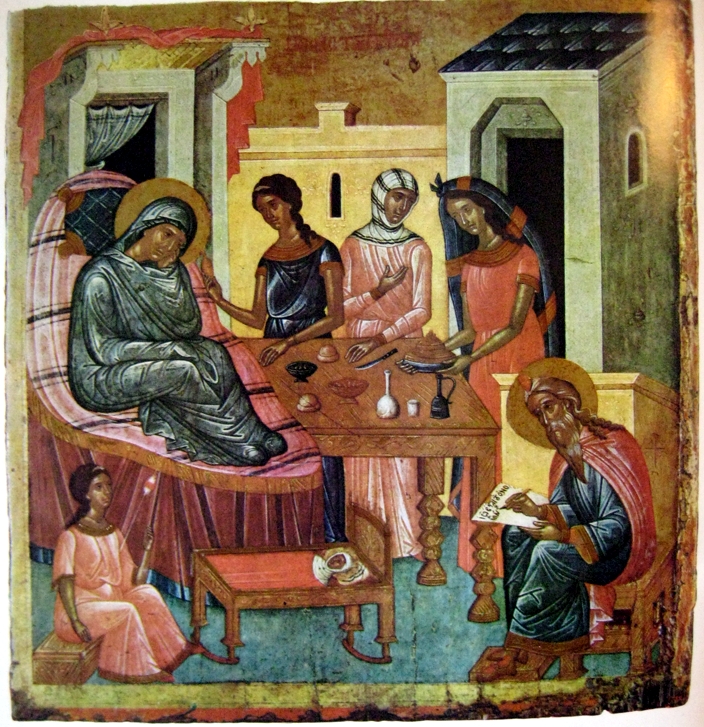
The Nativity of the Forerunner is a standard and abundant icon type, and it is compositionally a near-twin of the Nativity of the Theotokos — so much so that the two are regularly mislabelled in museum catalogues and in online reproductions, and no image should be identified as one or the other without a decisive marker. The shared scheme is the Byzantine birth of a saint: the mother reclining on a great bed in the upper register, attendants approaching with dishes and vessels, a screen of architecture behind, and in the lower register the bathing of the infant in a basin with a midwife testing the water, and the child again in a cradle.
What distinguishes the Forerunner's Nativity — and the only feature that reliably does — is Zachariah. He is shown haloed, an old man in priestly dress, seated apart at one side with a writing-tablet or scroll on his knee, in the act of writing "His name is John." In the Theotokos's Nativity the father, Joachim, is either absent or looks on from a gallery, and never writes. Secondary markers, less reliable: the Forerunner's Nativity may add a scene of Elizabeth fleeing into the mountain with the infant, or of the mountain opening to receive her, in a border or a corner; Elizabeth is usually painted older and more gaunt than Anna. In Greek practice the icon carries the inscription Η ΓΕΝΝΗΣΙΣ ΤΟΥ ΠΡΟΔΡΟΜΟΥ, in Slavonic Рождество Іоанна Предтечи.
The stored primary image is a fifteenth-century Byzantine panel in the State Hermitage Museum, St Petersburg. Its identity is beyond doubt on the criterion above: at the lower right the haloed Zachariah sits on a low seat, in the blue-green mantle, bending over a tablet in both hands and writing the name; Elizabeth reclines at the left on a red couch with four handmaids at a laden table, and beneath her the swaddled child lies on a low bench while a maidservant sits with a fan at the bed's foot. It is the classical recension of the type. The variant stored beside it is a Greek panel of 1848 signed by Dimitrios Lambou, from the collection published by the National Archive of Greece: the same scheme in a late, Italianate-influenced idiom — Elizabeth on a curtained bed, Zachariah enthroned at the right in a jewelled priestly mitre with the unrolled scroll across his knees, and in the foreground the washing of the child in a golden basin, with the cradle at the corner — under the gold-ground inscription Η ΓΕΝΝΗΣΙΣ ΤΟΥ ΠΡΟΔΡΟΜΟΥ, which settles the identification independently of the composition.
One further candidate was examined and rejected: a late-sixteenth-century panel in the Historical Museum at Sanok, Poland (inv. MHS/S/3413), catalogued as Narodzenie św. Jana. The museum's attribution may well be right, but the panel has lost its entire right-hand third — precisely the register in which Zachariah and his tablet would stand — and it bears no legible inscription, so that nothing visible in the image distinguishes it from a Nativity of the Theotokos. On the rule that an icon of this subject must be positively identified and not merely credibly labelled, it is not stored.
Disputed questions
- The historical date of the birth. Nothing in the sources fixes it. June 24 is a computation from Luke 1:26 anchored to December 25, not an anniversary; and December 25 is itself a fourth-century determination whose own basis (the paschal-computus reckoning of the conception, or the appropriation of the dies natalis Solis Invicti, or both) is still debated. The feast dates the interval, which is scriptural, and not the year, which is not.
- The order of dependence. Because September 23, December 25 and June 24 all fall out of March 25 together, it is disputed which of the four dates was fixed first — the older view derives all from the Nativity of Christ, while a strong strand of modern scholarship argues that March 25 (as the day both of the Annunciation and, in an old reckoning, of the Passion) was the anchor and the rest were computed from it. Either way the arithmetic, and the feast, are unaffected.
- Was Zachariah deaf as well as mute? The Greek of Luke 1:20 says only sōpōn kai mē dynamenos lalēsai, "silent and unable to speak"; but at the naming the neighbours make signs to him (1:62), which most of the Fathers take to mean he could not hear either — Gabriel's word having bound both the organ of unbelieving speech and the organ that had failed to hear. The hymnography follows the stricter reading; the text does not require it.
- The place of the birth. The Gospel says only "a city of Juda" in the hill country (Luke 1:39). The Byzantine synaxaria and the OCA's Lives say Hebron; the Latin tradition and the surviving shrine say Ain Karim, west of Jerusalem, where the church of St John in the Mountains stands over the traditional house of Zachariah, with the church of the Visitation on the opposite slope. Neither is demonstrable; the divergence is recorded here rather than resolved, as the project's constitution requires.
- The rank of this feast against the Forerunner's other days. The Forerunner's entry in this collection assigns his primary feast to June 24 — the oldest and most solemn day devoted purely and festally to his person — while the Synaxis file argues the January 7 case. The divergence between the two files is deliberate and is discussed in both: January 7 is his principal day in the order of the church year but is by nature an appendage of the Theophany; June 24 is the day that is his own. No third position is asserted.