
John the Iberian
Our Venerable Father John the Iberian, the Athonite, father of Euthymius and founder of the Monastery of the Iberians
Venerable · d. c. 1002–1005, at Iviron on Mount Athos
Commemorated 13 May — Commemoration with the Georgian fathers of Iviron
John the Iberian — called in the Greek notices Varasvatse, in Georgian Ioane Mtatsmindeli, "John of the Holy Mountain" — was a Georgian magnate of the tenth century, counsellor of David III Kuropalates of Tao, toparch of Iberian Meskhia and holder of a Byzantine dignity, who abandoned rank, house and family for the monastic life on Mount Olympus of Mysia. Having become a monk he recovered from Constantinople his young son Euthymius, whom his prince had given to the emperor as a hostage, and brought him to Mount Athos, where the two entered the Great Lavra of Saint Athanasius. Around John the Georgians of the Mountain gathered, and out of that gathering came the Monastery of the Iberians (Iviron), of which he is honoured as spiritual father and first abbot. He reposed at Iviron about 1002–1005, and is commemorated on May 13 with his son and the other Georgian fathers of the Holy Mountain.

The magnate of Tao
John belonged to the Georgian aristocracy of Tao-Klarjeti, the southern march that was in his lifetime the political and cultural heart of the Georgian lands. The Greek synaxaristes gives him the surname Varasvatse (Varazvache) and describes his standing precisely: counsellor of the ruler of Iberia, David the Kuropalates; toparch of Iberian Meskhia; and a title-holder of Byzantium — that is, a Georgian lord who also carried an imperial dignity, of the sort the empire conferred on the princes of its Caucasian frontier. He was married and had at least one son. He was, in the world's terms, at the height of his career.
He left it. "Disenchanted with the things of this world," in the words of the notice, he withdrew to become a monk on Mount Olympus of Mysia in Bithynia, the mountain of monasteries that had formed Theodore the Studite's generation and was still, in the tenth century, the school of Byzantine asceticism. He went as a private man, without his rank; the Georgian tradition treats this renunciation, and not any later achievement, as the act by which he became a saint.
The recovery of his son
But he had left a child behind, and the child was not free. Euthymius, his son, had been given over by David Kuropalates to the emperor at Constantinople as a hostage for his prince's loyalty — the ordinary coin of Byzantine–Georgian diplomacy. John obtained the boy's release and took him from the capital.
The tradition preserves the contest that followed. The child's maternal grandfather claimed him back for the family, and the case came before the emperor Nicephorus Phocas (963–969), who would not decide between a father and a grandfather and put the choice to the boy himself. Euthymius chose his father. It is a scene worth pausing over: the whole subsequent history of Georgian letters, and the transmission of Barlaam and Josaphat to Europe, turns on a child's answer in an imperial audience.
Athos, and the gathering of the Georgians
Father and son went to the Holy Mountain and were received into the Great Lavra of Saint Athanasius the Athonite, then in its first generation and the model of coenobitic life on Athos; John's own ascetic reputation and his standing among his countrymen drew Georgians to him, and a Georgian community formed around him inside the Lavra's orbit.
Two things then made a monastery of it. The first was John's kinsman Tornike Eristavi — the Georgian general who had also taken the habit at the Lavra as the monk John-Tornike, was called out of the cloister at the empire's need to lead David Kuropalates' Georgian troops against the rebel Bardas Skleros, and came back victorious with the imperial gratitude and the means to build. The second was John's son Euthymius, who saw that the ground granted to the Georgians within the Lavra could not hold them and resolved on an independent house under the direct protection of the emperors. On the site of the older foundation "of Clement" there rose the Monastery of the Iberians — Iviron — which John governed as its first hegoumenos and spiritual father, and which remains to this day the third house in the hierarchy of Athos and the monument of the Georgian presence there.
Repose
John reposed at Iviron, full of years, about 1002–1005, and was buried in his own monastery; his son Euthymius, who had already carried the building through, succeeded him in the governance. His Life, written together with that of Euthymius by George the Hagiorite (†1065), is one of the finest works of Georgian hagiography and the source of nearly everything recorded above.
Feast and commemoration
May 13 (church date; New Calendar civil May 13, Old Calendar civil May 26). John is commemorated with the other Georgian fathers of the Holy Mountain — his son Euthymius, George and Gabriel — so that the day serves in the Greek and Georgian books as the synaxis of the founders of Iviron, kept together with the Iberite venerable-martyrs. In the Georgian Orthodox Church he is among the most honoured of the national saints. Because the date of Pascha moves, May 13 falls in some years within the Paschal season and in others after Pentecost, and no fixed seasonal note belongs to the day. He is also numbered among the venerable fathers of Athos in the Athonite synaxis.
Hymns
Troparion — Tone 8 (common of a venerable father)
In thee, O Father, that which is according to the image was preserved exactly: for taking up the cross, thou didst follow Christ, and by thy deeds didst teach us to despise the flesh, for it passeth away, but to care for the soul, a thing immortal; wherefore thy spirit rejoiceth with the angels, O venerable John.
Original translation from the Greek
Kontakion — Tone 2
Leaving rank and rule and the counsels of princes, thou didst take the yoke of Christ upon thy shoulders, O John; and gathering thy countrymen upon the Holy Mountain, thou wast made the father of the house of the Iberians. With thy son Euthymius, pray for us who honour thee.
Iconography
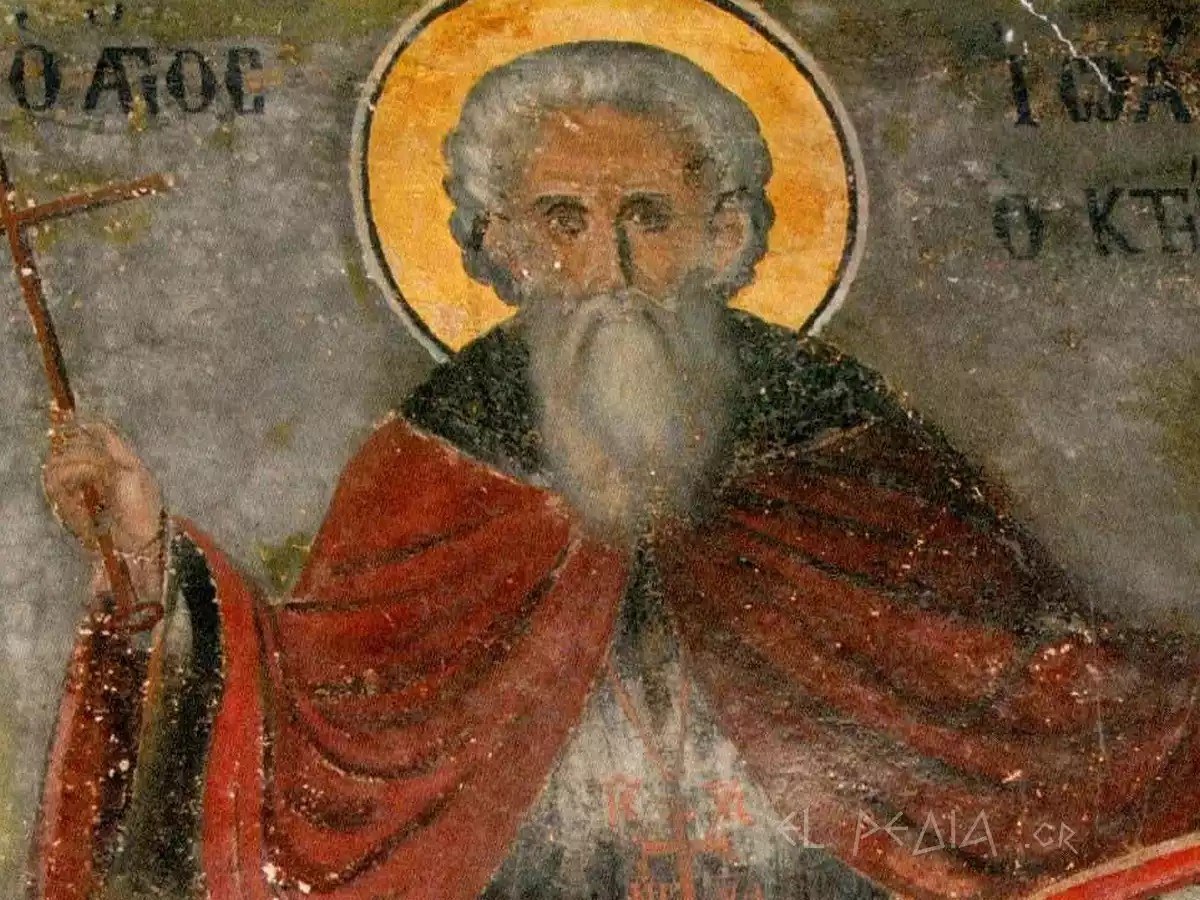
John is painted as an aged monastic father — long white beard, the dark mantle and analavos of the great schema — commonly with the model of the monastery of Iviron in his hands, the attribute of a founder, or with the scroll of a spiritual father. His most characteristic setting is the group of the Georgian Athonite fathers: John with his son Euthymius and with George the Hagiorite, the three shown together and inscribed in Georgian asomtavruli in Georgian foundations from Athos to the Monastery of the Cross at Jerusalem, and in the "radiant Georgians" composition. Where Tornike is included the group becomes four, and Tornike is distinguished by military dress beneath the habit. His feast being in May, the Menologion of Basil II (September–February) contains nothing for him. The stored image resolves the identification problem by its own inscription: a post-Byzantine fresco of the white-haired elder in the schema, cross in hand, inscribed Ο ΑΓΙΟΣ ΙΩΑΝΝΗΣ Ο ΚΤΗΤΩΡ — "Saint John the Founder" — the ktetor-title that on the Holy Mountain belongs to the founder of Iviron and distinguishes this John from every other.
Disputed questions
- The year of repose. The Georgian tradition gives 1005; other reckonings give 1002 or place his death shortly before the completion of the monastery. He is indexed here in the eleventh century, following the later of the transmitted dates, and the range is stated in the frontmatter rather than a false precision.
- First abbot, or founder? The Greek notices of May 13 make Euthymius the κτήτωρ (builder) of Iviron and John the ascetic father around whom the community formed; the Georgian tradition names the three founders together — John, Tornike, and Euthymius — with John as the spiritual head, Tornike as the benefactor and Euthymius as the builder and organiser. The accounts differ in emphasis, not in substance.
- "Monastic martyr." The Orthodox Church in America's list for May 13 styles him "Monastic Martyr John of the Iveron Monastery on Mount Athos." The Greek synaxaria call him Ὅσιος — venerable — and he died in peace in his own monastery; there is no tradition of his martyrdom. The OCA's heading appears to have transferred to the founders the title belonging to the later Iberite venerable-martyrs, killed by the Latins in the same monastery two and a half centuries afterwards, and this entry follows the Greek classification.
- Not to be confused with John-Tornike the general-monk, his kinsman and co-founder, whom some lists also call "John the Iberian"; nor with the many other saints named John of the Athonite and Georgian calendars.