
Euthymius the Iberian
Our Venerable Father Euthymius the Iberian, the Athonite, Translator and Builder of the Monastery of the Iberians
Venerable · Priest · b. c. 955, in Tao — d. 13 May 1028, at Constantinople
Commemorated 13 May — Repose at Constantinople and translation of his relics to Iviron
Euthymius the Iberian (c. 955 – 1028) was a Georgian nobleman's son given as a hostage to Byzantium, who was recovered by his monk father John the Iberian and brought to Mount Athos, and who there became the second and greatest builder of the Monastery of the Iberians (Iviron) and one of the supreme translators in the history of Christian letters. He governed Iviron some fourteen years, then laid down the abbacy in favour of George the Iberian in order to translate: he rendered the Holy Scriptures and more than fifty other works from Greek into Georgian — and, going the other way, put the Georgian Wisdom of Balahvari into Greek, from which it passed into every language of medieval Europe as Barlaam and Josaphat. Fluent in Greek and Georgian both, he was ordained priest and served as epitropos of the Great Lavra. He died at Constantinople on 13 May 1028 after a fall from a startled mule, and his relics were carried back to Iviron. He is not the ninth-century Euthymius the New of Thessalonica, with whom his English epithet is constantly confused.
.JPG)
Hostage of the empire
Euthymius was born about 955 in Tao (Tayk), the southern Georgian march, into the high nobility of Iberia. His father, John — called in the Greek notices Varasvatse, in Georgian Ioane — was a counsellor of David III Kuropalates, ruler of Tao and the greatest Georgian prince of the age, and himself toparch of Iberian Meskhia and holder of a Byzantine title. Byzantium and Iberia were bound in that generation by a diplomacy of hostages, and the boy Euthymius was handed over by David to the emperor and taken to Constantinople as a pledge of his prince's loyalty.
Meanwhile his father, "disenchanted with the things of this world," left rank and family and went to be a monk on Mount Olympus of Mysia in Bithynia, the great monastic mountain of the age. Having become a monk, John set about getting his son back. He obtained the boy's release from the capital and took him — and here the tradition preserves a scene of some human sharpness. The child's maternal grandfather claimed him for the family, and John claimed him for God; the dispute went before the emperor Nicephorus Phocas (963–969), who declined to decide it himself and put the choice to the boy. Euthymius chose his father, and with him the monastic life. That choice made by a child in the presence of an emperor is the beginning of everything that follows.
Athos and the founding of Iviron
Father and son went to the Holy Mountain and were received into the Great Lavra of Saint Athanasius, then newly founded and the model of the coenobitic life on Athos. Georgians began to gather around John, and the Lavra's hospitality had limits: the ground allotted to the Iberians was insufficient for the numbers coming to them. It was Euthymius who resolved that the Georgians must have a house of their own, independent and placed under the direct protection of the Byzantine emperors rather than under any other monastery. The site chosen was the older foundation "of Clement," on the north-eastern shore of the peninsula; rebuilt and endowed, it became the Monastery of the Iberians — Ἰβήρων, Iviron — the first great non-Greek house of Athos and to this day the third in the hierarchy of the Mountain.
The building was made possible by the family's other great figure, Tornike Eristavi — the Georgian general who had become the monk John-Tornike at the Lavra, was called out of the cloister to lead David Kuropalates' Georgian army against the rebel Bardas Skleros, and returned with the imperial gratitude and the spoils that endowed the new monastery. Iviron thus rose out of a combination almost unique in monastic history: a soldier's victory, a father's asceticism, and a son's administrative nerve.
Euthymius governed Iviron as abbot for some fourteen years. He rebuilt and extended churches, raised hospitals and hermitages, and gave the community the shape and the imperial charters it kept for centuries. He was ordained priest, and served the Great Lavra as its epitropos — guardian or trustee — so that his authority was felt beyond his own walls; the Athonite tradition credits him with miracles, among them the giving of rain in a drought at the prayer of the brotherhood.
The translator
Then he did the thing for which the Church chiefly honours him: he resigned the abbacy, handing Iviron to George the Iberian, and gave the rest of his life to translation.
Euthymius was perfectly bilingual — brought up from infancy in Greek at Constantinople, Georgian at home — and he used that accident of a hostage's childhood to refound the literary language of his own nation. He translated into Georgian the Holy Scriptures and, by the count of the tradition, more than fifty further works: the Gospels and Psalter, liturgical books, the Fathers, ascetic and canonical texts, the Great Horologion, homilies of Basil, Gregory, Chrysostom and John of Damascus. He is credited with introducing into Georgian use the Constantinopolitan liturgical order, so that his labour was not only literary but liturgical: he reset Georgian worship on the Byzantine pattern.
His most famous single work went in the other direction. He put into Greek the Georgian Balavariani, the Wisdom of Balahvari — the tale of the king's son converted by a hermit which is, in its remotest origin, a Christianised recasting of episodes from the life of the Buddha. From Euthymius' Greek came the immensely popular Byzantine romance of Barlaam and Josaphat, and from that the Latin, and from the Latin every vernacular of Western Europe; the story is one of the half-dozen most widely diffused narratives of the Middle Ages, and the channel through which it reached Christendom was the pen of a Georgian monk of Athos. This repository's entry on Barlaam and Josaphat treats the tale itself.
Repose and relics
Called to Constantinople on the affairs of his monastery, Euthymius met his death in the street: his mule was startled, he was thrown, and he died of the fall on 13 May 1028. The brethren carried his body back to the Holy Mountain, and his relics were laid at Iviron, in the church of Saint John the Forerunner beside the katholikon, where they remain. His Life was written a generation later by George the Hagiorite (†1065), abbot of Iviron and himself the next great Georgian translator, who had it from those who had known him: a hagiography of unusual sobriety and precision, and the foundation of everything reliable that is known about him.
Feast and commemoration
May 13 (church date; New Calendar civil May 13, Old Calendar civil May 26), the day of his death at Constantinople. He is commemorated with the other Georgian fathers of the Holy Mountain — John, George and Gabriel — so that May 13 functions in the Greek and Georgian books as the synaxis of the founders of Iviron; the Iberite venerable-martyrs are kept on the same day. In the Georgian Orthodox Church he is a saint of the first rank, the patron of translators and of the Georgian literary tradition. Because the date of Pascha moves, May 13 falls in some years within the Paschal season and in others after Pentecost, and no fixed seasonal note belongs to the day. He is also honoured among the venerable fathers of Athos in the Athonite synaxis.
Hymns
Troparion — Tone 8 (common of a venerable father)
In thee, O Father, that which is according to the image was preserved exactly: for taking up the cross, thou didst follow Christ, and by thy deeds didst teach us to despise the flesh, for it passeth away, but to care for the soul, a thing immortal; wherefore thy spirit rejoiceth with the angels, O venerable Euthymius.
Original translation from the Greek
Kontakion — Tone 2
Thou didst turn the tongue of the Greeks into the speech of thine own people, and didst give the Scriptures and the Fathers to Iberia, O wise Euthymius; builder of the house of the Iberians and lamp of the Holy Mountain, cease not to intercede for those who honour thee.
Original translation from the Greek
Iconography
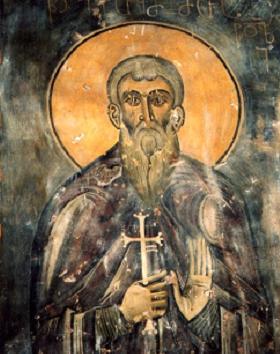
Euthymius is painted as a monastic father of middle to advanced age, with a broad, tapering grey beard, in the dark mantle and analavos of the great schema, either blessing, or holding a scroll or codex — the attribute of the translator, and the surest way of telling him from other Athonite fathers — or holding the cross of the monastic confession. In Georgian and Athonite programmes he is grouped with his father John and with George the Hagiorite as the three "radiant Georgians," and the group appears in Georgian foundations from Athos to the Monastery of the Cross at Jerusalem; at Iviron he is naturally shown with a model of the monastery. His inscriptions are in Georgian asomtavruli where the programme is Georgian, and in Greek on Athos. Because his feast falls in May, the Menologion of Basil II (September–February) is no source for him.
The stored image is the twelfth–thirteenth-century fresco of Saint Euthymius of Athos from the monastery of Akhtala, in present-day Armenia — a foundation whose painted programme is Byzantine and Georgian and includes the Georgian Athonite fathers, and whose figures carry asomtavruli Georgian inscriptions, the letters visible at the upper right of the panel. He appears as an elderly monastic with a full grey beard, in the schema, holding the cross before his breast in both hands. The identification rests on that Georgian inscription as read in the cataloguing of the image; it is recorded here rather than concealed, since Akhtala's programme also contains other Georgian monastic figures.
Disputed questions
- Not to be confused with Euthymius the New of Thessalonica. This is the single most persistent error attaching to this saint, and the reason for the epithet used in this entry. The English calendars call the Georgian "Euthymius the New," which is also the standing epithet of Euthymius the New of Thessalonica (c. 823–898), the Galatian stylite and deacon who founded Peristerai and was among the earliest named ascetics of Athos, commemorated October 15. Both men are called "the New," both are Athonite, and both have a claim to be called a father of Athonite monasticism — but they are separated by 130 years, by nation, and by everything else: the Thessalonian was a Galatian soldier who became a deacon and refused higher orders, the Iberian a Georgian nobleman's son who became a priest, an abbot and a translator. A third Euthymius, the Athonite new-martyr (†1814) commemorated on May 1 with Ignatius and Acacius, is also sometimes styled "the New." Where an English source says only "Euthymius the New," the feast day decides: October 15 is the Thessalonian, May 13 the Iberian, May 1 the new-martyr.
- The year of repose. The Georgian tradition, the Athonite tradition and the Slavic calendars agree on 1028. Some modern reference works give 1024 (and his birth as c. 955 or c. 963). The day, 13 May, is not in doubt, and the feast is the day of his death.
- Founder or second founder of Iviron? The Greek notices call Euthymius κτήτωρ — builder or founder — of Iviron, and the OCA's heading calls him its founder outright; the Georgian tradition gives the foundation to the three together, John, Tornike and Euthymius, with John as the spiritual father, Tornike as the benefactor whose campaign paid for it, and Euthymius as the one who conceived an independent house and carried the building through. All three accounts describe the same events with a different emphasis, and the disagreement is one of honour, not of fact.
- "Monastic martyr"? The Orthodox Church in America's May 13 list styles the Georgian Athonite fathers John, George and Gabriel "monastic martyrs," which the Greek synaxaria do not: they are ὅσιοι, venerable, and died in peace. The martyrs of Iviron are a distinct and later company, treated in this collection as the Iberite venerable-martyrs.