
Sabbas of Storozhevsk
Our Venerable Father Sabbas, Abbot of Storozhev, Wonderworker of Zvenigorod
Venerable · Wonderworker · d. December 3, 1406
Commemorated 19 January — Uncovering of the relics, 1652, 3 December — Repose, 1406
Sabbas of Storozhevsk (Savva of Zvenigorod, †1406) was one of the first and closest disciples of Sergius of Radonezh, tonsured by him in his youth at the Trinity Lavra, where he later served as father confessor to the whole brotherhood and, for a time, as Sergius's successor in the abbacy. At the request of Prince Yuri of Zvenigorod, whose spiritual father he was, he withdrew about 1398 to a wooded hill called Storozhi above the Moskva river and there founded the Savvino-Storozhevsky monastery, which became one of the great houses of Muscovite Russia. A man of extreme silence, simplicity, and humility, he was glorified as a wonderworker; his incorrupt relics were uncovered in 1652. He is commemorated on December 3.

Disciple of Saint Sergius
Little is recorded of Sabbas's origins; the sources take up his story already within the walls of the Trinity monastery, where "in his early youth" he forsook the world and received the monastic tonsure from Sergius of Radonezh himself, becoming one of that first generation of disciples who carried the Radonezh spirit across northern Russia. He was, even among them, a man marked by an extraordinary love of silence: he shunned conversation, wept over what he called the poverty of his soul, lived in constant bodily labour, ate coarse food, wore rough clothing, and trembled, the old Life says, before the judgment of God. Yet this hidden severity bore a wisdom others sought out, and Sabbas was appointed the spiritual father and confessor of the entire Trinity brotherhood — "a venerable and most learned elder."
When the Grand Prince Demetrius Donskoy built a monastery of the Dormition of the Mother of God on the Dubenka river in thanksgiving for the victory over the Tatar Mamai at Kulikovo (1380), it was Sabbas whom Sergius blessed to be its first abbot. He governed it in the same ascetic simplicity, and after the repose of Saint Sergius (1392), when the new abbot Nikon of Radonezh withdrew for a season into seclusion, the brethren of the Trinity Lavra turned to Sabbas and asked him to take up the abbacy of the mother house. He shepherded the flock, the tradition says, "to the best of his ability, helped by the prayers of his spiritual father"; the well that stood outside the Lavra walls was remembered as dug in his time.
The founding of Storozhevsk
Sabbas's abbacy of the Trinity Lavra was brief. Prince Yuri (George) Dmitrievich of Zvenigorod, a son of Demetrius Donskoy and godson of Saint Sergius, held the elder in deep love, chose him as his spiritual father, and begged him to come and bless his household. Sabbas hoped to return to his own monastery, but the prince pressed him to remain and to establish a new house in his patrimony, near Zvenigorod, on a hill called Storozhi ("the watch-post") above the Moskva. Praying in tears before an icon of the Mother of God — whose protection he entreated for that wild place — Sabbas consented. He raised a small wooden church in honour of the Nativity of the Most Holy Theotokos and a cell beside it, and about the year 1398 gathered the monastery that would bear his name.
He built it, as he had lived, with his own hands: digging a well at the foot of the hill and carrying the water up on his shoulders, encircling the community with a wooden palisade, and hollowing out for himself a hermit's cell in a ravine above the walls, where he could withdraw into the silence he loved. To all who came seeking a life of stillness and seclusion he opened the gates with paternal love. In 1399 he blessed Prince Yuri to set out on a military campaign, foretelling his victory; the prince's army, the chronicle says, won a swift triumph, and in gratitude a stone church of the Nativity of the Theotokos rose to replace the wooden one — the church in which the founder would be buried. Having appointed his disciple, another Sabbas, as his successor, the elder reposed in great age on December 3, 1406 (some later sources give 1407). The Christ-loving people of Zvenigorod, noble and common, gathered with their sick and infirm for his burial in the church he had built.
Veneration, relics, and later cultus
Veneration began at once: a stream of healings from the grave and repeated appearances of the saint convinced the region that their abbot was numbered among the holy. A letter of 1539 already calls him a wonderworker. The sixteenth-century Life preserves the account of how, near the end of the fifteenth century, Sabbas appeared to Dionysius, the monastery's fourth abbot, with the command, "Dionysius, arise and paint my icon"; and how the abbot, who had never seen him, summoned the aged Elder Habakkuk, who had known Sabbas in youth and confirmed that the vision matched the living man. Another tradition tells of the elder's taming of a wild bear, in the manner of his teacher Sergius. Sabbas was formally numbered among the saints at the Moscow Council of 1547, and his incorrupt relics were solemnly uncovered on January 19, 1652.
The Savvino-Storozhevsky monastery became a favoured royal shrine. Tsar Alexei Mikhailovich venerated Sabbas with special devotion and often went to the house on foot; a celebrated tradition holds that the saint appeared to the tsar during a hunt and saved him from a bear, and Alexei rebuilt the monastery on a magnificent scale. After the relics were seized and desecrated in the upheavals of 1919, the saint's remains were preserved and, in 1998, returned to the monastery in a second uncovering, restoring one of the principal centres of his veneration in Russia.
Feast and commemoration
Sabbas is kept on December 3, the day of his repose, in the Russian service books and by the Orthodox Church in America (Old Calendar civil December 16), within the Nativity Fast; his uncovering of relics of 1652 is a second commemoration on January 19. His veneration is proper to the Russian tradition rather than the universal Byzantine calendar.
Hymns
Troparion — Tone 8
Thou wast shown to be a goodly shoot of the wilderness, O venerable one; for from thy youth thou didst choose the pure life, following thy spiritual teacher, and by his instruction soaring in mind to the things of heaven, thou wast revealed a most wise guide to thy flock. Wherefore Christ hath enriched thee with miracles, as a radiant lamp. Entreat him to save our souls.
Original translation from the Slavonic
Kontakion — Tone 2
Set aflame with longing for the Lord, and shaking off the passions of the flesh by abstinence, thou wast revealed an unsetting luminary of the divine light, enlightening with rays of miracles all who hasten to the shrine of thy relics, O Sabbas our venerable father.
Original translation from the Slavonic
Iconography
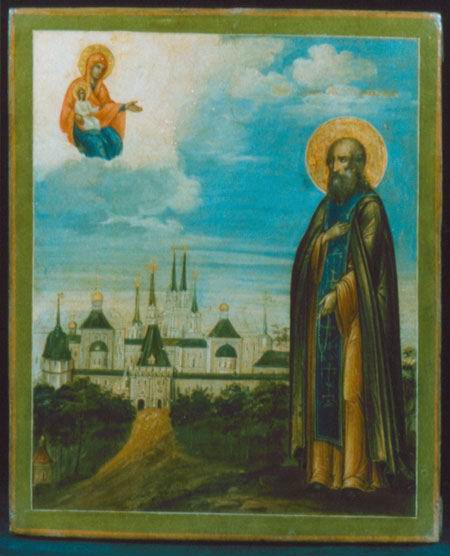
Sabbas is depicted as an aged monastic hierarch of the Russian type: a long, narrow grey beard, the deep-brown mantle and schema of a Great-Schema monk, one hand raised in blessing or holding a scroll. The characteristic full-length icons set him before his monastery on the Storozhi hill, sometimes with the Zvenigorod countryside behind and an icon of the Mother of God appearing in the clouds above — a reference to the Theotokos to whom he dedicated his church and whose protection he besought at the founding. The stored image is a nineteenth-century Russian panel of exactly this type: the saint standing at the right, the walls and cupolas of the Savvino-Storozhevsky monastery below, and the Mother of God enthroned in glory at the upper left.
Disputed questions
- Not to be confused with Sabbas the Sanctified of Palestine (commemorated December 5), the fifth-century founder of the Great Lavra near Jerusalem — the "Saint Sabbas" whose monastery figures in the Life of John the Silent, commemorated on this same December 3 — nor with Sabbas the Serbian (Sava of Serbia) or Sabbatius of Solovki; nor with the two Gothic martyr-Sabbases, Sabbas Stratelates the Roman general (April 24, †272) and Sabbas the Goth the reader of the Danube lands (April 12, †372).
- Not to be confused, above all, with Sabbas of Moscow (†1410, commemorated June 13), the second abbot of the Saviour-Andronikov monastery on the Yauza — the nearest of all the confusions, since the two are contemporaries, both Muscovite abbots of the Sergian tradition, both named Sabbas, and their reposes fall four years apart. That Sabbas was a disciple of Andronicus of Moscow and so at one remove from St Sergius, and never left his own house; this Sabbas was a direct disciple of St Sergius, briefly abbot of the Trinity monastery itself, and the founder of Storozhev at Zvenigorod. Images captioned only Преподобный Савва are far more often of this Sabbas than of the Muscovite abbot.
- The year of repose is given as 1406 in the received Life and by the OCA; some calendars and reference works give 1407. The day (December 3) is not in dispute.