
John the Soldier
The Holy Martyr John the Soldier, at Constantinople
Martyr · Righteous · d. c. 400, Constantinople
Commemorated 29 July — The commemoration as entered in the Greek Menaion, among the secondary notices of the day, 30 July — Commemoration of the soldier who sheltered the persecuted under Julian (Slavic usage)
John was a soldier of the imperial army under Julian the Apostate (361–363), enrolled in a detachment sent to hunt down Christians — and he used the commission to save them. He warned those about to be arrested, opened the way for prisoners to escape, carried help to the imprisoned and buried the dead, all the while passing among his fellow soldiers as a diligent persecutor. When the deception was discovered he was chained and sent to Constantinople to await the emperor's judgment; Julian fell in Persia before the case was heard, and John was released. He spent a long old age in almsgiving, fasting and prayer, and died in extreme age, and was buried among the poor and forgotten. Long afterwards he made himself known by appearing to a devout woman and naming his grave; his relics were taken up and laid in the church of St John the Theologian at Constantinople, where healings followed. In the Slavic world he became the patron of soldiers, the consoler of the sorrowing, and — by a usage as old as it is universal — the saint to whom one prays for the recovery of what has been stolen.
.jpg)
A Christian in Julian's army
The Church's memory of John begins in the shortest and strangest of persecutions. The emperor Julian, nephew of Constantine, raised in the Christian faith and apostate from it, reigned only twenty months (November 361 – June 363), and his campaign against the Church was less a matter of the rack than of pressure, disability and harassment: Christians excluded from teaching, from office and from the courts, temples restored at their expense, mobs given a free hand in the eastern cities. It was carried out largely by soldiers and officials, and among the soldiers detailed to it was John.
The synaxarion places him in a unit of the Taifali, a people of the lower Danube serving in the Roman army, and this is the whole of what is transmitted about his origin; he was a soldier of the empire, and Greek. He was also — secretly — a Christian, and he had been placed in a position where a secret Christian could do more good than an open one.
The double life
What John did is described in the sources with a certain relish. Sent with his company to search out believers, he warned those whose names were on the list, so that they might hide or flee. He let prisoners slip out of custody. He carried food, money and comfort to those already taken; he attended the sick; he buried the bodies of the martyred, which was itself a punishable act. Before his fellow soldiers he played the part of a zealous persecutor, so that the appearance of severity might cover the substance of mercy — the tradition is candid that he dissembled, and honours him for it.
The device could not last. He was denounced, arrested, loaded with irons and sent under guard to Constantinople, where he was thrown into prison to be kept for the emperor's own judgment, which in Julian's reign meant death. From the prison he continued to encourage the confessors shut up with him. But in June 363 Julian was struck down in the Persian campaign, and with him the persecution collapsed; the accession of the Christian Jovian emptied the prisons, and John came out a free man.
The long old age
Here the acta of a martyr would end in a sentence of execution, and John's do not. He was released, and he lived — for many years, the account says, to a great old age — in Constantinople, in a manner the tradition describes with more care than it describes his soldiering: he gave away what he had to the poor, sought out the sick, the imprisoned and the destitute, reconciled the quarrelling, fasted, kept vigil, and prayed. When at last he died, in extreme age, he was buried without ceremony in the burying-ground set aside for strangers and the poor — an unmarked grave among unmarked graves.
The revelation of the grave and the relics
Long after, when no one living remembered him, John appeared in a vision to a pious woman of the city, told her his name and something of his life, and showed her the place where he lay. The grave was opened; the relics were found whole, and were taken up and translated with honour into the church of the Apostle and Evangelist John the Theologian at Constantinople. Healings began at the shrine — the sources speak of the sick restored, of the possessed delivered and of a fragrant myrrh flowing from the relics — and from that translation the veneration of the saint dates. His memory spread from Constantinople through the whole Byzantine world.
Veneration among the Slavs
Nowhere did the cult strike deeper than in Russia, where John the Warrior — Ioann Voin — became one of the most familiar of household saints. Three things are asked of him. He is the patron of soldiers, and the intercessor of those who serve; he is "a great helper of those in sorrow and in hard circumstances," invoked for consolation in grief and injustice; and — most characteristically — he is the saint prayed to for the recovery of stolen property and for the conversion of thieves, a devotion reported in Russia from at least the seventeenth century and unbroken since. Moscow keeps a famous church dedicated to him on Yakimanka, built under Peter the Great, which sheltered relics and icons through the Soviet period. The logic of the third devotion is transparent once his life is remembered: a man who spent Julian's persecution quietly removing prisoners and property from the hands of those who had seized them is a plausible advocate for anyone who has lost something to force or fraud.
Feast and commemoration
July 30 (church date; New Calendar civil July 30; Old Calendar civil August 12) in the Slavic and American usage; July 29 in the Greek Menaion. The day stands in the free season between the Apostles' Fast and the Dormition Fast, which opens on August 1. In the Russian Church his memory carries a full service with proper troparion and kontakion and is widely kept, particularly by the armed forces and by parishes bearing his name; in the Greek and Antiochian books he is a notice without a proper office, the day belonging to the apostles of the Seventy on July 30 and to Kallinikos on July 29.
Hymns
Troparion — Tone 4
Thy martyr John, O Lord, in his contest received an incorruptible crown from thee our God; for possessing thy strength, he cast down the tyrants and shattered the feeble insolence of the demons: by his intercessions save our souls.
Original translation from the Greek
Kontakion — Tone 6
Set to hunt down the sheep of Christ, thou didst shepherd them instead, O John: loosing the bound, comforting the imprisoned and burying the slain, thou wast thyself bound for their sake. Wherefore, having received the crown of thy confession, thou art a ready helper to all who are wronged and in need.
Original translation from the Greek
Iconography
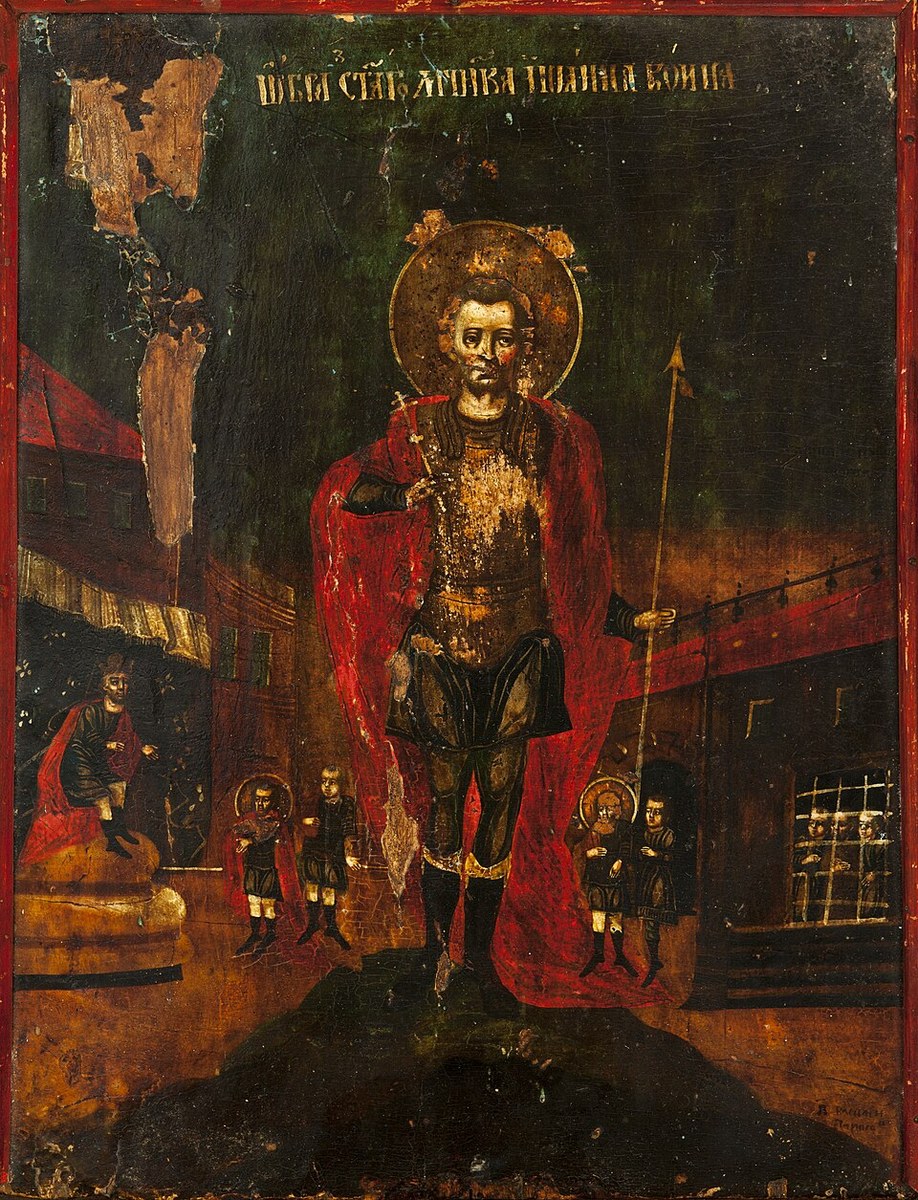
John is painted as a soldier-saint of middle years, with a high forehead, light or dark hair and a short rounded beard, in the tunic, breastplate and boots of a Roman soldier with a broad red cloak clasped at the shoulder. He stands frontally, most often holding the martyr's cross in the right hand and a spear in the left, or a spear and shield; a second and later Russian type dresses him instead in the long patrician robe of a civilian benefactor, sometimes with a scroll. Because his life is a story rather than a single scene, Russian icon-painters favoured the vita icon — the standing figure in the centre framed by small narrative panels: the search for Christians, the loosing of prisoners, the visiting of the imprisoned, his own arrest and chaining, the revelation to the woman, and the finding of the relics.
The stored image is a 17th-century Russian icon now in the National Museum in Kraków (MNK XII-347), inscribed across the top in Church Slavonic Образ святаго мученика Иоанна Воина — "the image of the holy martyr John the Warrior." The saint stands full length in armour and a great red cloak, a spear in his left hand, on a dark ground; to either side, in the same field rather than in separate border panels, are the scenes of his life — a seated official on a dais at the left, small haloed figures being led away, and at the right a barred prison window with two prisoners looking out.
Disputed questions
- Was he a martyr? The calendars call him martyr, and the icons paint him with the martyr's cross; but the transmitted life is explicit that he was released from prison at Julian's death and reposed in peace at a great age. The title in his case honours the confession rather than the manner of death: he was arrested, chained and held for execution for Christ's sake, and only the emperor's death in Persia deprived him of the end he had been given up to. A minority of later retellings, uneasy with the anomaly, make him die in prison; the older synaxarion does not. This repository keeps the calendar's title and records the fact beside it, and classifies him as martyr and righteous together.
- The date: July 29 or July 30? The Greek Menaion enters him on July 29, among the secondary notices of the day whose office belongs to the martyrs Kallinikos and Theodote — "and the commemoration of the blessed John the Soldier." The Slavonic books, and after them the Russian and the American calendars, keep him on July 30 as a principal commemoration with his own troparion and kontakion. Both usages are recorded here, the Slavic date as primary because it carries the fuller office; the Antiochian Archdiocese follows the Greek arrangement of the two days.
- Which persecution? A few later notices transfer him to the reign of Diocletian or of Maximian, drawn by the general pattern of soldier-martyrs; the whole force of the story, however — the pretended zeal, the emperor absent on a Persian campaign, the sudden release — belongs to Julian, and the older tradition is unanimous on that reign.
- Not to be confused with the other soldier-saints of the calendar, and in particular not with John of Egypt, the soldier of Edessa martyred with the unmercenary Cyrus (January 31 and June 28), whose feast is often confused with this one in indexes because both are styled "John the soldier."