
Julia of Carthage
The Holy Virgin-Martyr Julia of Carthage, who suffered in Corsica
Martyr · Virgin · d. c. 440 (some place her in the 7th century), at Nonza in Corsica
Commemorated 16 July — Crucifixion in Corsica
Julia was a Christian girl of a good family of Carthage who lost everything in the sack of her city by barbarians, was sold into slavery, and served a pagan merchant with such patience, chastity and steadiness in prayer and fasting that her master came to prefer her to all his household — and yet could not move her an inch towards his gods. Carried with him on a trading voyage from Syria towards Gaul, she was put ashore, or taken from the ship, at Corsica, where the people were keeping a pagan festival; when she refused to join it and confessed herself a Christian she was tortured and crucified. Monks from a neighbouring island recovered her body; her relics were translated in the eighth century to Brescia in Lombardy, where the great monastery of Santa Giulia bears her name. She is one of the very few Western martyrs kept on the Byzantine fixed calendar, and one of the still fewer women whom the tradition records as dying on a cross. Corsica honours her as its patroness. She is commemorated on July 16 in the East and on May 22 in the West.

Carthage, and the loss of a city
Julia was born at Carthage — the Latin-speaking Christian metropolis of Africa, the city of Cyprian, Perpetua and Felicity and Augustine's Hippo close by — into a family described as noble and Christian. Her childhood ended with the fall of the city. In the standard Western account the disaster is the capture of Carthage by the Vandals under Geiseric in 439, when the wealth of the African aristocracy was carried off and the Catholic population subjected to an Arian conqueror; the Greek synaxaristis follows this reckoning and dates her death to about 440. The Slavonic and English notices that descend from the Russian calendar say instead that she was "captured by the Persians," which is a garbling — Persia never touched Africa — and behind which the Vandals, or in the alternative tradition the Arabs, plainly stand.
Sold with the other captives, she passed into the hands of a pagan merchant of Syria, who is named Eusebius in the Latin passion. She served him as a slave.
The slave who would not be bought
The whole force of her life, as the tradition remembers it, lies in this period of servitude, which lasted years. Julia preserved her virginity, kept the fasts of the Church in a house where nobody kept them, worked without complaint at whatever was set her, and gave to prayer and to the reading of Scripture the hours other slaves gave to rest. Her master, a hard man with no sympathy for her religion, found that her work was better than anyone's and that she could be trusted absolutely; he came to value her above all his people and left off pressing her to sacrifice, contenting himself with occasional mockery. The account is careful on the point: she was not freed, and did not ask to be. She stayed a slave and was a saint in it.
Corsica: the festival, and the cross
Trade took Eusebius by sea towards Gaul, and Julia with him. The ship put in on the coast of Corsica, at a place the local tradition identifies with Nonza on Cape Corse, where the inhabitants — with their governor, whom the Greek notice names Felix — were keeping a festival with sacrifices. The merchant went ashore and took part; Julia refused, and stayed aboard the ship.
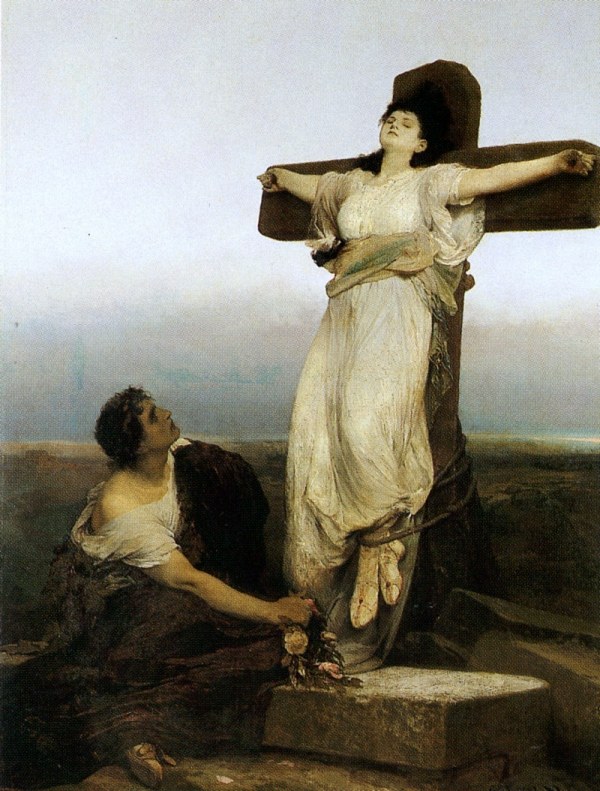
Her absence was noticed. In one version the governor, learning that there was a Christian on board, had her fetched while her master slept off the feast, and offered to buy her from him in order to compel her; in another the crowd simply took her off the ship. Brought before the festival she confessed Christ openly and would not sacrifice. She was struck on the face, her hair was torn out, and, when nothing would make her yield, she was nailed to a cross and so died — a death the calendars underline, since crucifixion is very rarely recorded of a woman martyr.
Relics: Gorgona, Brescia, and the return to Corsica
The body was taken up by monks from the neighbouring island of Gorgona, who crossed for it by night and buried her in their monastery. There her relics rested until the eighth century. About the year 763 they were translated to Brescia in Lombardy — the tradition attributes the translation to the Lombard king Desiderius and his queen Ansa — and laid in the royal nunnery of San Salvatore, which from that time was called Santa Giulia, and which survives as the great monastic complex and museum of the city. A portion of the relics was returned to Corsica in the twentieth century, to the church at Nonza built over the traditional site of her passion, where a spring is shown that the local memory associates with her death.
Corsica keeps her, with Devota, as one of the two patronesses of the island; Brescia keeps her as a patroness of the city; and in the Byzantine calendars she is one of a small handful of Western martyrs — with Felicity of Rome, Julitta, and the martyrs of Lyons — whose memory passed into the Greek synaxaria and so into the Slavonic and Antiochian books.
Feast and commemoration
July 16 (church date; New Calendar civil July 16, Old Calendar civil July 29). Julia is listed on this day in the Greek synaxaristis, the Slavonic menologia and the calendars derived from them, among the martyrs of the day and after Athenogenes of Pedachthoe and Antiochus the Physician. She has no proper office in the Byzantine books; the common of a woman martyr is sung. In Corsica and at Brescia her feast is kept with a proper Latin office on May 22, with processions and — at Nonza — a pilgrimage to the spring; the Orthodox parishes of Italy and France have taken up her commemoration on the Byzantine date, one of the small number of pre-schism Western saints whose cultus has been revived in the Orthodox West.
Hymns
Apolytikion — Tone 4
Thy lamb Julia crieth out to Thee with a loud voice, O Jesus: I love Thee, my Bridegroom, and in seeking Thee I contend; I am crucified with Thee, and buried with Thee in Thy baptism; I suffer for Thy sake, that I may reign with Thee; I die for Thee, that I may live in Thee. Receive me as a spotless sacrifice offered to Thee in love; and by her prayers, O merciful One, save Thou our souls.
Iconography
Julia is shown as a young woman, uncovered or lightly veiled, in the maiden's tunic and mantle, holding the cross of martyrdom — which in her case is not only the ordinary attribute of a martyr but the instrument of her death. The distinguishing type, common in Corsican and Lombard art and rare anywhere else, gives her crucified, clothed and upright on the cross with her hair loose, sometimes with a palm placed in her hand by angels; a subsidiary scene may show the ship at anchor offshore and the monks of Gorgona carrying away her body. At Brescia she is painted as the patroness of the abbey, crowned and holding a model of the church.
No pre-1900 image of her has been stored for this entry. The one Byzantine-style candidate found on Wikimedia Commons is a photograph of the statue and painting of her martyrdom in the Catholic church at Nonza: the photograph is offered under a Creative Commons licence by the photographer, but the licence is the photographer's alone, and the underlying statue and painting are of undetermined and probably modern date, so their maker's rights are untouched by it — the image is accordingly not storable under the icon policy of this corpus. The Western engravings of her in the Wellcome collection are old enough to be free of copyright but are devotional prints of the Latin tradition rather than icons, and none has been adopted here.
The stored image is a Western work per §34: Gabriel von Max's painting of the crucified martyr of Corsica (1866). An Eastern image remains wanted and is listed among the upgrade-wanted icons.
Disputed questions
- Fifth century or seventh? The two datings turn on which conquest of Carthage carried her off. The older Western tradition, followed by the Greek synaxaristis, makes it the Vandal capture of 439 under Geiseric, putting her death about 440 and her relics at Gorgona for three centuries before the translation. A second tradition, reflected in the Slavonic and American calendars' cautious "fifth or seventh century," attaches her captivity to the Arab conquest of Africa at the end of the seventh century, which would compress the interval before the translation of 763 to a couple of generations and would suit the documentary record of the translation better. The corpus indexes her under the fifth century, as the majority tradition, and records the alternative here.
- "Captured by the Persians." The phrase in the widely-circulated English notice has no historical content; it is a corruption in transmission of the barbarian invaders of Africa — Vandals in the older account, Arabs in the later one.
- Julia of Corsica and Julia of Carthage are one. The Byzantine calendars name her from her birthplace and the Western from the place of her passion; the Latin passio, the Greek synaxarion and the Slavonic notice tell the same story, and the double title has occasionally been mistaken for two saints. She is distinct from the Julitta of Caesarea and from the mother of the child-martyr Cyricus, from Julia the companion of Quadratus, and from the Roman Julia greeted in the sixteenth chapter of the Epistle to the Romans.
- The two feasts. The East keeps her on July 16, the West on May 22 (in some Italian and Corsican usage May 23, or the translation on the Sunday after). The corpus follows the Byzantine date as the church date and records the Western observance here.