
Juliana of Lazarevo
Our Holy and Righteous Mother Juliana of Lazarevo, the Merciful
Righteous · b. c. 1530, near Murom — d. January 2, 1604, Lazarevo
Commemorated 2 January — Repose at Lazarevo (1604)
Juliana of Lazarevo (c. 1530–1604), called the Merciful, is the great Russian saint of the married state and of works of mercy — a noblewoman of the Murom country, wife of the landowner George Osorgin and mother of many children, who sanctified an ordinary life in the world by ceaseless charity, fasting, and night-long prayer. She gave away all she had to the poor and the sick, tended the plague-stricken, and in the terrible famine at the turn of the seventeenth century sold everything, even to her own goods, to feed the hungry, baking bread of bark and orach that in her hands (the tradition says) tasted sweet. She reposed on January 2, 1604; her relics were found streaming with fragrant myrrh in 1614. Her Life, written by her son, is a landmark of old Russian literature — a rare biography of a laywoman saint by one who knew her — and she is honoured as the pattern of holiness attainable in family life. She is commemorated on January 2, within the forefeast of the Theophany.

Origins and early life
Juliana was born about 1530, the daughter of Justin Nedyurev, a chamberlain at the court of the tsar. Orphaned young — her mother died when she was six, her father soon after — she was raised by her grandmother and then by an aunt in the district of Murom, on the Oka. From childhood she was drawn to prayer, fasting, and stillness, and to the needlework by which, even as a girl, she clothed the poor: while her kinswomen mocked her gravity, she gave herself in secret to vigils and to sewing garments for orphans, widows, and the sick of the neighbourhood.
Marriage and household
At about sixteen she was married to George (Georgy) Osorgin, a well-born landowner whose estate lay at the village of Lazarevo, near Murom — whence her name. She proved a model wife and mistress of a great household: obedient and gentle to her husband and his parents, just and kind to the servants, and unwearied in the ordering of the estate. She bore many children (the tradition counts thirteen, of whom several died young), and bore the griefs of the household — including the violent death of two sons — with faith. Through all the demands of family and estate she kept a hidden ascetic life: rising for prayer in the night, sleeping little and hard, wearing no comforts, and turning the produce and the needlework of the house toward the relief of the poor. When her husband was away in the tsar's service, she gave herself the more freely to prayer and almsgiving.
Works of mercy and the great famine
Juliana's charity was the marvel of the country. She sought out the destitute, the sick, and the imprisoned; in a time of plague, when others shut their doors, she secretly washed and tended the bodies of the dead and cared for the stricken. Her greatest trial and her greatest glory came in the famine of 1601–1603, under Tsar Boris Godunov, when failed harvests brought starvation across Russia. Juliana sold her cattle, her goods, and at last her very household stuff to buy bread for the hungry; when nothing remained, she had her servants bake bread from the bark of trees and from orach (goosefoot), and this bread — the Life relates — was found sweet in the mouths of those she fed, so that the poor said the widow of Lazarevo baked sweeter bread than the rich, and would not believe it was made of bark. She gave away all, and kept nothing for herself.
Widowhood and repose
After the death of her husband George, Juliana intensified her ascetic life, giving herself wholly to prayer, fasting, and the poor, and longing for the monastic tonsure she was never able to receive. Worn by her labours and her charity, she fell ill at the end of 1603 and, having communed of the Holy Mysteries and blessed her children, reposed on January 2, 1604, at Lazarevo. Those present, the Life says, saw a golden crown about her head, and a fragrance filled the house.
Relics and veneration
Juliana was buried beside her husband at the church of Saint Lazarus in Lazarevo. In 1614, when a grave was being opened nearby, her coffin was found, and her relics were discovered incorrupt and streaming with fragrant myrrh, which healed the sick who were anointed with it; from that time she was venerated as a saint of the Murom country, and her veneration spread through the Russian Church. Her memory owes much to the Life composed by her son Kallistrat (Druzhina) Osorgin in the early seventeenth century — a work treasured both as hagiography and as literature, one of the earliest and most vivid Russian biographies of a laywoman, and a chief witness to the holiness possible in marriage, motherhood, and the management of a worldly estate.
Feast and commemoration
Juliana is kept on January 2 (church date; Old Calendar civil January 15), the day of her repose in 1604, within the forefeast of the Theophany; the Russian and OCA calendars keep her, styled righteous (pravednaya) and "the Merciful." The uncovering of her relics in 1614 is also remembered in the Russian tradition. She shares the day with the great elder Seraphim of Sarov and with Silvester of Rome.
Hymns
Troparion — Tone 3
Taking up thy cross upon thy shoulder, thou didst follow Christ in almsgiving, in fasting, and in prayer, O all-praised and merciful Juliana; and to all who live in the world thou wast shown to be a rule of life. Wherefore, having inherited the Kingdom on high, pray thou unceasingly that our souls may be saved.
Original translation from the Slavonic
Kontakion — Tone 8
Let all of us who are beset by troubles and sicknesses sing the praises of holy Juliana, the helper swift to hear; for she lived in the world in a manner pleasing to God and showed boundless mercy to the poor — wherefore, by the providence of God, she found the grace of wonders.
Original translation from the Slavonic
Iconography
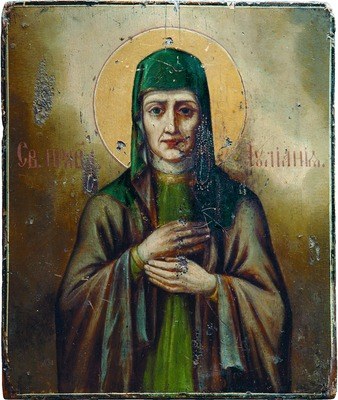
Juliana is depicted as a Russian noblewoman-saint of the old style: standing in prayer in the long robe and married woman's headdress of sixteenth-century Muscovy, a scroll or her hand raised in prayer, sometimes with loaves or with the poor she fed at her feet, in token of her mercy — the image of the righteous laywoman rather than the nun. The stored image is a Russian icon of the 1870s of the righteous mother of Murom.
Disputed questions
- Not to be confused with the ancient virgin-martyrs of the same name — Juliana of Nicomedia (†c. 304, kept December 21) and the martyr Juliana who suffered with Cyrenia in Cilicia (†c. 305, kept November 1). Juliana of Lazarevo is a Russian righteous laywoman of the seventeenth century, glorified not by martyrdom but by a life of mercy in the world.
- The genre of her Life. The Life by her son is written with an intimacy and a domestic detail unusual in the hagiographic tradition, and scholars value it as much for its picture of Russian household and social life around 1600 — the famine, the estate, the family — as for its record of her sanctity; the two purposes are woven together, and the historical detail is unusually secure for a saint's Life.