
Juliana of Nicomedia
The Holy Virgin-Martyr Juliana of Nicomedia
Martyr · Virgin · d. c. 304
Commemorated 21 December — Martyrdom at Nicomedia
Juliana of Nicomedia (†c. 304) is the virgin-martyr who broke off her marriage to save her chastity for Christ. The daughter of a pagan noble named Africanus, she was betrothed as a child to Eleusius, a magistrate of Nicomedia; secretly baptised, she refused to complete the wedding unless her bridegroom became a Christian, and when he would not, she was denounced by her own father and handed to Eleusius for judgment. Beaten, hung by the hair, poured over with molten metal, and — in the celebrated passio — locked in prison where she overcame and bound a demon that came to her disguised as an angel, she was healed of every wound; the crowd who watched, some five hundred men and a hundred and thirty women, confessed Christ at the sight and were beheaded with her. Juliana was executed by the sword about the year 304. She is commemorated on December 21, within the forefeast of the Nativity.

Origins and early life
Juliana was born at Nicomedia in Bithynia, the great administrative city of the eastern empire, in the years of the last and fiercest persecution of the Christians. Her father, named in the passio Africanus, was a pagan of rank and a persecutor of the faith; while she was still a girl he betrothed her to a certain Eleusius (the accounts also spell the name Elusius or Eleusios), a young man of standing who was, or would soon become, a magistrate — an eparch, in the Greek — of the city. Juliana, however, had come to see through what the passio calls "the delusion of the idols," and had received holy baptism in secret, consecrating her virginity to Christ.
Martyrdom
As the day of the wedding drew near she refused to go through with it. To gain time, and to test the sincerity of her suitor, she declared that she would not marry Eleusius unless he first attained a higher office — or, in the fuller form of the story, unless he abandoned the idols and became a Christian. When Eleusius, raised at length to the magistracy, came to claim her and she made plain that only his conversion would satisfy her, both her betrothed and her father turned against her. Africanus, enraged that his daughter would shame the family, urged and then beat her to obedience; failing, he denounced her as a Christian and handed her over to Eleusius to be judged by the law.
Eleusius, still hoping to win her, pleaded with Juliana to relent, promising that he would not compel her to sacrifice if only she would consent to the marriage. She answered that she would sooner die than be joined to a man who would not confess Christ, and the wooing turned to torture. The passio recounts a long sequence of torments from which she emerged each time unharmed: she was scourged at length, hung up by the hair so that the skin was torn from her head, her body burned and poured over with heated metal, and cast bound into prison — yet after every trial she was found healed and strengthened, the wounds closed by the grace of God.
The demon in the prison
The most famous episode of Juliana's passio, and the scene by which she is known in East and West alike, is her contest in prison with a demon. As she prayed in her cell there appeared to her a figure in the likeness of an angel of light, who counselled her — for her own preservation — to yield and offer sacrifice, since God, he said, would not blame her for bowing to necessity. Juliana, discerning the deceit, prayed for light, and a voice bade her seize her visitor and force the truth from him. Laying hold of the demon she compelled him to confess that he was one of the powers of darkness, sent to break her, and he was made to recount at length the works by which he and his kind assail the saints and drag souls to ruin. Having bound and mastered him, she dragged him out with her when she was brought again before the judge, and cast him from her. The disputation with the bound demon — a woman catechising the devil on his own malice — became one of the set-pieces of Byzantine and Anglo-Saxon hagiography.
The five hundred and the hundred and thirty
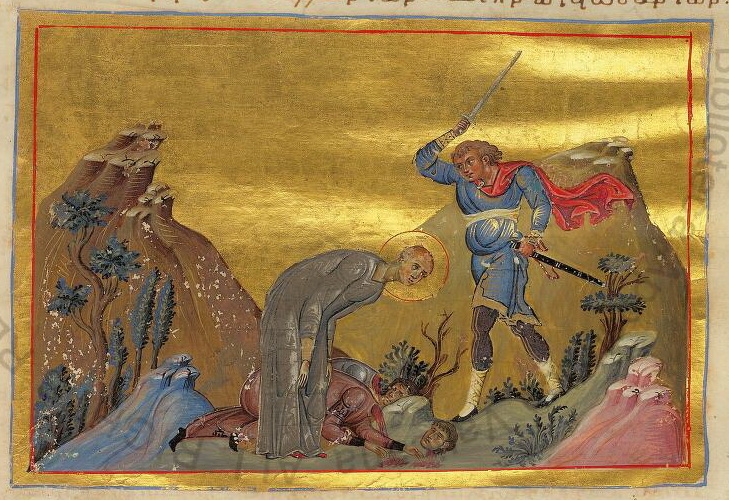
Brought out once more and subjected to fire and to a cauldron of molten lead, Juliana stood unharmed, the flames leaving her untouched and the lead cooling about her like a warm bath. Her punishment was public, staged before a great crowd to terrify the Christians and gratify the pagans; but the sight of the young virgin healed again and again of mortal wounds worked the contrary effect. The tradition relates that five hundred men and a hundred and thirty women in the watching multitude were so moved by her constancy and by the manifest power of God that they cried out in confession of Christ. Eleusius, unable to shake them, had them all beheaded; unbaptised in water, they were, in the words of the synaxarion, "baptised in their own blood." Convinced at last that he could not part the virgin from her heavenly Bridegroom, the magistrate condemned Juliana herself to death. She received the sentence with joy, glorifying God that she was counted worthy of the martyr's crown, and was beheaded by the sword. The year was about 304.
Relics and the Western tradition
Juliana's body was taken up by the faithful of Nicomedia. In the Western tradition her relics were later translated by sea and came at length to Cumae in Campania, and afterward to Naples, where she has long been venerated as Juliana of Cumae; the Roman Martyrology keeps her on February 16, and medieval Latin piety made her a much-loved figure, invoked against sickness and, like other demon-binding saints, against the assaults of the devil. The Orthodox Church keeps her on December 21, the day transmitted in the Greek synaxaria and the Slavic menologia.
Veneration and later cultus
Juliana's cult spread early and widely. In the East her passion was read on her feast and her image entered the great illustrated menologia — the Menologion of Basil II (c. 1000) carries her miniature under December 21. In the medieval West she was among the most popular of the virgin-martyrs, and the Anglo-Saxon poet Cynewulf devoted to her one of his four signed poems, the Juliana of the Exeter Book (late eighth or ninth century), retelling in Old English verse her refusal of Eleusius and her binding of the demon — a witness to how far her fame had travelled from Bithynia by the early Middle Ages.
Feast and commemoration
Juliana's feast is December 21 (church date; Old Calendar civil January 3), within the forefeast of the Nativity of Christ, which begins on December 20. In the Greek Menaion her service is joined to the forefeast hymns: proper stichera and an exaposteilarion of the saint are appointed, together with the common apolytikion of a virgin-martyr, while the kontakion sung on the day is the kontakion of the forefeast. The Slavic books give her, in addition, a proper kontakion in the third tone. The company of martyrs who confessed at her suffering — the five hundred men and the hundred and thirty women — are commemorated with her and have no separate feast. The Roman Church keeps Juliana of Cumae on February 16.
Hymns
Troparion — Tone 4
Thy lamb Juliana, O Jesus, crieth out with a great voice: Thee, my Bridegroom, do I love, and seeking Thee I contend; I am crucified and buried with Thee in Thy baptism, and I suffer for Thee, that I may reign with Thee; I die for Thee, that I may live in Thee. As a spotless sacrifice receive her who with longing was slain for Thee. By her intercessions, as Thou art merciful, save our souls.
Original translation from the Greek
Kontakion — Tone 3
Purified by the graces of virginity, O maiden, and now crowned, Juliana, with the wreath of martyrdom, thou givest healing and salvation to those set in peril and in sickness who draw near to thy shrine; for through thee Christ poureth forth divine grace and life everlasting.
Original translation from the Slavonic
Iconography
Juliana is shown as a young virgin-martyr, richly robed in the manner of a noblewoman of rank, holding the martyr's cross and often a scroll, sometimes crowned. Her distinctive attribute in both Eastern and Western art is the bound demon: she is depicted grasping or leading a small dark figure, or with the devil chained at her feet — the visual sign of the prison contest that made her famous. Narrative cycles show her scourging, her hanging by the hair, and her beheading. The stored image is the miniature of her martyrdom from the Menologion of Basil II (Constantinople, c. 985; Vatican Library), the first-resort menologion source for the saints of the fixed year.
Disputed questions
- The company of confessors. The number of those who confessed at her suffering — five hundred men and a hundred and thirty women — is transmitted by the synaxaria and the OCA; it is the received tradition rather than a documented figure, and the passio itself is a hagiographic composition of the developed type, not a court record.
- Nicomedia and Cumae. The Eastern tradition places her martyrdom and burial at Nicomedia; the Western tradition of Juliana of Cumae carries her relics to Campania and keeps her on February 16. The two are treated as one saint, the divergence being one of the later history of the relics and the calendar day, not of identity.
- Not to be confused with the several other martyrs named Juliana: Juliana of Cilicia, burnt with Cyrenia at Rossos (November 1); the martyr Juliana who suffered beside the great-martyr Barbara at Heliopolis (December 4); and — commemorated on this same day, December 21 — the right-believing princess Juliana of Vyazma and Torzhok (†1406), a Russian saint of wholly different life and age; and the righteous laywoman Juliana of Lazarevo (†1604, January 2), "the Merciful," of Murom.