
Cyrenia and Juliana
The Holy Martyrs Cyrenia and Juliana in Cilicia
Martyr · d. c. 305
Commemorated 1 November — Burnt alive at Rossos in Cilicia under Maximian Galerius
Cyrenia and Juliana (†c. 305) were two Christian women of Cilicia martyred by fire in the persecution of Maximian Galerius. Cyrenia was from Tarsus and Juliana from the city of Rossos; both had given themselves to works of mercy — caring for orphans, comforting poor widows, and tending the sick without fee — and to bringing pagans to Christ by the Gospel and by their own patience. Arrested by Marcian, governor of Cilicia, and refusing to deny Christ, Cyrenia was shorn and paraded naked through the streets of Tarsus, after which both women were taken to Rossos and burnt alive. They are commemorated on November 1.

The two martyrs belonged to the Christian community of Cilicia in the reign of Maximian Galerius (305–311). Cyrenia (the OCA transliterates the Greek Κυριαίνα as "Kyriaina") was a native of Tarsus, the metropolis of Cilicia; Juliana came from Rossos (Rhosus), a coastal town of the same region. The tradition remembers them less for a station in life than for a manner of life: they devoted themselves to charity and Christian philanthropy, caring for orphans, comforting impoverished widows, and treating the sick without asking any payment — a ministry that echoes, among women, the freely-given healing of the unmercenaries whose feast they share. Lettered enough to read and write, they used their means and their patience to sustain the faith of those crushed by poverty or injustice, and won many pagans to Christ.
Martyrdom
They were arrested by Marcian, governor of Cilicia, who pressed them to deny Christ. When they would not, he singled out Cyrenia for a particular humiliation: her hair and eyebrows were shaved off and she was driven naked through the streets of Tarsus, an outrage meant to break a modest woman's spirit. It did not. The two were then taken to Rossos and there burnt alive, enduring the fire with a steadfastness the synaxarist marks as the measure of their crowns, and so received the incorruptible wreath of martyrdom.
Feast and commemoration
November 1 (church date; Old Calendar civil November 14), the day of the unmercenaries Cosmas and Damian, with whose great feast their memory is kept. As minor martyrs they have a synaxarion notice but no proper service; the day's offices belong to the unmercenaries, and the common of two women martyrs serves them where an office is required.
Iconography
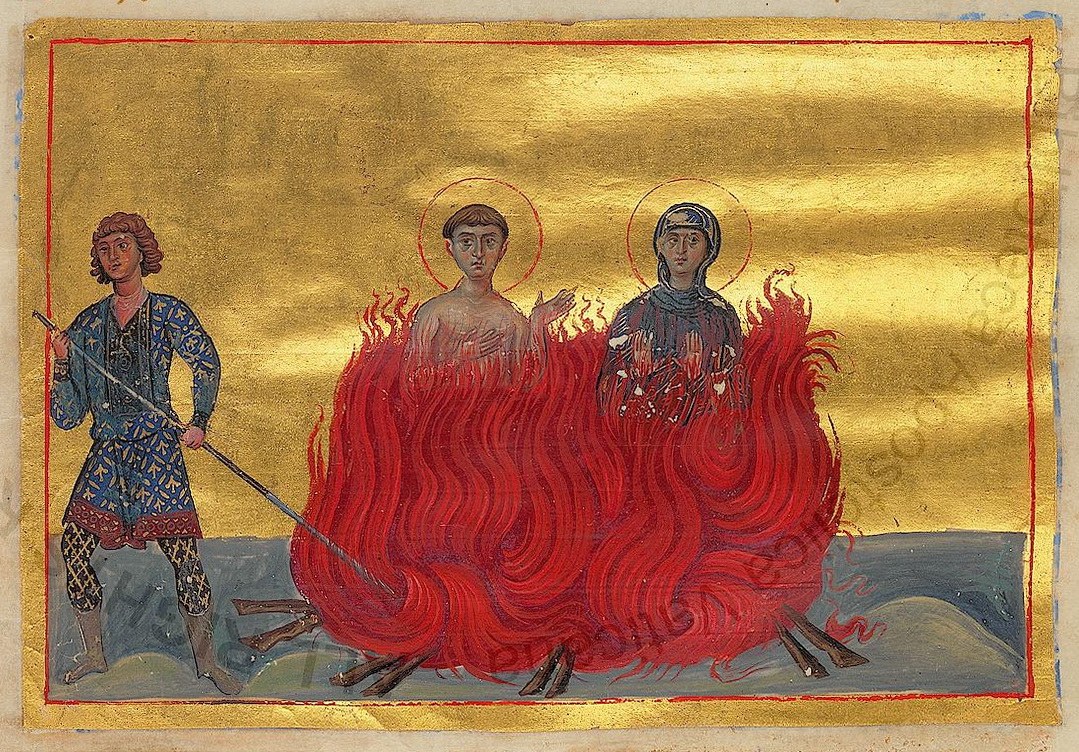
The stored image is the miniature of the Menologion of Basil II (Constantinople, 985): the two martyrs stand praying in the great fire at Rossos, the flames drawn up around them while the executioner stokes the pyre — the narrative scene of their end, exactly as the synaxarion tells it. A portrait icon would show a pair of women martyrs in the maphorion, each holding the cross of martyrdom.
Disputed questions
- Not to be confused. The Juliana martyred here with Cyrenia in Cilicia (November 1) is distinct from the virgin-martyr Juliana of Nicomedia (December 21) and from the martyr Juliana who suffered beside the great-martyr Barbara at Heliopolis (December 4); and from the righteous Juliana of Lazarevo (†1604, January 2), the merciful Russian noblewoman of Murom: distinct saints of the one name.