
Justinian and Theodora
The Holy Right-believing Emperor Justinian and the Empress Theodora
Righteous · King · Queen · b. Justinian c. 482, at Tauresium in Illyricum; Theodora c. 500 — d. Justinian 14 November 565; Theodora 548 — both at Constantinople
Commemorated 14 November — Repose of the Emperor Justinian; the Empress commemorated with him
Justinian the Great (c. 482–565), emperor of the Romans from 527, and his consort the Empress Theodora (c. 500–548) are commemorated together by the Orthodox Church as right-believing sovereigns. Justinian is remembered as the codifier of Roman law, the builder of Hagia Sophia, the reconqueror of the lost West, and above all the emperor who convened the Fifth Ecumenical Council (553) in defence of the Chalcedonian faith; the tradition also ascribes to him the hymn "Only-begotten Son and Word of God," sung at every Liturgy. Theodora, risen from the lowest station of the Hippodrome to the purple, was his partner in rule — of legendary resolve, the saviour of his throne in the Nika revolt — though her sympathy for the anti-Chalcedonian Miaphysites left a question the Church records rather than resolves. Their joint feast is November 14, the day of Justinian's repose. This Theodora is to be distinguished from Theodora the Empress who restored the holy icons (wife of Theophilus, † 867, kept on the First Sunday of Lent) and from Theodora of Alexandria the penitent.

Justinian
Justinian was born of Latin-speaking provincial stock about 482 at Tauresium in the Balkan province of Illyricum. He owed his rise to his uncle Justin, a peasant who had come to Constantinople as a soldier and mounted through the guard to the throne as the emperor Justin I; Justin, childless, brought his able nephew to the capital, educated him, and made him his right hand and, in 527, his colleague and successor. For thirty-eight years Justinian ruled with a tireless ambition to restore the Roman world in its unity, its law, and its faith.
His enduring monument is the codification of Roman law: the Codex, Digest, Institutes, and Novellae, gathered by a commission under the jurist Tribonian into what later ages called the Corpus Juris Civilis — the foundation of the legal tradition of both East and West. In 532 the great factional riot known as the Nika revolt nearly cost him his throne and left the city in ashes; from the ruin he raised the new Church of the Holy Wisdom, Hagia Sophia, dedicated in 537, the supreme achievement of Christian architecture, at whose completion he is said to have cried, "Solomon, I have surpassed thee." His generals Belisarius and Narses recovered North Africa from the Vandals and Italy from the Ostrogoths, and for a time the Mediterranean was again a Roman sea.
In religion Justinian held himself the guardian of Orthodoxy. He laboured, not always with success, to reconcile the Miaphysites who rejected the Council of Chalcedon while himself upholding its definition; he closed the last pagan philosophical school, the Academy of Athens, in 529; and in 553 he convened the Fifth Ecumenical Council, the Second of Constantinople, which condemned the "Three Chapters" and confirmed the Church's Christology against both Nestorian and Monophysite readings. He wrote theological edicts and treatises of his own, and the tradition ascribes to him the troparion "Only-begotten Son and Word of God" (Ὁ μονογενὴς Υἱός), a compact confession of the Incarnation that entered the Divine Liturgy in his reign and is sung at every celebration to this day. He reposed on 14 November 565, and for his defence of the faith and his ordering of the Christian empire the Church numbers him among the righteous.
Theodora
Theodora was born about the year 500 of the humblest origins — the hostile historian Procopius, in his Secret History, makes her the daughter of a bear-keeper of the Hippodrome and an actress of ill repute before she met Justinian. Whatever the truth beneath that invective, she rose to become his wife (a law was altered to permit the marriage) and, crowned with him, Augusta and full partner in his government. Her courage is fixed in the memory of the Nika revolt: when the terrified court urged flight and ships were ready, Theodora rose and refused, declaring — in the words Procopius gives her — that she would not live to be seen without her purple, for "the purple makes a fine winding-sheet"; her resolve stiffened Justinian, the revolt was crushed, and the throne saved. She used her power for the protection of women and worked, against her husband's Chalcedonian policy, to shelter the persecuted Miaphysite clergy and monks, for whom she remained a patroness. She died, probably of cancer, in 548, some seventeen years before her husband.
Feast and commemoration
The Emperor and Empress are commemorated together on November 14, the day of Justinian's repose (church date; Old Calendar civil November 27). The Orthodox Church in America and the Greek and Russian synaxaria keep them on this day, styling Justinian "the right-believing emperor" and Theodora "the empress," she being honoured with him although she died on this day's eve of the calendar rather than upon it.
Two cautions of identity attend the Empress. She is not Theodora the Empress who, as wife of the emperor Theophilus, restored the holy icons in 843 and is commemorated on the First Sunday of Great Lent and on February 11 — a different woman of a later century. Nor is she Theodora of Alexandria, the penitent who lived disguised as a monk. The Church's veneration of this Theodora, given her known Miaphysite sympathies, has been variously received — some calendars carry her name with Justinian, others pass over it — and the tension is recorded here rather than resolved.
Iconography
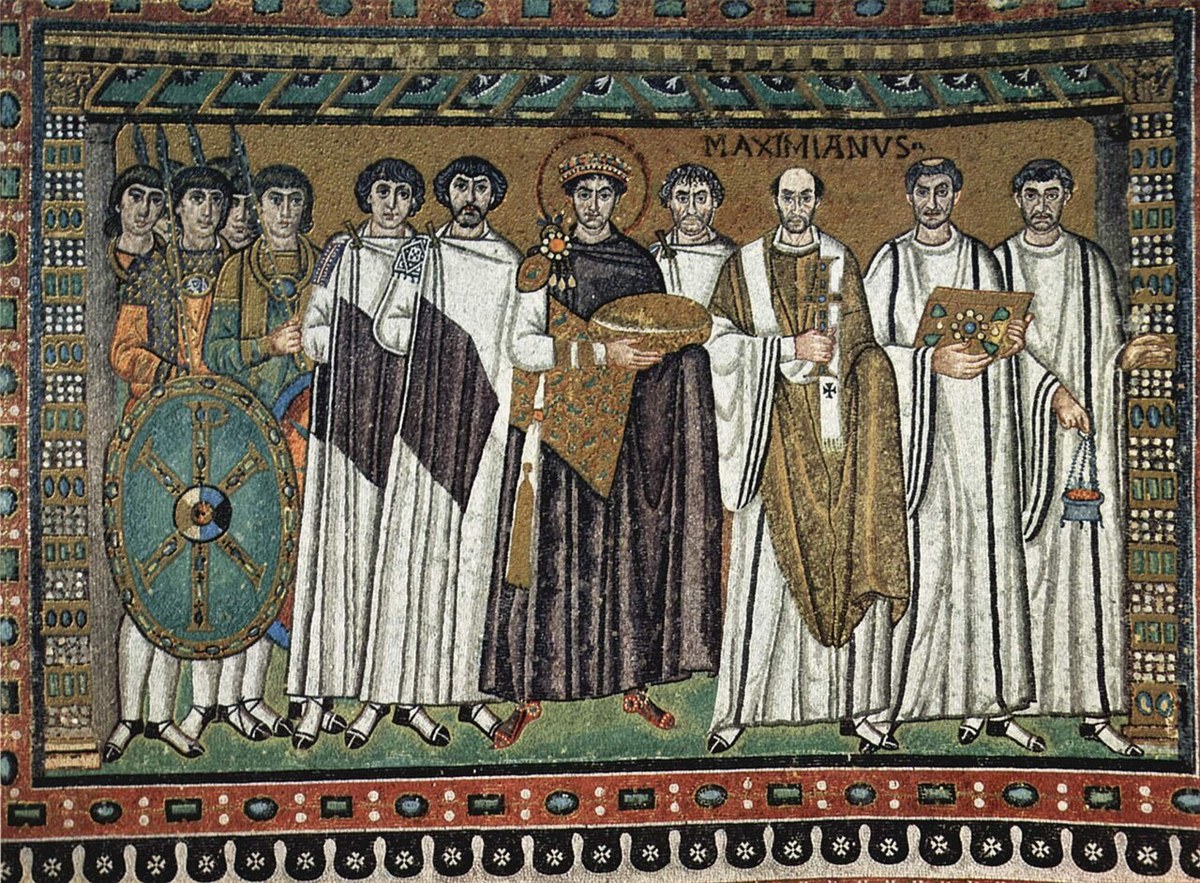
Justinian and Theodora possess what is perhaps the most famous imperial portrait to survive from antiquity: the twin dedication mosaics of the Basilica of San Vitale at Ravenna (c. 547), where the two sovereigns stand in procession, robed in purple and heavy with jewels, each bearing a gift for the altar — Justinian the paten, Theodora the chalice — amid their courtiers and clergy. Though made in their lifetime as imperial images rather than as icons of veneration, they are contemporary likenesses of unmatched authority, and it is on their model that the saints are shown: the Emperor crowned and haloed with the paten, the Empress crowned, haloed, and jewelled with the chalice.