
Theodora the Empress
The Holy and Right-believing Empress Theodora, Restorer of the Holy Icons
Queen · Righteous · b. c. 815, in Paphlagonia — d. c. 867, at Constantinople
Commemorated 11 February — Repose of the Empress Theodora, restorer of the holy icons
Theodora (c. 815 – c. 867) was the Byzantine empress who restored the veneration of the holy icons and so ended, once and for all, the long iconoclast controversy. Of a pious Paphlagonian family, she was married to the last iconoclast emperor, Theophilus, whose persecuting policy she never shared, secretly keeping and venerating icons in the women's quarters of the palace. On his death in 842 she became regent for her infant son Michael III, and within a year — having deposed the iconoclast patriarch and set the confessor Methodius on the throne of Constantinople — she convened the council of 843 that solemnly reaffirmed the seventh Ecumenical Council and restored the icons to the churches. That restoration is kept every year as the Triumph of Orthodoxy on the First Sunday of Great Lent, at which the Church still proclaims Theodora's memory. She governed the empire with wisdom for fourteen years until her son and his uncle Bardas thrust her from power; she ended her days in the monastery of Gastria, and is venerated as righteous. She is to be distinguished from Theodora of Alexandria the penitent, from the Empress Theodora, wife of Justinian, and from the several monastic Theodoras of the calendar.

Origins and marriage to Theophilus
Theodora was born about the year 815 in Paphlagonia, on the Black Sea coast of Asia Minor, into a family of rank and of firm attachment to the veneration of the icons; her mother Theoktiste is herself remembered for her devotion, and several of her sisters married into the high nobility. About the year 830 she was chosen — the tradition says through a bride-show, the parade of eligible maidens before the young sovereign — as the wife of the emperor Theophilus (reigned 829–842), the last and in some ways the most zealous of the iconoclast emperors, who had renewed with severity the imperial campaign against the holy images. The marriage set a secret venerator of the icons at the very heart of the iconoclast court.
The chroniclers preserve the domestic drama of that division of conscience. Theodora kept icons hidden in her apartments and did them reverence in private; a palace fool or jester, seeing them, innocently reported to the emperor that his wife had "pretty dolls," and Theodora, questioned, turned the matter aside by answering that he had seen only her reflection and her maids' in a mirror. Whatever the precise truth of such tales, they preserve a real memory: that the empress never adopted her husband's heresy, and that under an iconoclast emperor the future restorer of the icons was already keeping the faith of the images within the palace itself.
Regent, and the restoration of the icons (843)
Theophilus died on 20 January 842, leaving the throne to his son Michael III, then a child of about two, with Theodora as regent and head of the council of guardianship. She held the effective government of the Roman empire in her hands, and she resolved to undo the religious policy of her late husband. Moving with care against the still-powerful iconoclast establishment, she secured the removal of the iconoclast patriarch John the Grammarian (John VII) and the elevation to the see of Constantinople of the confessor Methodius, who had suffered imprisonment for the icons. In March 843, a synod at Constantinople under Methodius, with the empress's authority behind it, solemnly restored the veneration of the holy icons, reaffirming the definition of the Seventh Ecumenical Council (Nicaea II, 787) and anathematising the iconoclast teaching. On the First Sunday of Great Lent of that year the icons were borne back into the churches in triumphal procession, the clergy, the empress, and the young emperor at their head — the event the Church has kept ever since as the Triumph or Sunday of Orthodoxy.
To this restoration belongs the tender tradition of the pardon of Theophilus. Theodora, who had loved her husband, could not bear that he should be counted among the condemned, and she pleaded with Methodius and the assembled fathers to intercede for his soul. The bishops kept vigil; and the empress, in a dream or vision, saw her husband delivered from his torments — or, in another form of the account, the name of Theophilus was found erased from the book of the condemned after the night of prayer. The Church did not thereby reverse its judgement on the heresy, but the story enshrines both Theodora's fidelity as a wife and the gentleness with which the victory of Orthodoxy was received: she sought not vengeance upon the iconoclasts but the salvation even of the emperor who had led them.
Regency and fall
For some fourteen years Theodora governed the empire in her son's minority, and governed it well. Her administration kept the treasury full, defended the frontiers, and pursued the missionary and diplomatic work that would soon bear fruit in the conversion of the Slavs; against the dualist Paulician heretics of the eastern marches, however, her regime moved with a harshness the sources record. As Michael grew, his uncle Bardas — Theodora's own brother, able and ambitious — drew the young emperor away from his mother's tutelage; and about 856 Michael and Bardas removed Theodora from the regency and from power. She and her daughters were in time compelled to withdraw from the palace, and Theodora passed the remainder of her life in retirement, in the convent of Gastria at Constantinople which her family had founded. There she reposed in peace, about the year 867, and was buried among her kin; the Church, honouring the empress who had given back the icons, numbers her among the righteous.
Relics
Theodora's relics remained at Constantinople until the fall of the city to the Ottomans in 1453, when they were carried for safety to Corfu, where they rest to this day in the island's cathedral beside the relics of Saint Spyridon's companion tradition — the empress being honoured as a patron of Corfu, her incorrupt body a treasure of the Ionian church.
Feast and commemoration
Theodora is commemorated on February 11 (church date; Old Calendar civil February 24), the day of her repose, on which the Greek, Antiochian, and Slavic calendars keep her memory — the Slavic books naming her "the righteous Theodora, Queen of the Greeks, who restored the veneration of the holy icons," the Greek "Θεοδώρα ἡ Αὐγούστα." Her deeper commemoration, however, is movable: the restoration she convened is kept every year as the Triumph of Orthodoxy on the First Sunday of Great Lent, where the synodikon proclaimed in the churches still names "Theodora the ever-memorable" among the champions of the icons. Her fixed feast and the movable feast of Orthodoxy thus belong together — the person on February 11, the deed on the first Sunday of the Fast — and this entry records the movable connection without minting a separate feast of the Empress.
Two cautions of identity attend her name. She is not the Empress Theodora, wife of Justinian (†548), of three centuries earlier, whose Miaphysite sympathies the Church records with a question; nor Theodora of Alexandria, the penitent who lived disguised as a monk; nor Theodora of Thessalonica (†892), the nun of that city, nor the later Theodora of Sihla, the Romanian hermitess, nor Theodora of Arta the princess — all distinct saints who share only the common name.
Hymns
Troparion — Tone 2
We venerate Thy most pure icon, O Good One, and ask forgiveness of our transgressions, O Christ our God; for of Thine own will Thou wast well-pleased to ascend the Cross in the flesh, that Thou mightest deliver from bondage to the enemy those whom Thou hadst fashioned. Wherefore we cry to Thee with thanksgiving: Thou hast filled all things with joy, O our Saviour, who camest to save the world.
Original translation from the Greek
Iconography
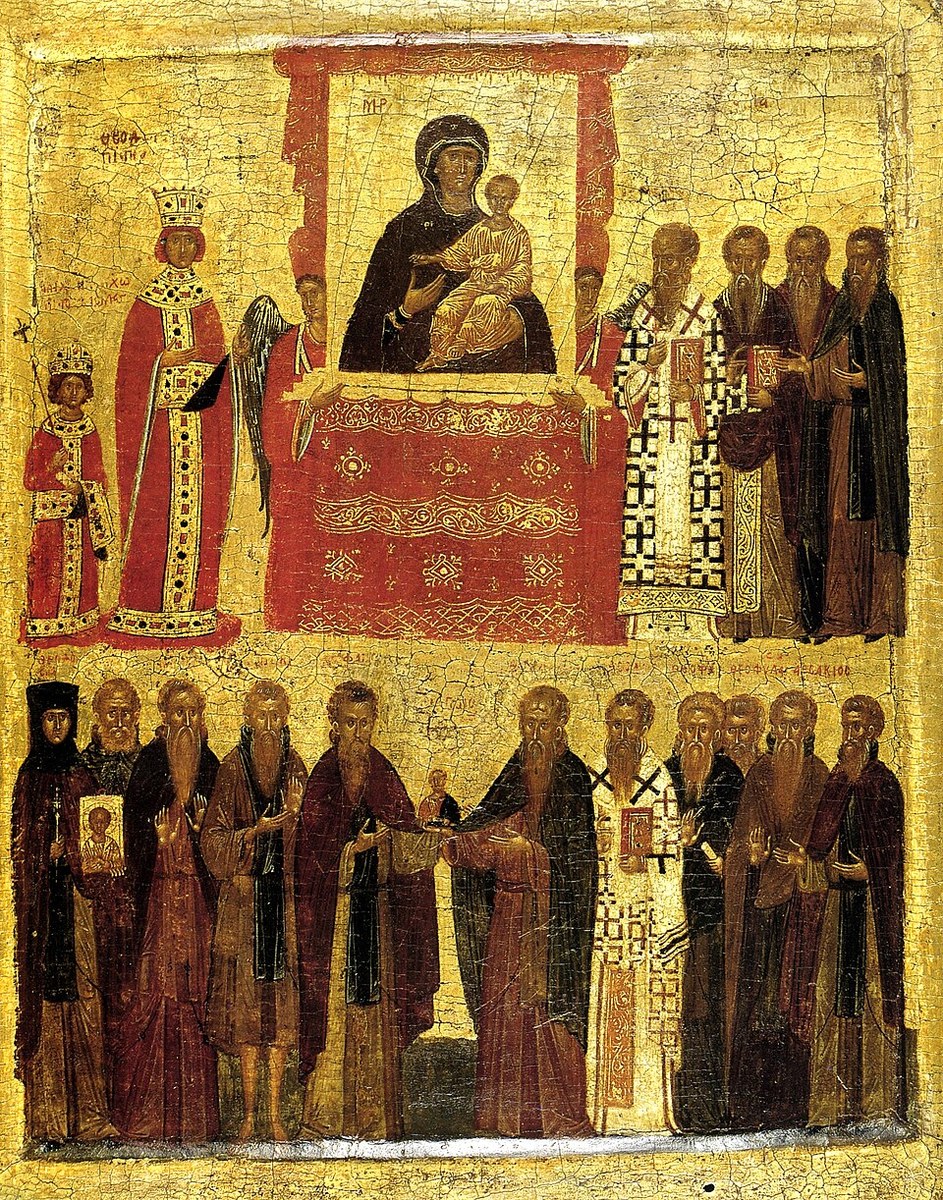
Theodora is shown as a crowned Byzantine empress, in the loros and jewelled diadem of the Augusta, often bearing a holy icon in her hands — the sign of her office as restorer of the images. Her characteristic setting is not a solitary portrait but the icon of the Triumph of Orthodoxy itself, in which she stands crowned at the left, beside her young son Michael III, as the great double-sided Hodegetria icon of the Mother of God is borne in procession and the patriarch Methodius and the confessors of the icons gather about it — the empress made a permanent figure of the feast she brought to pass.
The stored image is precisely such an icon: the late-Byzantine Triumph of Orthodoxy (c. 1400; British Museum), showing the Hodegetria upheld between angels while the Empress Theodora and Michael III stand crowned to the left and Methodius and the venerators of the icons — among them the martyred nun Theodosia and the monastic confessors — stand below (source, public domain, pd-old-work).