
Kyriaki of Nicomedia
The Holy Great Martyr Kyriaki of Nicomedia
Great Martyr · Virgin · Martyr · b. c. 268 — d. 289
Commemorated 7 July — Martyrdom at Nicomedia under Diocletian and Maximian
Kyriaki — "she of the Lord's Day" — was the only child of a prosperous Christian couple of Nicomedia who had prayed long for a child and named their daughter for the Sunday on which she was born. Vowed to virginity, she refused the suit of a magistrate, who denounced the whole family to Diocletian; her parents were beaten and exiled to Melitene, and Kyriaki was passed from tribunal to tribunal — to Maximian at Nicomedia, to the eparch Hilarion at Chalcedon, and to his successor Apollonius — enduring scourging, suspension by the hair, burning with torches, the fire and the beasts, and being delivered each time. At her prayer the idols of the temple were thrown down in an earthquake; when at last she was sentenced to the sword, she asked for a moment to pray and gave up her soul before the blade fell. She is honoured as a Great Martyr, one of the most loved of the Greek virgin-saints, and is commemorated on July 7.

The child of the Lord's Day
The passion places Kyriaki's birth at Nicomedia in Bithynia, about the year 268, in the household of Dorotheus and Eusebia — Christians of substance who had grown old childless and had begged God for a child. The daughter given them was born on a Sunday, the Lord's Day, ἡ Κυριακή, and they named her for it: not for a patron or a kinswoman, but for the day of the Resurrection. The name governs everything that follows, and the hymnographers never let it go — she is "named for the Lord," κυριώνυμος, and the Church loves the play upon it: Kyriaki, belonging to Kyrios.
She grew up beautiful and rich in prospects, and refused every prospect. She had, the account says, consecrated her virginity to Christ, and her parents supported her in it. When a magistrate of Nicomedia sought her hand for his son and was refused, he took the refusal as an insult and answered it by denouncing Dorotheus, Eusebia, and their daughter to the authorities as Christians.
Before four tribunals
The persecution then raging was that of Diocletian (284–305), whose capital was Nicomedia itself and whose edicts fell first and heaviest upon that city. The three were arrested and brought before the emperor. When they refused to sacrifice, Dorotheus was flogged and he and Eusebia were sent into exile at Melitene in Armenia, where they died; Kyriaki, whose beauty and youth the tribunal thought would yield to pressure or flattery, was kept back and sent to Maximian, Diocletian's colleague, at Nicomedia.
Maximian tried persuasion first — an advantageous marriage, honours, a place at court — and then the whips. The passion records with grim precision that the soldiers who scourged her had to be relieved three times, exhausted before she was. Making nothing of her, he sent her across the strait to Hilarion, eparch at Chalcedon. Hilarion had her hung up by the hair and her body burned with torches; she was taken down insensible and thrown into prison, and there — the account says — the Lord Himself appeared and healed her wounds, so that the next morning her jailers found her whole.
Hilarion then had her dragged to the temple of the idols, expecting her to sacrifice. She prayed; there was an earthquake, and the images fell and were shattered. The crowd fled; Hilarion, running out with them, was struck down — the notices say by lightning — and died. His successor Apollonius took up the case, ordered her burnt alive, and the fire went out; ordered her thrown to the wild beasts, and the beasts lay down and fawned on her. He condemned her at last to be beheaded.
"Receive my spirit"
Led out to the place of execution, Kyriaki asked the soldiers for a little time to pray. They granted it. She prayed — for herself, for those who had condemned her, and for all who should afterwards keep her memory — and, the passion says, before the sword could be lowered she gave up her spirit to God, so that the executioners found her already dead. She was twenty-one years old; the year given is 289. Christians took up her body and buried it, and her tomb became a place of healing.
The manner of her death is theologically the point of her passion, and the hymnography draws it out: the martyr who could not be killed by fire, or by beasts, or by the sword, laid down her life herself, freely, as her Lord did — the Kyriaki who belonged to the Kyrios to the end.
Cult and patronage
Kyriaki is among the most widely venerated of the virgin-martyrs in the Greek world; the name is one of the commonest women's names in Greece, and churches of Agia Kyriaki are found in nearly every diocese. She is the patron of Servia in Kozani, where her cathedral stands. Among the Slavs she is Sveta Nedelja (Bulgarian and Macedonian) or Sveta Nedjelja (Serbian and Croatian) — the same name translated, "Holy Sunday" — and under that title she has churches from Sofia to Ohrid; in Romanian she is Sfânta Chiriachi. She is invoked for the healing of the eyes and against sudden death, and, because of her name, for the sanctification of the Lord's Day.
Feast and commemoration
July 7 (church date; Old Calendar civil July 20), kept with Thomas of Mount Maleon, the second commemoration of Acacius of Sinai, and the martyrs of Dyrrachium and Tomis. In the Greek usage her feast is celebrated with a proper service and is a major local festival wherever she is patron — most notably at Servia in Kozani. In the Bulgarian and Macedonian churches the day is Sveta Nedelja, and the cathedral of Sofia which bears the name keeps its patronal feast. In the Antiochian usage she is commemorated as a Great Martyr on the day.
Hymns
Apolytikion — Tone 4 (common of a virgin-martyr)
Thine ewe-lamb, O Jesus, crieth aloud with a great voice: I love Thee, O my Bridegroom, and in seeking Thee I contend, and I am crucified and buried with Thee in Thy baptism; I suffer for Thy sake, that I may reign with Thee; I die for Thee, that I may live in Thee. Receive as a spotless sacrifice her who was slain for love of Thee. By her intercessions, since Thou art merciful, save our souls.
Kontakion — Tone 4
Named for the Lord's own Day and belonging wholly to the Lord, thou didst quench the fire by faith and tame the beasts by prayer, O Kyriaki; and when the sword was lifted, thou didst render up thy soul unwounded to the Bridegroom whom thou hadst loved. Wherefore the Church of Christ, adorned with thy struggles, doth celebrate thy holy memory.
Original translation from the Greek
Iconography
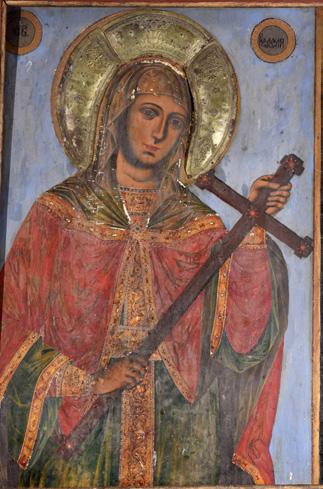
Kyriaki is painted as a young woman of noble bearing, full-face, in a red or crimson maphorion over a green or blue undergarment, and — unusually among the virgin-martyrs — she is very often crowned, with a jewelled diadem or a closed crown, and richly robed, in the manner of the great martyrs who are shown as brides of the King. Her constant attribute is the martyr's cross, and in her case it is characteristically large — held diagonally across the body, sometimes almost a processional cross rather than the small hand-cross of the ordinary martyr. Occasionally she holds a scroll, or a martyr's crown in the free hand.
Because her name is the Lord's Day, a distinct and very old iconographic type exists in the Slavic lands under the name Sveta Nedelja, in which the saint is shown surrounded by roundels or small scenes of the works forbidden on Sunday — ploughing, spinning, carting — a didactic image against labour on the Lord's Day. This type is common in Bulgarian, Macedonian and Serbian village churches and is peculiar to her; it should not be read as a scene from her life.
The stored image is the patronal icon of the church of St Kyriaki at Debrene, painted in 1844 by the Macedonian iconographer Dičo Zograf (Dimitar Krstev Andonov, 1819–1872): the saint bust-length behind a parapet, crowned beneath a gilt halo, in a crimson mantle with a green lining, holding a large red-brown cross diagonally across her breast, with a Cyrillic inscription in the roundel at the upper right. The underlying panel is well out of copyright; the photograph is a flat, faithful reproduction and so is stored under pd-old-work. The only reproduction available is small, and the inscription cannot be read letter by letter — the identification rests on the icon's attributes and on its position as the patronal image of a church dedicated to this saint.
Disputed questions
- Historicity. No contemporary acta survive; the passion is a developed hagiographic text of the type produced for the great Nicomedian martyrs, with the standard sequence of four tribunals and successive deliverances. The core — a Christian virgin of Nicomedia put to death in the Diocletianic persecution — is entirely credible for that city, which lost Christians in thousands under Diocletian; the miraculous apparatus belongs to the genre. The date 289 given in the notices sits slightly before the general edicts of 303 and may reflect a local persecution or simply the vagueness of the tradition.
- Rank. The Greek books consistently style her μεγαλομάρτυς, Great Martyr, and this entry follows them; some Slavonic and English calendars print her simply as "Martyr Kyriake," which is a difference of usage and not of substance.
- Not to be confused with Kyriake, Kaleria and Mary of Caesarea (June 7, †c. 304, Caesarea in Palestine) — three women martyred together, whose leader bears the same name. The confusion is easy, since both companies fall in the Diocletianic persecution and both are indexed under "Cyriaca"; but that Kyriake suffered in Palestine with two companions, while this Kyriaki suffered alone in Bithynia. Nor with the Roman Cyriaca, the widow who sheltered Laurence the Archdeacon (August 10) and in whose field on the Via Tiburtina he was buried.