
Laurence of Rome
The Holy Martyr and Archdeacon Laurence of Rome
Martyr · Deacon · b. c. 225, traditionally at Osca (Huesca) in Hispania Tarraconensis — d. 10 August 258, at Rome
Commemorated 10 August — Martyrdom on the gridiron at Rome under Valerian
Laurence, archdeacon of the Roman Church, was put to death on 10 August 258, in the persecution of the emperor Valerian, four days after his bishop Sixtus II had been seized and beheaded in the catacombs. As archdeacon he had charge of the alms and the treasury of the Church; ordered by the city prefect to surrender its wealth, he asked for three days, spent them distributing everything to the poor, and then presented the beggars, the crippled and the widows of Rome with the words that have never been forgotten — "Behold the treasures of the Church." For that he was, in the tradition received by both East and West, roasted alive on an iron gridiron, and from the fire he mocked his executioners, telling them to turn him over because one side was done. He is one of the very few Latin martyrs whom the Byzantine calendar keeps at full rank, and his August 10 is one of the oldest fixed commemorations in Christendom.

The archdeacon of Rome
Nothing certain survives of Laurence's origins. A late and much-loved Spanish tradition, first firmly attested in the Middle Ages, makes him a native of Osca (Huesca) in the Ebro valley of Tarraconensian Spain, born about 225, and brings him to Rome in the company of the future Sixtus II — a tradition that Spain has honoured with churches and pilgrimage but which no third-century source supports. What is historical is his office. By 257 he was archdeacon of the Roman Church: the first of the seven deacons of the city, and by that office the bishop's right hand in everything that touched money. Rome's deacons administered the seven ecclesiastical regions of the city, kept the registers of the poor and the widows, received and disbursed the offerings, and had custody of the sacred vessels. The Church of Rome in the middle of the third century was rich in exactly this sense — not in lands or palaces, but in a very large charitable establishment: a generation earlier Pope Cornelius could report that the Roman Church supported more than fifteen hundred widows and persons in distress. Laurence's office was to keep and to spend that fund, and it is precisely this that brought him to the notice of the state.
The persecution of Valerian
Valerian (r. 253–260) began his reign mildly toward the Christians and turned against them in his fifth year. Two rescripts define the persecution. The first, of the summer of 257, ordered the clergy to sacrifice to the gods of the empire and forbade assembly and the use of the cemeteries; it sent bishops into exile — Cyprian of Carthage to Curubis, Dionysius of Alexandria into the Libyan desert — and it took the life of Stephen I, bishop of Rome, on 2 August 257. The second, of the summer of 258, was far harsher and quite explicit: bishops, presbyters and deacons were to be executed at once, on identification alone; senators and equites who were Christians were to lose rank and property, and if they persisted, their lives; matrons were to be stripped of their goods and banished; Christians of the imperial household were to be sent in chains to the imperial estates. Its second clause is the key to what followed at Rome. The state was no longer only suppressing a cult; it was confiscating a treasury and interrogating the officers who kept it.
The rescript reached Rome in the first days of August 258. On 6 August, Sixtus II — who had been bishop for less than a year — was taken while seated in the chair, teaching, in the cemetery of Praetextatus on the Via Appia, and beheaded on the spot with the deacons who were with him. Felicissimus and Agapitus, two of the seven deacons, suffered the same day. The Roman Depositio martyrum of the year 354 — the oldest calendar of the Roman Church, and a document of the highest authority — enters both events: VIII idus Aug. Xysti in Callisti on the sixth, and IIII idus Aug. Laurenti in Tiburtina on the tenth. That the archdeacon outlived his bishop by four days is therefore not legend but record; the reason for the interval is what the tradition supplies.
"Where are you going, Father, without your son?"
The scene of the parting of Sixtus and Laurence is the oldest and best-attested element of the story after the bare dates: Ambrose of Milan, writing his De officiis about 390 — within living memory of men who had known Rome under Constantine — gives it as a thing handed down. As the old bishop was led away, the archdeacon followed weeping and cried out that he was being abandoned: had the priest ever offered the sacrifice without his deacon? Where was the father going without his son? And Sixtus answered that he was not deserting him, but that a greater contest was reserved for him — that as strength is spared the old man, so a more glorious triumph over the tyrant was kept for the young — and that in three days he would follow.
The treasures of the Church
The interval was the state's doing, and Laurence used it. Ambrose tells the rest. Knowing that the archdeacon held the Church's money, the prefect of the city had him arrested and demanded that the treasure be produced; the legendary acta name the prefect Cornelius Secularis, and add that Laurence asked for three days to gather it in. In those days he went through the seven regions of Rome and gave away everything he had: the alms-fund, the plate, and — the tradition insists — even the sacred vessels, sold and distributed, on the principle that the Church's gold exists to ransom the poor and not to be surrendered to Caesar. On the third day he came before the prefect with a crowd behind him: the blind, the lame, the lepers, the widows on the roll, the orphans of the Church. These, he said, are the treasures of the Church, and they are treasures that neither rust nor moth consumes and that thieves cannot break through to steal; in these poor bodies Christ is stored up, and their hands have carried the Church's wealth ahead of it into heaven.
The saying is not a pious ornament. It is a compressed statement of the Roman Church's whole understanding of what its property was for, delivered at the moment when the state was attempting to seize it, and it is the reason Laurence became — far beyond the circle of his own city — the patron and pattern of Christian almsgiving.
The gridiron
For this the prefect, according to the tradition received everywhere by the fourth century, condemned him not to the sword but to a slow death by fire, so that the mockery might be repaid. An iron gridiron (craticula) was set over coals, and Laurence was bound upon it and roasted. He prayed for the city of Rome and for the conversion of its people; and after a long time he turned his head toward the judge with the words that made him, of all the martyrs, the most quoted: "It is roasted on this side; turn it, and eat." So the poet Prudentius has it in the Peristephanon at the end of the fourth century, and so Augustine repeats it in his sermons for the day. The relics were taken up by the Christians and buried in the cemetery on the Via Tiburtina, in the field afterwards called the Campo Verano.
The company of the passion
Around the martyrdom the fifth- and sixth-century Roman passio gathered a company of converts whom the Byzantine synaxarion partly received:
- Hippolytus, the officer of the prison in which Laurence was held, who saw him restore sight to a blind prisoner named Lucillus, was baptised with his whole household, buried the martyr's body, and was for that torn to pieces by wild horses — the strand of the legend that ties this Hippolytus, confusingly, to the several other Roman Hippolyti.
- Romanus, a soldier of the guard, who saw an angel wiping the martyr's face as he was tortured, asked for baptism at his hands, and was beheaded on 9 August, the day before Laurence himself.
- Cyriaca, a widow of the Caelian hill who sheltered Laurence and whose house served the poor of the city; and Justinus the presbyter, who gave him communion in prison. Cyriaca is the Latin form of the name of the martyr Kyriaki, with whom the calendars sometimes confuse her.
Relics, basilica, and cultus
Over the grave on the Via Tiburtina Constantine built a basilica — the basilica maior of St Laurence — and endowed it richly; rebuilt by Pelagius II in the sixth century and joined to a second church by Honorius III in the thirteenth, it is the San Lorenzo fuori le Mura of today, one of the seven pilgrimage churches of Rome and the burial place of many popes. About 560 the relics of the protomartyr Stephen, brought from Jerusalem, were laid in the same confession, and the two archdeacons of the Church — the first deacon-martyr of Jerusalem and the first of Rome — have shared a tomb ever since; a charming Roman legend has Laurence courteously shifting to one side to make room for his guest.
His name entered the Roman Canon of the Mass among the martyrs invoked after the apostles, standing between Stephen and Chrysogonus, and his feast acquired a vigil and an octave — a distinction shared at Rome with none but the apostles, the Baptist and, later, the Theotokos. The gridiron became one of the best-known emblems in Christian art, and because the Perseid meteor shower falls in the days around 10 August, the shooting stars of that week have been called in a dozen languages "the tears of St Laurence."
The saint in the East
Laurence is one of a small handful of purely Latin martyrs — with Clement of Rome, Sixtus, and the martyrs of the Via Salaria — whom the Byzantine calendar received and keeps with a proper office. The Greek Menaion of August 10 heads the day Ἄθλησις τοῦ ἁγίου μάρτυρος Λαυρεντίου τοῦ ἀρχιδιακόνου, Ξύστου πάπα Ῥώμης καὶ Ἱππολύτου — the three names in one notice — and appoints him a proper apolytikion in the third tone and a proper kontakion in the second. At Constantinople the empress Pulcheria built him a church in the quarter of the Pulcherianai, one of the great shrines of the fifth-century city; it was there that the relics of the prophet Isaiah were enshrined under Theodosius II, and there that Pulcheria herself was buried. The Antiochian and Greek usage keeps his memory on the tenth within the Dormition Fast and the afterfeast of the Transfiguration.
Feast and commemoration
August 10 (church date; Old Calendar civil August 23), within the Dormition Fast (August 1–14) and within the afterfeast of the Transfiguration. The day is one of the oldest fixed feasts in the calendar of the Church, entered already in the Roman Depositio martyrum of 354; the Greek Menaion joins to Laurence the names of Sixtus and Hippolytus in a single notice, while the Slavic and OCA calendars list the whole company — Sixtus, Felicissimus, Agapitus, Romanus and Hippolytus — under the heading "and those with him." In the West he keeps a feast of the highest rank with its own vigil, and the Roman Church counts him among its three patrons after the apostles. He is invoked by cooks, by those who work with fire, by the poor and by almoners, and against burns.
Hymns
Apolytikion — Tone 3
Illumined by the divine Spirit, thou didst burn away the thorns of error as a living coal, O Laurence, archdeacon of Christ and victorious martyr; and having entered into converse with fire, in the fire thou wast made perfect. Wherefore entreat Him earnestly, that they who praise thee may be delivered from dangers and from every assault of the enemy.
Kontakion — Tone 2
Thy heart being set aflame with the fire of God, thou didst burn the fire of the passions utterly to ashes, O God-bearing martyr Laurence, foundation of them that contend; and in the midst of thy sufferings thou didst cry aloud in faith: *Nothing shall separate me from the love of Christ*.
Original translation from the Greek
Iconography
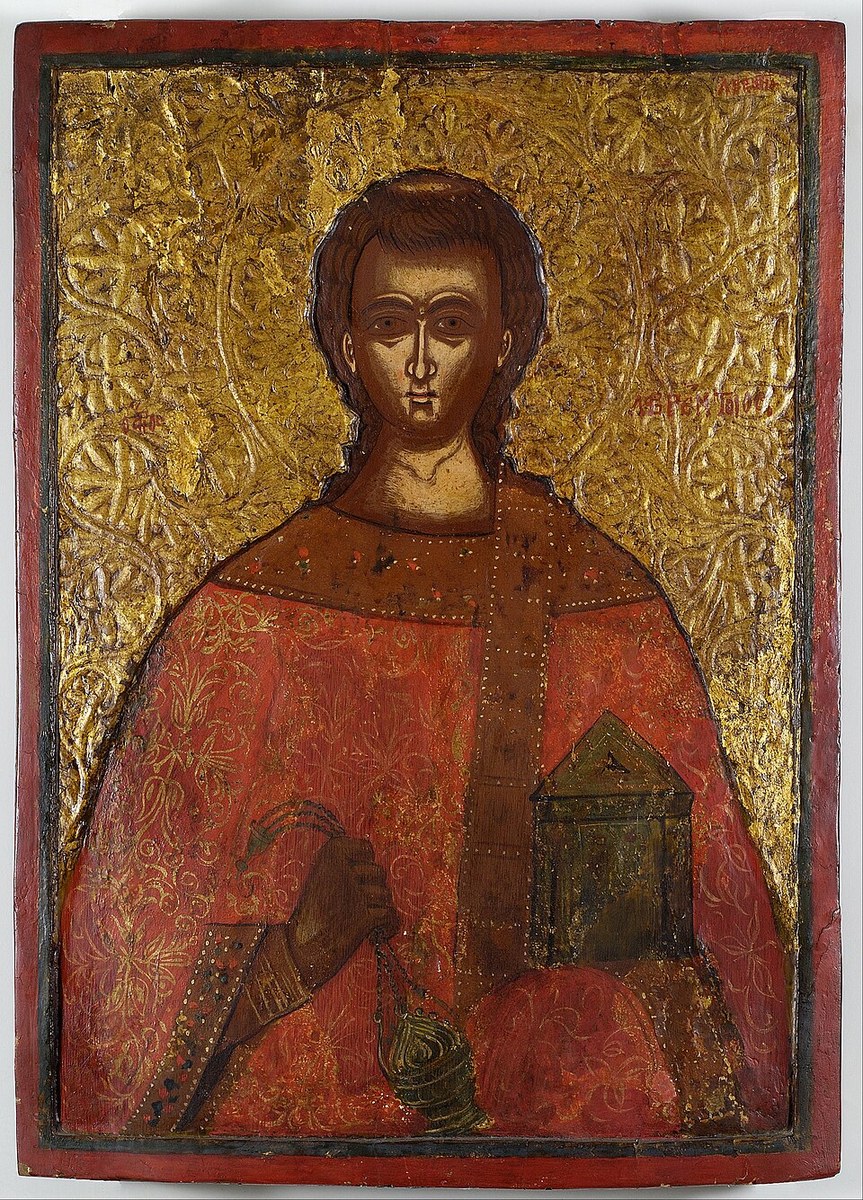
Laurence is painted as a young deacon: beardless or lightly bearded, with dark curling hair, vested in the sticharion with the deacon's orarion over the left shoulder, and holding in his hands the two implements of his order — the censer and the golden artophorion or pyxis, the little house-shaped vessel in which the reserved Gifts are kept. This is the Byzantine deacon-type he shares with Stephen the Protomartyr and Euplus, and the two archdeacons are frequently painted as a pair, flanking the sanctuary. Where his martyrdom is shown, the gridiron appears beneath him with the coals and the fork of his tormentors; in the West the gridiron alone became his emblem, carried in his hand as a book or a palm is carried by others.
The stored image is a seventeenth-century Greek icon by Konstantinos Adrianoupolitis in the Benaki Museum, Athens (inscribed Ο ΑΓ. ΛΑΒΡΕΝΤΙΟΣ): the saint half-length against a gilded and incised ground, in a crimson deacon's vestment sewn with pearls and a brown orarion, holding a censer by its chains in the right hand and the golden artophorion in the left.
A second image is kept as a variant: a Russian icon of 1897 by M. I. Dikarev (Hermitage Museum), signed and dated by the painter and inscribed along the lower border МѢСЯЦЪ АВГУСТЪ 10е ЧИСЛО — "the month of August, the tenth day" — which fixes the identification beyond doubt. Laurence stands full-length in a brocaded sticharion and green mantle, swinging a censer, with the Christ Child blessing from the clouds above; it is a fine specimen of the late Moscow ikonopis' made for the Menaion cycle.
Disputed questions
- The gridiron, or the sword? The most serious historical doubt about Laurence concerns the manner of his death. Valerian's rescript of 258 prescribed immediate decapitation for deacons, and Sixtus, Felicissimus and Agapitus were in fact beheaded four days earlier under the same order. It is therefore argued — the case was put most sharply by Pio Franchi de' Cavalieri early in the twentieth century — that Laurence too was beheaded, and that the gridiron entered the record through a copying error, an original passus est ("he suffered") being read as assus est ("he was roasted"), after which the Roman imagination did the rest. Against this stands the fact that the fire is already universal by the last quarter of the fourth century — Ambrose, Prudentius, Augustine, Pope Damasus's verse inscription and the Depositio's own topography all know it — and that Roman magistrates were entirely capable of exceeding a rescript when they thought a prisoner had made fools of them. Neither case is decisive. This entry gives the received account and records the objection.
- Spanish or Roman? The birth at Huesca, the parents Orentius and Patientia, and the journey to Rome with Sixtus belong to Spanish tradition of the eleventh century and later, and were assisted by the wish of the Aragonese Church to claim him. Nothing in the Roman sources knows of it. The related legend that Laurence sent the chalice of the Last Supper home to Huesca — the origin of the Santo Cáliz venerated at Valencia — is later still.
- Which Hippolytus? The Hippolytus of the Laurentian legend, the converted jailer torn apart by horses, is distinguished in this collection from Hippolytus of Rome, the writer and bishop kept on January 30, whose entry sets out the whole tangle of Roman Hippolyti. The Greek notice of August 10 names its Hippolytus without qualification; see Hippolytus the Jailer.
- Not to be confused with the monastic saints of the same name kept elsewhere in the year: Laurence of Pelion, Laurence of Komel (May 16), Laurence of Turov (January 29), nor with Laurence of Kaluga, the fool-for-Christ who shares this very day — a coincidence of date which the Russian calendars have never explained and which is simply the day of the latter's repose.