
Laurence of Kaluga
Our Blessed Father Laurence, Fool-for-Christ and Wonderworker of Kaluga
Fool for Christ · Righteous · Wonderworker · d. 10 August 1515, near Kaluga
Commemorated 10 August — Repose at his hermitage by the church of the Nativity near Kaluga
Blessed Laurence of Kaluga (†10 August 1515) was a fool-for-Christ who lived in a hut on a wooded hill above the Oka, beside the wooden church of the Nativity of Christ outside Kaluga, going barefoot summer and winter in a plain shirt and a sheepskin. He is remembered above all for a single day: on a May morning in 1512, while sitting in the house of Prince Simeon Ivanovich of Kaluga, he leapt up crying for his sharp axe because "dogs have set upon Prince Simeon" — and was seen the same hour on the prince's boat in the middle of the Oka, heartening the men against a Crimean Tatar raiding force which was driven off. He is painted with a long-handled axe in his hand for that reason. Over his grave a monastery grew, named from his church the Laurentiev or Nativity monastery, and by the reign of Ivan IV his tomb was one of the recognised holy places of the Russian south-west.

The hermit outside the town
The written life of Laurence is late and short; what it preserves is a manner of living rather than a biography. He appears at Kaluga — then a small fortified town on the upper Oka, on the exposed southern frontier of Muscovy — in the last years of the fifteenth century or the first of the sixteenth, and settled outside it, on the wooded hill above the river where a wooden church of the Nativity of Christ stood in a grove. There he made a hut and lived alone, in the manner of the Russian fools: barefoot at every season, through the frosts of the Oka winters, in a coarse shirt and a sheepskin coat thrown over it, refusing the ordinary comforts of a house and eating what was given him. From his hut, the tradition says, an underground passage ran to the church, so that he could come to the services unseen; the passage was still shown to visitors in the nineteenth century.
That he was of the boyar family of Khitrovo is the standing local tradition, supported by the very great and continuous patronage which the Khitrovo family afterwards showed his monastery, and by nothing else. If it is true, his folly was the usual Russian pattern — the deliberate abandonment of rank, name and dignity — and would explain the ease of his access to the prince's household.
"Give me my sharp axe"
The one dated event of his life is the Tatar raid of May 1512. In that year a large force under the sons of Mengli Giray of the Crimea came up against the Muscovite frontier, and part of it fell upon Kaluga. Prince Simeon Ivanovich (1487–1518), the fifth son of Ivan III and appanage prince of Kaluga, met them on the Oka, fighting from boats — the standard tactic of the river frontier, where the crossings were the whole battle.
Laurence, according to the life, was in the prince's town house when the attack began. He rose suddenly and cried out: "Give me my sharp axe — the dogs are upon Prince Simeon; we must defend him!" — took the axe and went out, and was gone. At that moment, the prince's men afterwards testified, the blessed one was seen on the prince's own vessel in the midst of the fighting, going up and down among the soldiers and encouraging them; and the attack, which had been pressing hard, broke. Later the same day Laurence was back in the house crying that he had defended Prince Simeon from the dogs. The prince, who had believed himself lost, held him from that day in reverence, and it is from this episode that his iconography comes: he is painted holding an axe on a long haft, the peasant's tool turned into the sign of a bloodless deliverance.
Repose and burial
Laurence reposed on 10 August 1515, at about sixty years of age, and was buried where he had lived, beside the church of the Nativity. Prince Simeon, who survived him by three years and died in 1518, is believed to have founded the monastery over the grave; the house took the name of the church but was known familiarly from its saint as the Laurentiev monastery, and it stood a mile or so outside Kaluga until the Soviet closures.
Veneration and miracles
The cultus is attested early and from an unimpeachable quarter. A charter of Tsar Ivan IV of 1565 granting land to the house names it "the monastery of the Nativity of Christ, where lies Laurence, fool for Christ's sake" — proof that within fifty years of his death he was locally venerated as a saint, before any formal glorification. The Kaluga chronicles and the monastery's own registers gathered miracles at the tomb through the seventeenth and eighteenth centuries. The best known is of 1621: Lev Kologrivov, a nobleman of the region who had lain paralysed and speechless, was brought to the tomb, prayed there, and rose and walked home.
Laurence became the patron of the city of Kaluga, whose arms and whose cathedral honour him, and the diocese keeps his memory together with that of the Kaluga Icon of the Mother of God as the two chief local holy things. The monastery church was destroyed in the twentieth century and the relics remain under a bushel — buried and unexhumed — beneath the site, which has been returned to the diocese and is again a place of prayer.
Feast and commemoration
August 10 (church date; Old Calendar civil August 23), the day of his repose, within the Dormition Fast (August 1–14) and the afterfeast of the Transfiguration. His is a Russian commemoration: universal in the Russian Church and central in the diocese of Kaluga, whose heavenly patron he is, and carried by the Orthodox Church in America in its calendar of Russian saints; the Greek calendars have received him as well and enter him on the tenth as Ἅγιος Λαυρέντιος τῆς Καλούγας. He is celebrated in Kaluga with a procession to the site of his monastery.
Hymns
Troparion — Tone 4
Enlightened by divine grace, O wise one, thou didst turn thy mind and thy heart from the vanity of the world unto the Creator, and, keeping thy faith unblemished, didst take upon thee the folly of Christ; and after thy departure the radiance of thy life was made manifest, pouring forth an unfailing well of wonders. Wherefore we cry to thee: O Blessed Laurence, pray to Christ God that our souls may be saved.
Original translation from the Slavonic
Kontakion — Tone 8
To the chosen and wondrous one among the righteous, who received of Christ the gift of miracles, we bring our words of praise; and do thou, having boldness before the Holy Trinity, ask deliverance for thy servants from every evil, that we may cry to thee: Rejoice, O Laurence, our defender.
Original translation from the Slavonic
Iconography
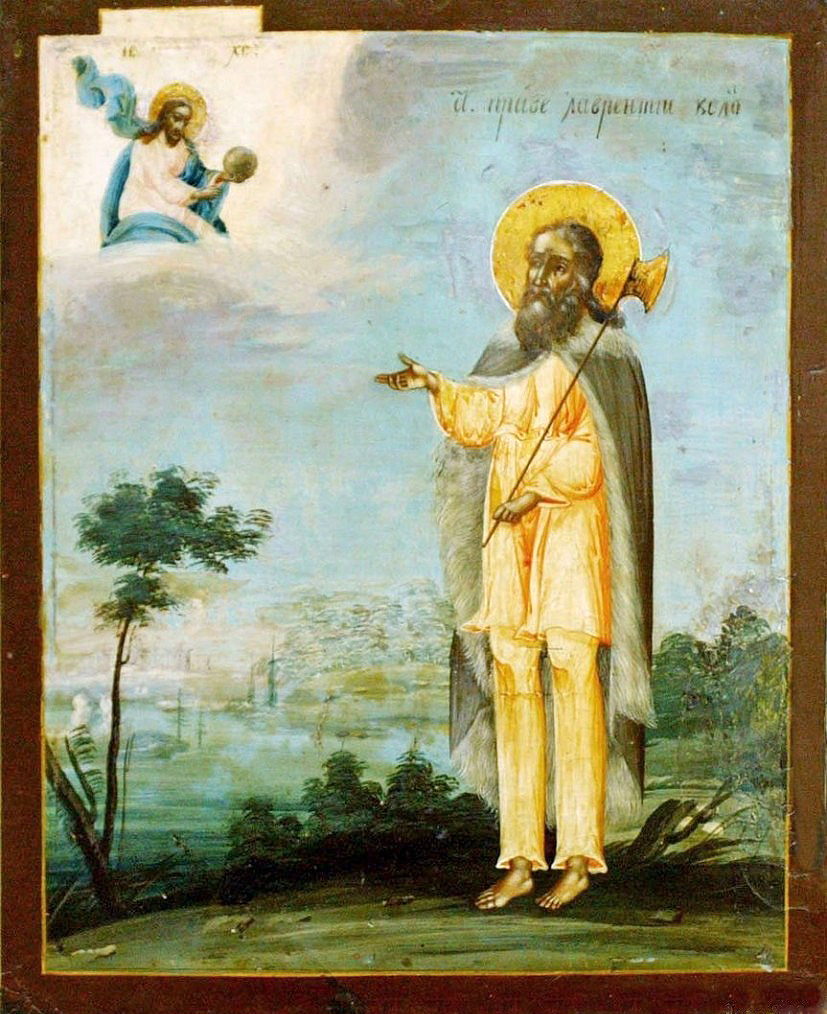
Laurence is painted in the Russian manner of the blessed fools: barefoot, standing on bare ground, in a plain long shirt with a sheepskin hanging from the shoulders, thin, with a long dark beard going grey and hair to the shoulders. His one unmistakable attribute is the axe on a long haft, held upright in the right hand or resting against the shoulder — the weapon he called for in the prince's house — which distinguishes him at once from every other Russian fool-for-Christ. The setting is regularly a landscape rather than a gold ground: the river Oka with the town of Kaluga and its churches on the far bank, and the wooded hill of his hermitage; Christ blesses from a segment of heaven in the upper corner.
The stored image is a Russian panel of the first half of the nineteenth century, inscribed along the top Ст҃ый праведный Лаврентїй Калужскїй, and containing all these elements: the saint standing barefoot in a yellow shirt with the sheepskin over his back, the long-handled axe against his right shoulder, his right hand raised in speech, the Oka and the distant town behind him, and the Christ Child blessing from the clouds at the upper left.
Disputed questions
- The date of birth and the family. Neither is documented. A birth about 1455 is inferred from the statement that he was some sixty years old at his death; the Khitrovo descent is local tradition, not record.
- Was he a monk? He is styled blessed (блаженный) and fool-for-Christ, not venerable, and the sources describe a layman living beside a parish church, not a tonsured monastic; the monastery arose after his death and around his grave. This entry types him fool-for-christ and righteous accordingly, following the Russian usage which keeps the blessed fools distinct from the monastic saints.
- The coincidence of the day. That the Russian fool should be commemorated on the same August 10 as Laurence the Archdeacon of Rome, whose name he bore, is a coincidence of the day of his repose and nothing more: the calendars did not move him to his patron's feast, and the Russian books enter the two commemorations side by side without remark. He is not to be confused with the Roman deacon-martyr, nor with the monastic Laurences of the Russian calendar — Laurence of Komel (May 16), abbot in the Vologda forests, and Laurence of Turov (January 29), the recluse and bishop.