
Transfiguration of the Lord
The Holy Transfiguration of our Lord and God and Saviour Jesus Christ
The Holy Transfiguration of our Lord and God and Saviour Jesus Christ (August 6) is the Great Feast of the Lord on which the Church celebrates what happened upon the mountain when Christ, taking with him Peter, James and John, "was transfigured before them: and his face did shine as the sun, and his raiment was white as the light" (Matthew 17:2); when Moses and Elijah stood and spoke with him of the exodus he was to accomplish at Jerusalem; and when out of a bright cloud the voice of the Father declared, "This is my beloved Son, in whom I am well pleased; hear ye him." The Church has never read the event as a change worked in Christ, but as a change worked in the eyes of the three: he was transfigured "not by taking on what he was not, but by showing to his own what he already was," and what shone from him was neither a created radiance nor the unapproachable divine essence, but the uncreated light of the Godhead itself. On that confession the whole doctrinal weight of the feast rests, for it was over the light of Tabor that the hesychast controversy of the fourteenth century was fought and Gregory Palamas's distinction between the essence and the energies of God was received as the faith of the Church. The Transfiguration is therefore not only a manifestation of who Christ is but a promise of what the human person may become: the glory the apostles saw is the glory in which the saints are to be clothed, and the feast is the Church's annual charter of theosis. It is one of the Twelve Great Feasts, kept with an all-night vigil, alone among them celebrated inside a fast, and marked everywhere by the blessing of the grapes and the first-fruits of the harvest.
.jpeg)
The Gospel narrative
Three Evangelists tell the event, and a fourth witness — the Apostle Peter himself, in his second Epistle — testifies to it in his own person. The Church reads all four together, and the differences between them are part of the feast's substance rather than an embarrassment to it.
Matthew (17:1–9) sets the scene immediately after the confession at Caesarea Philippi and the first prediction of the Passion. "And after six days Jesus taketh Peter, James, and John his brother, and bringeth them up into an high mountain apart, and was transfigured before them: and his face did shine as the sun, and his raiment was white as the light. And, behold, there appeared unto them Moses and Elias talking with him." Peter breaks in — "Lord, it is good for us to be here: if thou wilt, let us make here three tabernacles; one for thee, and one for Moses, and one for Elias" — and while he is yet speaking "a bright cloud overshadowed them: and behold a voice out of the cloud, which said, This is my beloved Son, in whom I am well pleased; hear ye him." The disciples fall on their faces and are sore afraid; Jesus comes and touches them, saying, "Arise, and be not afraid"; and when they lift up their eyes they see "no man, save Jesus only." Coming down, he charges them to tell the vision to no man until the Son of Man be risen from the dead.
Mark (9:2–9), the shortest and the most physical, has the same six days and the same three disciples, and describes the garments with the detail of a man who has watched a fuller at work: "his raiment became shining, exceeding white as snow; so as no fuller on earth can white them." Mark alone remarks that Peter spoke "for he wist not what to say; for they were sore afraid," and it is Mark who records the disciples questioning one another on the descent "what the rising from the dead should mean," and the conversation that follows about Elijah who must first come.
Luke (9:28–36) diverges in three ways that the tradition has weighed carefully. He gives "about an eight days after these sayings" where Matthew and Mark give six. He alone says that Jesus "went up into a mountain to pray," and that "as he prayed, the fashion of his countenance was altered, and his raiment was white and glistering" — so that in Luke the Transfiguration is an event of prayer, as the Baptism is in his Gospel. And Luke alone tells what Moses and Elijah were saying: they "spake of his decease (τὴν ἔξοδον αὐτοῦ, his exodus) which he should accomplish at Jerusalem." Luke adds too that "Peter and they that were with him were heavy with sleep: and when they were awake, they saw his glory" — the same heaviness that will overtake them in Gethsemane — and that they entered the cloud in fear.
The frame of the story is the same in all three: the confession at Caesarea Philippi, the first open announcement of the Cross, the hard saying about taking up the cross and losing one's life, and then the promise that "there be some standing here, which shall not taste of death, till they see the Son of Man coming in his kingdom" (Matthew 16:28) — a promise which the Evangelists place immediately before the Transfiguration, so that the vision on the mountain is offered as its first and partial fulfilment. The glory is given precisely to those who have just been told about the Cross.
Six days, or eight
Matthew and Mark say "after six days"; Luke says "about eight days after these sayings." The oldest and simplest resolution is arithmetical: Luke counts inclusively in the Greek manner, reckoning both the day of the sayings at Caesarea Philippi and the day of the vision into his total, so that his eight and their six describe the same interval; his own "about" (ὡσεί) shows that he is not pressing the number. But the Fathers were unwilling to leave a number in the Gospel merely arithmetical, and both figures were read for their meaning.
The six days are read against Exodus 24:16, the first of the three Old Testament readings appointed at the Vespers of the feast: "And the glory of the Lord abode upon mount Sinai, and the cloud covered it six days: and the seventh day he called unto Moses out of the midst of the cloud." The six days of waiting before Moses entered the cloud are answered by the six days before the three disciples enter the bright cloud on the second mountain — the whole Sinai theophany deliberately rehearsed and surpassed. The six days are read also as the six days of creation, so that the vision belongs to a seventh and eighth day beyond the making of this world.
The eight days carry that further. Eight is in the patristic reckoning the number of the age to come — the day after the sabbath, the day of the Resurrection, the day that has no evening — and Luke's number was taken to signal that what the apostles saw on the mountain belongs not to the seven days of this creation but to the Eighth Day. Gregory Palamas, preaching on the feast, makes exactly this the key: the Transfiguration is "the mystery of the Eighth Day, that is, of the age to come." He also offers, as an additional reading rather than a replacement, a count of persons: six were visible on the mountain — Jesus, Peter, James, John, Moses and Elijah — while the Father in his voice and the Spirit in the cloud were invisibly present, making eight, so that the two numbers of the Gospels are both true of the same scene, one counting what was seen and the other what was there.
Moses and Elijah
The two who appear beside the transfigured Christ are chosen with precision. Together they are the Law and the Prophets — Moses the lawgiver, Elijah the greatest of the prophets before the Forerunner — standing on either side of the one to whom Law and Prophets alike bear witness, and yielding to him: when the cloud passes, they are gone, and the disciples see "Jesus only." The scene is the visible form of the claim that Christ came not to destroy the Law and the Prophets but to fulfil them.
They are also the two men of the Old Covenant to whom God granted a theophany upon a mountain, and both those theophanies are read at the Vespers of this feast. Moses on Sinai asked, "Shew me thy glory," and was set in the cleft of the rock and covered with God's hand while his glory passed by, and saw only his "back parts," for no man could see God's face and live (Exodus 33:11–23; 34:4–6, 8). Elijah at Horeb, after the forty-day fast, stood at the mouth of the cave and found the Lord not in the great wind, nor the earthquake, nor the fire, but in the sound of a fine stillness (3 Kingdoms 19:3–16). What was denied to Moses on Sinai and given only obliquely to Elijah at Horeb is given plainly on Tabor: they now behold, face to face and in the flesh, the God whose glory they once glimpsed from behind and in a whisper. Both, too, had fasted forty days before their vision, as Christ fasted forty days in the wilderness — the ascetic pattern the Church still keeps.
And they are set there as a pair for a further reason that the hymnography never fails to draw out: one of them died and the other did not. Moses died in the land of Moab and was buried by God in a grave no man knows (Deuteronomy 34:5–6); Elijah was carried up alive in the chariot of fire and has not tasted death (4 Kingdoms 2:11). They come to the mountain from the two conditions in which the human race is found, and their standing together before Christ declares that he is Lord of both — of the living and of the dead, of those in Hades whom he will raise and of those alive whom he will meet. The feast's stichera say it directly, and the point is not decorative: the Transfiguration is placed under the shadow of the Cross, and the two prophets are there as witnesses that the death he is about to die touches every state of humanity.
Luke supplies the content of their conversation, and it is the hinge of the whole feast: they "spake of his exodus which he should accomplish at Jerusalem." The word is exodus — a departure, a going-out, and unavoidably the Exodus that Moses himself led. What is discussed in the light is the Passion. The glory is not an escape from the Cross but its interpretation.
Peter, James and John
The same three are taken apart at the raising of the daughter of Jairus (Mark 5:37) and again into the depth of the garden of Gethsemane (Matthew 26:37); they are the witnesses of the greatest glory and of the greatest anguish, and the tradition insists that the pairing is the point. They saw the face shining as the sun so that they might be able to bear the face covered with spittle; they saw the raiment white as light so that they might endure to see it stripped away. This is precisely what the kontakion of the feast says: they beheld the glory "that when they should see thee crucified they might understand that thy suffering was willing."
Why these three and no others? Three, first, because the Law required that a matter be established at the mouth of two or three witnesses (Deuteronomy 19:15), and the vision was to be testified. Beyond that the Fathers offer a reading of each: Peter, because he loved Christ ardently and had just confessed him the Son of the living God; John, because he was loved, the disciple who leaned on his breast and who would write that "we beheld his glory"; James, because he was to be the first of the Twelve to drink the cup and die for him, beheaded by Herod (Acts 12:2). The three were also, though they did not know it, being prepared for their office: the vision was sealed under silence "until the Son of Man be risen from the dead," and was released for preaching only afterwards.
Peter's proposal of three tabernacles is treated by the tradition with a mixture of affection and severity. Luke and Mark both note that he did not know what he was saying. The proposal is generally read as the natural desire to arrest and domesticate the vision — to build and stay — and, since the Feast of Tabernacles was near at hand in the season, as an impulse to keep the feast of booths on the spot; the Fathers add the sharper criticism that to build three equal booths was to set the servants beside the Master, a levelling that the voice from the cloud immediately corrects: this is my beloved Son; hear ye him.
The voice itself repeats what was said at the Jordan (Matthew 3:17) with one addition — "hear ye him" — which is a quotation of Moses' own promise, "a Prophet shall the Lord your God raise up unto you of your brethren, like unto me; him shall ye hear" (Deuteronomy 18:15). The Father thus identifies his Son in the words by which Moses, standing there, had foretold him. And the cloud which overshadows is the cloud of the Exodus and of the tabernacle, the visible sign of the divine presence; the verb Matthew uses for its overshadowing (ἐπεσκίαζεν) is the verb used of the Spirit at the Annunciation. The three disciples fall on their faces, as prophets fall before glory, and are raised by the touch of a hand.
The mountain: Tabor and Hermon
Not one of the Evangelists names the mountain. Matthew and Mark say "an high mountain apart"; Luke says only "a mountain." From at least the fourth century the Christian tradition of Palestine identified it as Mount Tabor, the isolated dome that rises some 575 metres out of the plain of Esdraelon in lower Galilee — a mountain whose perfect separateness from the ranges around it made it a natural image of "apartness," and which the psalm names together with Hermon: "Tabor and Hermon shall rejoice in thy name" (Psalm 88:13 LXX), a verse the festal hymnography takes up with delight. Cyril of Jerusalem and Jerome name Tabor without hesitation, Origen is cited for the identification earlier still, and by the sixth century the summit carried churches and by the Crusader period a monastery; a Greek Orthodox and a Latin monastery stand there now, and Tabor's name has passed so completely into the theology of the feast that the light itself is called the Taboric light.
The identification is nonetheless contested, and the entry records the case honestly. The objection is one of geography and of history. Of geography: Matthew places the episode "after six days" from the neighbourhood of Caesarea Philippi (Matthew 16:13), which lies at the southern foot of Mount Hermon, some hundred and thirty kilometres north of Tabor and rising to 2,814 metres — by far the more obvious "high mountain" in the immediate narrative, and the one to which a party at Caesarea Philippi would naturally have gone up. Of history: Tabor's summit was not a solitude. Polybius records that Antiochus III took a town on it in 218 BC, and Josephus fortified its summit against the Romans in AD 66; the objection, pressed by Henry Alford in 1868 and by many since, is that a fortified and inhabited hilltop is a poor place to be "apart." Defenders answer that the fortification of 66 is later than the event and that a settlement need not have occupied the whole summit. Other proposals — Mount Meron, and even Mount Nebo — have had occasional advocates, and a considerable body of modern exegesis declines to choose, treating "the high mountain" as the theological topography of Scripture, the place where God and man meet, from Sinai and Horeb and Carmel to this one.
The Church's liturgy has settled on Tabor and sings it by name — the exapostilarion of the feast begins "in thy light which hath appeared this day on Tabor." That is a liturgical, not a topographical, commitment: what the feast confesses is the light, and the mountain is named because the light must have shone somewhere.
The apostolic witness: 2 Peter
Uniquely among the events of the Lord's life, the Transfiguration has an eyewitness deposition outside the Gospels, and it is read as the Epistle of the feast. "For we have not followed cunningly devised fables, when we made known unto you the power and coming of our Lord Jesus Christ, but were eyewitnesses of his majesty. For he received from God the Father honour and glory, when there came such a voice to him from the excellent glory, This is my beloved Son, in whom I am well pleased. And this voice which came from heaven we heard, when we were with him in the holy mount" (2 Peter 1:16–18). The passage claims the vision as the ground of apostolic preaching against the charge of myth, and its language — epoptai, "eyewitnesses," a word from the vocabulary of the mysteries — asserts that what was seen was really seen.
The Church's choice of the surrounding verses (the reading runs 1:10–19) is theologically deliberate, for the same chapter contains the sentence on which the whole doctrine of deification is built, nine verses earlier: that we are called "by glory and virtue" and given "exceeding great and precious promises: that by these ye might be partakers of the divine nature" (2 Peter 1:4). And the reading ends where the light is turned toward the hearer: "we have also a more sure word of prophecy; whereunto ye do well that ye take heed, as unto a light that shineth in a dark place, until the day dawn, and the day star arise in your hearts" (1:19). The glory on the mountain, the promise of participation in the divine nature, and the dawning of the light within the believer are set in one apostolic paragraph — which is precisely the argument of the feast.
The uncreated light and the hesychast controversy
What the three disciples saw is the doctrinal heart of August 6, and it became, in the fourteenth century, the most consequential theological dispute of the later Byzantine world.
The patristic tradition had long insisted on two things at once. First, that Christ did not change. The Transfiguration added nothing to him and altered nothing in him; the formula repeated through the homilies and the hymns is that he was transfigured not by receiving what he was not, but by showing forth to his disciples what he was — the divinity that his flesh ordinarily veiled shining out through the flesh. Second, that the disciples were changed: their eyes were opened, their senses were altered by grace to see what flesh cannot see, so that, as the troparion puts it with careful restraint, he showed them his glory "so far as they were able" to bear it. The light was not projected into their eyes from outside; they were raised to it.
The question left open was what kind of light it was. In the 1330s the Calabrian monk Barlaam came to Constantinople and, learning of the hesychast monks of Athos who in stillness and unceasing prayer claimed to behold the divine light, pronounced their experience delusion and the light of Tabor a created symbol — a phenomenon produced by God for the occasion, like any other sign, which came into being and passed away. Behind this lay a theology of God as simply and wholly unknowable, in whom nothing can be distinguished and with whom no real contact is possible.
The answer of Gregory Palamas — monk of Athos, later Archbishop of Thessalonica — is the theology of this feast. In the Triads in Defence of the Holy Hesychasts and in the Hagioritic Tome of 1340, which the elders of the Holy Mountain signed as their common confession, he drew out a distinction implicit in the Fathers and made it explicit: in God one must distinguish the essence (οὐσία), which is utterly transcendent, imparticipable and unknowable, from the energies (ἐνέργειαι), the uncreated operations by which God himself goes forth, is truly known and is truly shared. The light of Tabor is neither a created thing nor the divine essence: it is God himself in his energy, the uncreated glory of the Godhead, seen by bodily eyes made capable of it. To call it created is to make the vision of God impossible and salvation a matter of created intermediaries; to call it the essence is to claim what no creature can bear. The energies are the ground on which the promise of 2 Peter 1:4 stands, for it is by them that the saints become partakers of the divine nature without ceasing to be creatures — which is what the Church means by theosis.
The dispute was tried before councils at Constantinople in 1341, which condemned Barlaam; through the years of civil war and the opposition of Gregory Akindynos and Nikephoros Gregoras, during which Palamas was excommunicated and imprisoned; and decisively in 1347 and 1351, when the essence–energies distinction was defined as the faith of the Church and its deniers anathematised. The definition was written into the Synodikon of Orthodoxy read on the First Sunday of Lent, and Palamas himself was glorified in 1368 and given the Second Sunday of Great Lent as a second Sunday of Orthodoxy. He left two homilies on the Transfiguration, and it is one of these that the OCA still prints in place of a synaxarion notice on August 6 — a fair sign of how completely the feast and the doctrine have grown together.
The consequence for the feast is that August 6 is not merely the memorial of a past luminous event. It is the Church's public confession that God is genuinely knowable and genuinely partaken; that the vision granted to Peter, James and John is of the same order as the light given to purified hearts in prayer; and that the transfiguration of the human person — body included, for the apostles saw with their eyes — is the actual content of salvation. "God became man," runs the ancient formula that the feast enacts, "that man might become god" by grace.
The history of the feast
The observance is old, and its beginnings are not fully recoverable. A commemoration of the Transfiguration was kept in the Christian East well before it can be documented in the West, and its origin is commonly connected with the dedication of the churches on Mount Tabor — the tradition of three basilicas on the summit, corresponding to the three tabernacles Peter proposed, is recorded from an early date, and dedications of shrines regularly generated fixed feasts in the calendar (the Elevation of the Cross is the clearest parallel). By the eighth century the feast was fully formed and of the first rank in the Byzantine world: its two canons are the work of Cosmas of Maiuma and John of Damascus, and Andrew of Crete preached on it — three men of the same generation and the same Palestinian milieu, which places a solemn August 6 in the churches of Palestine and Syria by about the year 700 at the latest. Thereafter it is universal in the East, and the Slavs received it with the rest of the Byzantine calendar as Preobrazhenie Gospodne. In the Arabic of the Antiochian patriarchate it is ʿĪd al-Tajallī, "the feast of the shining-forth."
The Armenian Church keeps the Transfiguration on a movable date — the fourteenth Sunday after Pascha — under the name Vardavar, a festival that absorbed and christianised an older summer water-festival and is still marked by the drenching of passers-by with water.
In the West the feast was kept locally in various places from an early period, but it entered the universal Roman calendar late and for a particular reason: Pope Callixtus III made August 6 a feast of the whole Western Church in 1457, in thanksgiving for the raising of the Ottoman siege of Belgrade by John Hunyadi and John of Capistrano, news of which had reached Rome on August 6, 1456. The date the West adopted was the date the East had long kept.
Feast and commemoration
August 6 (church date; New Calendar civil August 6, Old Calendar civil August 19), a feast of the Lord and one of the Twelve Great Feasts, kept throughout the Byzantine rite with an all-night vigil. Being a Dominical feast, it displaces everything: where August 6 falls on a Sunday the resurrectional propers are set aside and the feast alone is sung, and the saints of the day — the new-martyr Habakkuk among them — are reduced to a commemoration or transferred.
The festal cycle is short but complete. There is a forefeast of one day, August 5, kept together with the martyr Eusignius, at which the pre-feast hymns already summon the faithful to go up the mountain; and an afterfeast of eight days, the longest given to any feast of August, running to the leavetaking (apodosis) on August 13 — the day on which Maximus the Confessor, the theologian of the uncreated light of Tabor, reposed in exile, and for whose sake his principal feast was moved to January 21. The eight days are not arbitrary: they carry through the whole octave the "eighth day" of Luke's reckoning, and they end exactly where they must, for August 14 is the forefeast of the Dormition, and the Church passes from the mountain of glory straight to the falling-asleep of the Mother of God.
The feast falls in the middle of the Dormition Fast (August 1–14) and does not abolish it. Fish, wine and oil are permitted on August 6 — a relaxation, not a dispensation — so that the Transfiguration is the only Great Feast of the Lord in the year celebrated within a fasting season and under fasting discipline. Where a liturgical colour is appointed the feast is served in white and gold, the colours of light; Greek practice keeps no fixed colour system and vests in bright festal cloth by custom. In Russian usage August 6 is the second of the three "Saviours" of August — the Honey Saviour on August 1 (the Procession of the Precious Wood), the Apple Saviour on August 6, and the Nut or Bread Saviour on August 16 (the Translation of the Image Not-Made-by-Hands) — three feasts of the Lord within a fortnight, each attached to a harvest.
Why August 6, and not Lent
The Transfiguration belongs chronologically to the last months of the Lord's ministry, after Caesarea Philippi and before the final journey to Jerusalem: by the reckoning the tradition has always used, it took place some forty days before the Crucifixion. Kept in its historical place it would fall inside Great Lent, where the Church cannot celebrate a Great Feast of glory — the Lenten services admit no such solemnity, and even the Annunciation, which cannot be moved because it is fixed nine months before the Nativity, sits awkwardly inside the fast and carries an elaborate apparatus of rubrics to make its celebration possible.
The Church therefore preserved the interval and moved the anchor. Instead of counting forty days back from Pascha, it counts forty days back from September 14, the Elevation of the Cross, which liturgically re-presents the Crucifixion on a fixed date — and August 6 is the fortieth day before September 14, reckoned inclusively as the tradition reckons. The relationship is real and intended, and it explains the otherwise puzzling shape of both feasts: the Transfiguration is a feast of glory kept in a fast, and the Elevation is a feast of the Cross kept as a strict fast, and each is the other's completion. The vision on the mountain was given to prepare the disciples for the Cross; forty days later in the calendar, as forty days later in the history, the Cross is lifted up.
Two further considerations reinforced the August date. If the feast grew out of the dedication of the churches on Tabor, the date is simply the anniversary of that dedication. And August 6 falls at the beginning of the grape harvest in the Mediterranean lands, which fitted the day for the blessing of the first-fruits described below — so that a historical anniversary, a theological computation, and the agricultural year converged on the same day.
The blessing of the grapes and the first-fruits
The characteristic rite of the day, kept everywhere in the Orthodox world, is the blessing of grapes after the Divine Liturgy. The faithful bring the first of the new vintage to the church; the priest reads over them the proper prayer of the Euchologion, blessing the fruit and asking that as these grapes are sanctified so those who eat of them may be sanctified, and that God who grants the fruits of the earth would grant also the fruits of the Spirit; and the blessed grapes are distributed. In Greece and in the Levant it is widely held that the new grapes should not be eaten at all before this blessing, and in the villages the whole vintage is understood to begin on August 6. Where grapes do not ripen — in Russia, the Slavic north, and the Orthodox diaspora of the northern latitudes — apples are brought and blessed in their stead, which is the origin of the Russian name for the day, the Yablochny Spas or Apple Saviour; elsewhere other first-fruits are offered, and in Greek practice the same rubric applies to the first grain.
The custom is not merely rustic. Its canonical root is the third of the Apostolic Canons, which forbids the bringing of anything to the altar except new ears of corn and grapes in their season, together with oil for the lamps and incense — the ancient discipline of the offering of first-fruits, kept in the Church from apostolic times. Its theological root is the feast itself. Grapes become wine and wine becomes the Blood of Christ; the offering of the first of the vintage on the day the flesh of Christ shone with the uncreated light is a statement that the material creation is destined for transfiguration too, and that matter is not to be escaped but glorified. The Transfiguration sanctifies the first-fruits of the harvest as the Theophany sanctifies the waters: both are cosmic feasts, and both hand the world back to God at its own season.
Places and dedications
The mountain has never lacked its churches: the summit of Tabor carries the Greek Orthodox monastery of the Transfiguration and, beside it, a Latin basilica, and the Liturgy of August 6 there draws pilgrims from the whole Levant. The greatest single monument of the feast is the sixth-century apse mosaic in the katholikon of the Monastery of Saint Catherine at Sinai, described below. On Mount Athos the chapel of the Transfiguration crowns the peak of the Holy Mountain itself, more than two thousand metres above the sea, and the Liturgy is served in it on the feast, so that the monks who defended the Taboric light keep its feast at the top of their own mountain. Cathedrals and monasteries of the Transfiguration are among the most numerous dedications of the Slavic world — the Spaso-Preobrazhensky churches of Russia, one of which produced the icon stored with this entry.
Hymns
Apolytikion — Tone 7 (the Grave Tone)
Thou wast transfigured upon the mountain, O Christ God, showing thy glory to thy disciples so far as they were able to bear it. Shine forth thy everlasting light upon us sinners also, at the intercessions of the Theotokos. O Giver of light, glory to thee.
Kontakion — Tone 7 (the Grave Tone)
Upon the mountain wast thou transfigured, and thy disciples beheld thy glory, O Christ God, so far as they could contain it; that when they should see thee crucified they might understand that thy suffering was of thine own will, and might preach unto the world that thou art truly the Radiance of the Father.
Original translation from the Greek
Exapostilarion — Tone 3
O Word, unchanging Light, Light of the unbegotten Father: in thy light which hath shone forth this day upon Tabor we have seen the Father as Light, and the Spirit as Light, guiding all creation into light.
Appointed readings
Epistle — 2 Peter 1:10–19
10Wherefore the rather, brethren, give diligence to make your calling and election sure: for if ye do these things, ye shall never fall: 11For so an entrance shall be ministered unto you abundantly into the everlasting kingdom of our Lord and Saviour Jesus Christ. 12Wherefore I will not be negligent to put you always in remembrance of these things, though ye know them, and be established in the present truth. 13Yea, I think it meet, as long as I am in this tabernacle, to stir you up by putting you in remembrance; 14Knowing that shortly I must put off this my tabernacle, even as our Lord Jesus Christ hath shewed me. 15Moreover I will endeavour that ye may be able after my decease to have these things always in remembrance. 16For we have not followed cunningly devised fables, when we made known unto you the power and coming of our Lord Jesus Christ, but were eyewitnesses of his majesty. 17For he received from God the Father honour and glory, when there came such a voice to him from the excellent glory, This is my beloved Son, in whom I am well pleased. 18And this voice which came from heaven we heard, when we were with him in the holy mount. 19We have also a more sure word of prophecy; whereunto ye do well that ye take heed, as unto a light that shineth in a dark place, until the day dawn, and the day star arise in your hearts:
Gospel — Matthew 17:1–9
1And after six days Jesus taketh Peter, James, and John his brother, and bringeth them up into an high mountain apart, 2And was transfigured before them: and his face did shine as the sun, and his raiment was white as the light. 3And, behold, there appeared unto them Moses and Elias talking with him. 4Then answered Peter, and said unto Jesus, Lord, it is good for us to be here: if thou wilt, let us make here three tabernacles; one for thee, and one for Moses, and one for Elias. 5While he yet spake, behold, a bright cloud overshadowed them: and behold a voice out of the cloud, which said, This is my beloved Son, in whom I am well pleased; hear ye him. 6And when the disciples heard it, they fell on their face, and were sore afraid. 7And Jesus came and touched them, and said, Arise, and be not afraid. 8And when they had lifted up their eyes, they saw no man, save Jesus only. 9And as they came down from the mountain, Jesus charged them, saying, Tell the vision to no man, until the Son of man be risen again from the dead.
Iconography
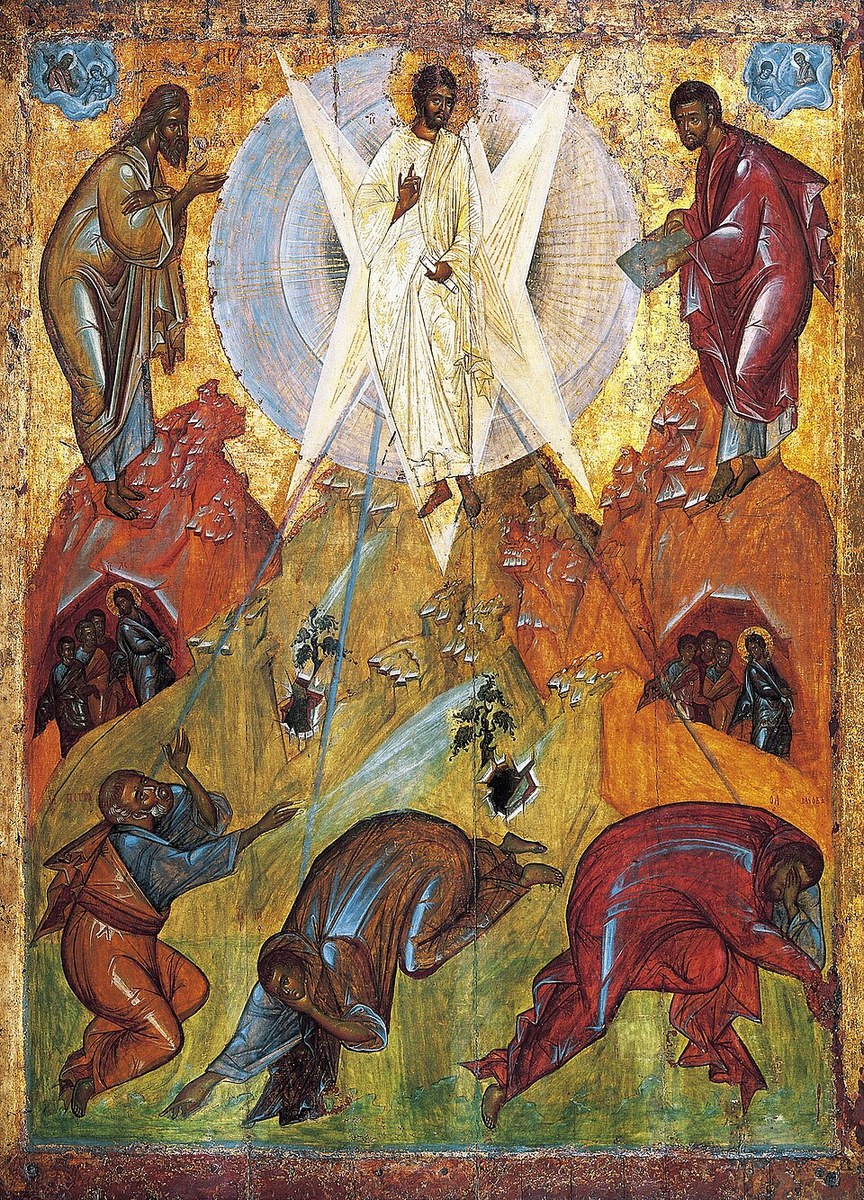
The Transfiguration is one of the great fixed types of Orthodox iconography, established in its essentials by the sixth century and elaborated but never overturned thereafter. Its structure is always the same, and always vertical: glory above, terror below.
At the centre and highest point stands Christ, frontal, upright, in garments of white — often rendered with fine gold or silver striations that make the cloth itself look like emitted light — his right hand raised in blessing, a scroll or the gesture of teaching in his left. He is enclosed in a mandorla, the almond or circular aureole that in Orthodox iconography marks uncreated glory. The mandorla of this feast is its most theologically loaded element: it is normally built of concentric bands which grow darker toward the centre rather than lighter, so that the closer one looks to the divine presence the deeper the blue-black becomes. This is the "divine darkness" of Dionysius the Areopagite made visible — the doctrine that God's inaccessibility increases with proximity, that the light is so far beyond seeing that at its source it registers as darkness. Superimposed on the bands there is very often a star of six or eight points, formed of two or more intersecting rhomboids, and from the mandorla rays shoot out — usually three principal shafts, one to each of the fallen disciples — which are the visual assertion that the light comes from Christ and strikes them, rather than falling on him from outside. No other feast icon uses rays this way; in the Theophany the ray descends from heaven upon Christ, here it issues from him.
Flanking him on the mountain peaks, and standing (not fallen), are Moses and Elijah, turned inward toward Christ in attitudes of conversation. Moses is the younger of the two in most recensions and holds the tablets of the Law, or a closed book; Elijah is the shaggy, grey, long-haired ascetic in a rough mantle, his hand raised in address. They are shown standing because they are at home in the glory; the apostles are shown fallen because they are not.
Below, on the lower slope, the three disciples are cast down in three distinct and carefully differentiated attitudes — the most humanly vivid passage in all Byzantine festal painting. Peter is commonly at the left, half-risen on one knee, one hand flung up to shield his eyes, the other gesturing toward Christ: he is speaking, proposing the three tabernacles. James is in the centre, thrown headlong, face to the ground, arms sprawled. John is at the right, tumbling backwards or downwards, upside down or with his back to the light, in the most violent of the three postures. Their limbs go in every direction, their garments fly, and one or more sandals is often shown coming off — a detail the painters loved, and a reference to the command at the burning bush to loose the shoes from the feet, for the place is holy ground. The contrast is the whole composition: above, three figures utterly still; below, three figures in complete disorder.
Fuller recensions add narrative scenes in the middle register: Christ leading the three up the mountain at one side and leading them down again at the other, the ascent and descent that frame the Gospel account; and, in the upper corners, angels bearing Moses and Elijah on clouds to the mountain — Elijah brought from heaven where he was taken alive, Moses brought up from Hades where he lay among the dead, a small visual footnote making the point about the living and the dead.
The stored icon is one of the supreme examples of the developed type: the festal panel painted about 1403 for the Cathedral of the Transfiguration at Pereslavl-Zalessky, long ascribed to Theophanes the Greek and now more cautiously attributed to his workshop or circle (the attribution is contested, the quality is not); it is in the State Tretyakov Gallery, Moscow. Christ stands in white in a great pale mandorla of concentric spheres crossed by a brilliant six-pointed star, three shafts of blue-white light driving down from him to the disciples below. Elijah leans in from the left crag in a golden-ochre mantle, Moses from the right in deep red with the tablets in his hands. Beneath them the three apostles are hurled down the ochre slope — Peter at the left on one knee with his hand raised against the light, James pitched forward on his face at the centre, John flung headlong at the right. In the middle register the ascent and the descent of the mountain are painted in miniature within the rocks, and in the two upper corners angels bring Moses and Elijah on blue clouds. The colour is the painter's argument: the light is white, and everything it falls on burns orange.
The second stored image is the ancestor of them all: the apse mosaic of the katholikon of the Monastery of Saint Catherine at Mount Sinai, set up under Justinian about 565–566 and surviving intact — the earliest monumental Transfiguration in existence, and one of the very few major works of sixth-century mosaic anywhere. Christ stands in a deep blue-green oval mandorla against a gold ground, blessing, with rays radiating from him to each of the five other figures. Elijah (ΗΛΙΑC) is at the left and Moses (ΜΩΥCΗC) at the right, both named in Greek beside their heads and both turned toward the centre. Below, John (ΙΩΑΝΝΗC) kneels at the left with both hands raised, James (ΙΑΚΩΒΟC) kneels at the right, and Peter (ΠΕΤΡΟC) lies prostrate beneath Christ's feet at the bottom of the conch. The whole is framed by a band of medallions containing the apostles and the prophets. That the sixth-century composition already contains everything — mandorla, rays, the two standing prophets, the three cast down, the names — is the measure of how early and how completely this icon was settled. That it was placed in the sanctuary of a monastery built at the foot of the mountain of Moses, above the altar, where the community that lived beside the burning bush would see it at every Liturgy, is a commentary in itself.