
Leontius of Rostov
Our Father among the Saints Leontius the Wonderworker, Bishop of Rostov
Bishop · Wonderworker · b. 11th century, at Constantinople (so the tradition) — d. c. 1073, at Rostov
Leontius was the first successful bishop of Rostov and the effective apostle of the north-east of Rus'. A monk of the Kiev Caves, of the generation of Sts Antony and Theodosius, he was sent about the middle of the eleventh century to a see whose two previous bishops had been driven out by its pagan inhabitants; he too was beaten and expelled from the city, settled in a small church of the Archangel Michael outside the walls, and there began again from the bottom, teaching and baptising the children of Rostov and winning their parents afterwards. When at last a pagan mob came against the cathedral he went out to meet it in full episcopal vesture with the cross in his hands, and — the life says — his fearlessness and his words broke the riot and converted many of those who had come to kill him. He was killed, or died, about 1073. In 1164, when the foundations of Andrei Bogoliubsky's new stone cathedral were being dug, his coffin was found and his body and vestments were incorrupt; that uncovering, on the twenty-third of May, is his feast, and it made him the first canonised saint of the Russian north-east.

Origins: a Greek or a Russian?
The oldest life makes Leontius a Greek, born at Constantinople, who came to Rus' and was formed as a monk in the Monastery of the Caves at Kiev under its founders — so that he was Greek by birth and Russian by profession, and (the notices stress) fluent in both the Greek and the Slavonic tongues, which is exactly what a missionary bishop of that generation needed. The Caves tradition claims him as the first bishop the monastery gave to the Russian Church, the head of the long line of hierarchs drawn from that house.
He came to Rostov in the reign of Yaroslav the Wise or of his sons — the notices are not agreed, and the see's early chronology is genuinely uncertain (see Disputed questions). The diocese was the vast, thinly Christianised country of the upper Volga and the Kliazma, whose population was in large part the Finnic Merya, and whose towns had a Christian minority at best. Two bishops, Theodore (†1023, June 8, who went on to Suzdal and is honoured as the first bishop of the see) and Hilarion, had already been driven out of Rostov by its pagans. Leontius came third.
Expelled from the city; the children of Rostov
He fared no better at first: the life says he was beaten and thrown out of the town. He did not leave the diocese. Outside Rostov, by the lake, he built himself a small church of the Archangel Michael and lived there — a bishop with a wooden chapel and no congregation.
What he did next is the most memorable thing about him, and the reason he succeeded where two predecessors had failed. Instead of preaching to the men of Rostov, who had already refused him, he gathered their children. He fed them — the notices say he baked kolivo, boiled wheat, and gave it to them — taught them the rudiments of the faith, and baptised them. The parents followed the children. Within a few years he had a Christian population where there had been none, and could return to the city and to the cathedral of the Dormition.
The mob at the cathedral
The reaction came, stirred (the life says) by the pagan priests and sorcerers, when the Christians were already numerous enough to be resented. An armed crowd gathered against the cathedral, some with clubs and some with weapons, intending to kill the bishop. The clergy hid. Leontius vested fully — sakkos, omophorion, mitre — took the cross, and walked out of the church to meet them at the doors, with his clergy behind him.
The account of what happened is sober enough to be credible in outline: the sight stopped them, he spoke, and the crowd broke up; several of those who had come to kill him asked for baptism. The scene is the standing subject of his narrative iconography and the heart of his cult: not a miracle of power but the plain courage of a bishop who would not run away.
Repose
He reposed about 1073, after a long episcopate, and was buried in the cathedral church of the Dormition at Rostov. Whether he died in peace after that long labour or was at last killed by the pagans is the one substantial disagreement in the record about him (see Disputed questions).
The uncovering of the relics, 1164
In 1164 Prince Andrei Bogoliubsky rebuilt the Rostov cathedral in stone. Digging the foundations, the workmen came upon two coffins. One held Leontius; the other held his successor Isaiah. Leontius' body was found whole, his face (the account says) shining, and his vestments entire after ninety years in the ground. The relics were laid in the new church, and the prince — who was building his own new ecclesiastical order in the north-east — pressed the veneration forward: a life and a service were written, and Leontius became the first saint of the Rostov–Suzdal land to receive a formal cultus, honoured from the later twelfth century onward and confirmed for the whole Russian Church at the councils of the sixteenth century.
The uncovering fixed his feast on the twenty-third of May — the day, not of his death, but of the finding — which is why the same date is also the feast of the uncovering of St Isaiah's relics, and why the Synaxis of the Saints of Rostov and Yaroslavl was afterwards attached to it.
Veneration and later cultus
Rostov keeps him as its first patron, and the trio of its founding hierarchs — Leontius, Isaiah and Ignatius — became a standing iconographic group. Miracles of healing at the tomb are recorded from the twelfth century. His relics remained in the Dormition cathedral at Rostov, in a silver shrine from the seventeenth century; the Soviet authorities opened the shrine in the 1920s, as they did the other great Russian reliquaries. He is invoked as the enlightener of the Rostov land, and the Kiev Caves Lavra honours him among the fathers of the house who became bishops.
Feast and commemoration
May 23 (church date; New Calendar civil May 23, Old Calendar civil June 5) — the uncovering of the relics in 1164, which serves as his principal feast, there being no reliable date for his repose. The commemoration is Russian and Ukrainian, kept also by the Orthodox Church in America; it is not in the Greek or Antiochian books, where May 23 belongs to Michael of Synnada and Mary of Cleopas. On the same day the Russian calendars keep the uncovering of the relics of his successor Isaiah — found in the same excavation — and the Synaxis of the Saints of Rostov and Yaroslavl, instituted by Patriarch Alexis I in 1964, which gathers some ninety saints of that region and takes this date precisely because it is Leontius' day. At Rostov he is honoured with Isaiah and Ignatius as one of the three founding hierarchs of the see.
Hymns
Apolytikion — Tone 4 (common of a hierarch)
O God of our fathers, who dealest with us ever according to Thy gentleness: take not Thy mercy from us, but by the prayers of Leontius direct our life in peace.
Kontakion — Tone 2
Sent to a people that knew not God, thou wast beaten and cast out of the city, yet thou didst not forsake thy flock; but gathering the children thou didst give them the bread of the faith, and going forth with the Cross against the raging crowd thou didst turn their weapons into prayers. O hierarch Leontius, first shepherd of the Rostov land, intercede for our souls.
Original translation from the Slavonic
Iconography
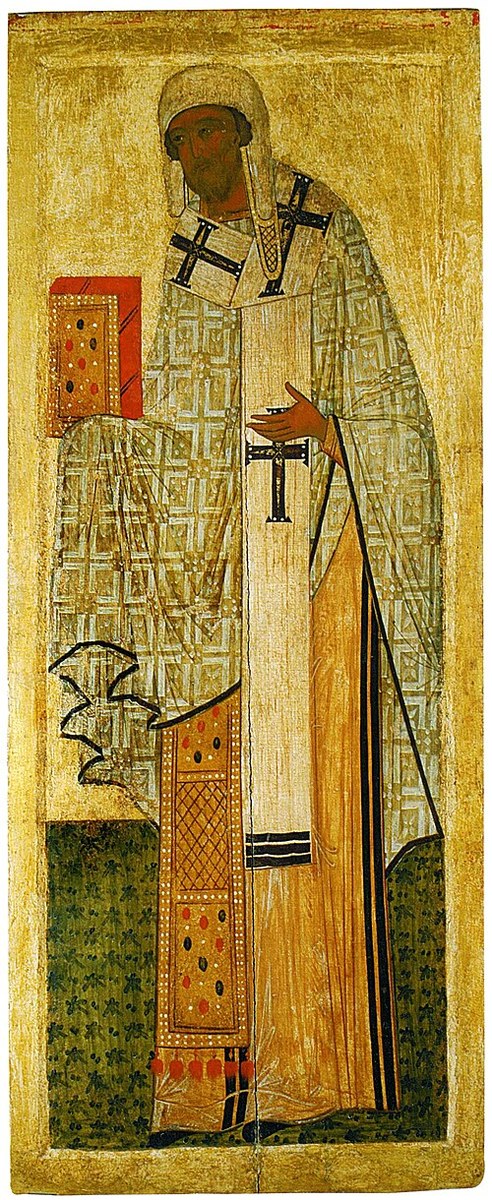
Leontius is painted as a Russian hierarch of the earliest period, and because he stood at the head of the Rostov succession his image is one of the fixed points of Rostov icon-painting from the fourteenth century onward. The type is: a full-length or bust-length bishop, an ascetic face with a short greying beard, the polystavrion phelonion — the cross-covered vestment of the ancient hierarchs — or a patterned sakkos, the omophorion with large crosses, the epigonation at the side, the Gospel book held in the covered left hand and the right raised in blessing; on the head either a white klobuk or the low early Russian mitre. He is regularly shown in the deesis tier of Rostov iconostases, turned three-quarters towards the centre in intercession.
His two distinguishing groupings are the three hierarchs of Rostov — Leontius, Isaiah and Ignatius standing together, known from Rostov panels of the later fifteenth century — and the wider assemblies of the saints of Rostov and Yaroslavl. Narrative cycles paint the scenes of the life: the bishop teaching and baptising the children by the lake, and above all the confrontation at the cathedral doors, where he stands vested with the cross before an armed crowd.
The stored image is such a deesis figure: a panel of the last quarter of the fifteenth century, Rostov school, from the deesis tier of the cathedral of the Borisoglebsky monastery on the Ustye near Rostov, now in the State Museum-Preserve "Rostov Kremlin" (inventory И-530, linden panel, tempera, 168 × 67.5 cm). The saint stands full length in three-quarter turn, nimbed, in a silver-white patterned phelonion with the black-crossed omophorion and a jewelled epigonation, the low white cowl on his head, the red Gospel held away from the body in the left hand and the right hand open in prayer. The panel carries no surviving inscription: the identification is the museum's and that of the Russian icon-art catalogue that publishes it, not an uploader's guess, and it is recorded here as resting on that attribution.
Disputed questions
Martyrdom or repose in peace? The Russian Church's liturgical title for him is svyatitel' — hierarch, not martyr — and his office is that of a bishop. But an important strand of the hagiographical tradition, followed in several printed lives and in the Slavonic notices reproduced by the Russian devotional literature, says that he was killed by the pagans at the instigation of their priests, about 1073. Both are transmitted; the calendars have not harmonised them. This entry follows the liturgical designation — hence types: [bishop, wonderworker] and not hieromartyr — while recording that the violent death is well attested in the narrative sources. A reader who meets "the hieromartyr Leontius of Rostov" has not met a different saint.
The date of his episcopate. The early Rostov succession is one of the vexed problems of eleventh-century Russian church history. The notices place his consecration variously in the 1040s, under Yaroslav the Wise, and around 1051–1073; his predecessors Theodore and Hilarion are barely more than names; and the number of years he is given at Rostov varies accordingly. The 1164 uncovering is the first firmly dated event in his dossier, and the chronology behind it is reconstruction.
Greek or Russian by birth? The tradition of a Constantinopolitan birth is old but has been doubted, partly because the northern Russian sees of that generation were being filled from Kiev rather than from Byzantium, and partly because the claim serves the Caves monastery's own narrative. The bilingualism ascribed to him is consistent with either origin.
Not to be confused with the other Leontii of the calendar — the martyr Leontius of Tripoli (June 18), the soldier-martyr of the Phoenician coast; Leontius the Canonarch of the Kiev Caves (June 18), who like this saint was a monk of the Caves; Leontius the Athonite and Leontius the Shepherd, also of June 18; the Leontius of the company of Leontius, Dometius, Terentius and Domninus (October 16); and Leontius, patriarch of Jerusalem (May 14) — nor with Leontius of Rostov's own successors in the see.