
Leontius of Jerusalem
Our Father among the Saints Leontios, Abbot of Patmos and Patriarch of Jerusalem
Patriarch · Bishop · Venerable · b. first half of the 12th century, at Tiberioupolis in Phrygia — d. 14 May, c. 1185 (dates from 1175 to 1190 are transmitted)
Commemorated 14 May — Repose; kept on Patmos and in Jerusalem
Leontios of Jerusalem was a Phrygian monk who became abbot of the great monastery of Saint John the Theologian on Patmos and then, unwillingly, Patriarch of Jerusalem — called to the mother see at the worst moment in its medieval history, when the Holy City was in Latin hands and its Orthodox patriarch could not securely reside there. He had refused a bishopric in Russia and another in Cyprus from the hand of the emperor Manuel Komnenos, and accepted Jerusalem only because he judged that it could not be refused. He governed a church in exile, travelled into Palestine at real risk, fell foul of the tyranny of Andronikos Komnenos and was banished, and reposed in great old age on the fourteenth of May. Patmos, which formed him, and Jerusalem, which he served, keep his memory on that day.

Phrygia and the monastery of Ptelidion
Leontios was born at Tiberioupolis in Phrygia, of parents who were both wealthy and devout; the year is not recorded, but it falls in the earlier part of the twelfth century. He was still a boy — the Life says between fifteen and seventeen — when his father died. He left his birthplace, put himself to study under a pious priest, and then entered the monastery of the Mother of God at Ptelidion, where he was tonsured a monk.
From Ptelidion he came to Constantinople, and there attached himself to the Metropolitan of Tiberias as his elder, submitting himself to him in obedience. When that hierarch set out to return to his diocese, Leontios went with him, and on the way they put in at Patmos to venerate at the monastery of Saint John the Theologian, the great foundation of Christodoulos. Leontios then set out for Cyprus; but, as his biographer reads the event, the will of God turned him back, and he came again to Patmos — and stayed.
Abbot of Patmos
On Patmos he lived under the hegoumenos Theoktistos, a man of proven spiritual experience, and under his guidance became known in the community for brotherly love and humility above all else. When Theoktistos reposed, the monks chose Leontios to succeed him by unanimous vote.
As abbot he had charge not only of the community but of its estates, and the sources record the journeys this entailed. He went to Crete, where the Patmos house held a dependency within the walls of the ancient city of Aptera, above the harbour of Kalami on the Souda bay; and he went to Constantinople on the monastery's business. It was there that he came to the notice of the emperor Manuel I Komnenos (1143–1180), who conceived a high respect for him and offered him episcopal office — a bishopric in Russia, or one in Cyprus. Leontios declined both, out of humility.
Patriarch of a captive city
Then the throne of Jerusalem was offered him, and this, the Life says, he could not refuse. He was made Patriarch of Jerusalem — the Greek tradition dates his elevation to 1170, modern scholarship a few years later — at a moment when the Church of Jerusalem was "being tested by the domination of the Latins." Since the First Crusade the Holy City had had a Latin patriarch installed in the Anastasis, and the Orthodox patriarchs of Jerusalem lived in practice at Constantinople, administering their flock at a distance and depending on the emperor's protection.
Leontios' patriarchate was therefore an exercise in governing what he could not hold. The tradition credits him with journeying into Palestine notwithstanding the Latin regime, with labouring for the Orthodox monasteries and the Arabic-speaking faithful of the patriarchate, and with maintaining the claim of the see against the Latin hierarchy — the standing question of the twelfth-century East, and one in which the Antiochian and Jerusalem patriarchates shared the same predicament.
Exile and repose
The end of his life fell in the violent last phase of Komnenian rule. When Andronikos Komnenos seized power (1183–1185) and turned on the aristocracy and the churchmen who would not serve his purposes, Leontios — whose moral authority over the new emperor's court the sources describe as an offence to him — was sent into exile. He died there, at a great age, on the fourteenth of May. The Life gives the year as 1190; other reckonings, ancient and modern, place his death in 1185 or as early as 1175.
Veneration and later cultus
Leontios is honoured chiefly in the two places that have the best claim to him: Patmos, where he had been abbot and where his memory is kept in the monastery of Saint John, and Jerusalem, whose throne he had held. A service of the saint was printed at Jerusalem in 1912, which indicates a cult still living at the beginning of the twentieth century. His Life was translated from Greek into Russian in an abridged form, and afterwards more fully by Nikodemos the Hagiorite (†1809), whose version is the vehicle by which most of the tradition reached the modern synaxaria.
Feast and commemoration
May 14 (church date; Old Calendar civil May 27), "commemorated on Patmos and in Jerusalem," as the synaxarion notes, and listed on this day in the Greek synaxarion and by the Orthodox Church in America. In Greek and Antiochian usage the day is headed by Isidore of Chios and the hieromartyr Therapon of Cyprus, with Leontios third; his own proper service, printed at Jerusalem in 1912, is used where it is available, and elsewhere he is sung with the common of a hierarch. Depending on the year the day falls late in the Paschal season or after Pentecost.
Hymns
Apolytikion — Tone 4 (common of a hierarch)
A rule of faith and an image of gentleness, a teacher of abstinence, hast thou been shown forth to thy flock by the truth of things; wherefore thou hast gained the heights by humility, and riches by poverty. O father and hierarch Leontios, intercede with Christ God that our souls may be saved.
Kontakion — Tone 2 (common of a hierarch)
Having shone forth as a shepherd upon the throne of the Holy City in the days of its affliction, thou didst keep the flock entrusted to thee and wast not shaken by exile: pray for us who honour thee, O all-blessed hierarch Leontios.
Original translation from the Greek
Iconography
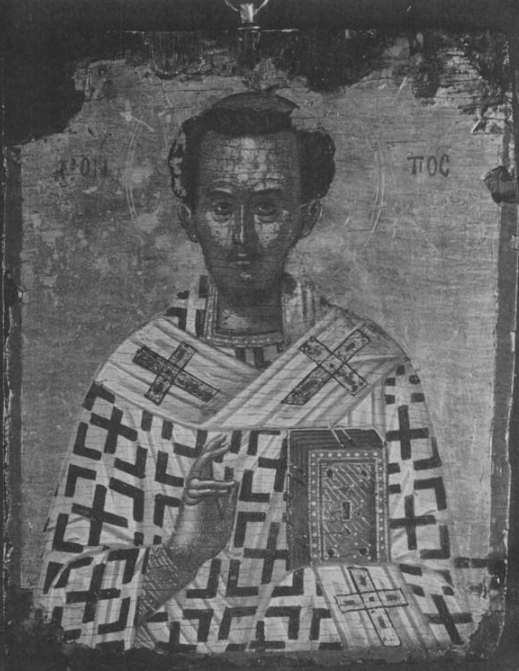
Leontios is painted as a hierarch of patriarchal rank: bareheaded, in the polystaurion phelonion — the cross-patterned vestment proper to patriarchs and metropolitans — with the crossed omophorion, blessing with the right hand and holding the jewelled Gospel in the left, which he supports at his breast. He is shown with dark hair and a short rounded beard rather than as an old man, which is worth noting given that he died in advanced age: the type follows the Patmos portrait tradition rather than the biography. Where he is painted at Patmos he may be grouped with the founder Christodoulos and the other abbots of the house; where he is painted at Jerusalem, among the patriarchs of the mother church.
The stored image is a fifteenth-century panel of the Cretan school from the treasury of the Monastery of Saint John the Theologian on Patmos, inscribed for a saint who is described in the monastery's records as "abbot and patriarch" — that is, this Leontios, the one man who was both. It is a bust-length figure in a white polystaurion of black crosses over the crossed omophorion, the right hand raised in blessing before the breast, the left holding an ornamented Gospel; the ground and the upper field are heavily abraded, and only fragments of the inscription survive.
Disputed questions
- The dates of his patriarchate and death. The transmitted figures are irreconcilable. (i) The Life as received gives elevation in 1170 and death on 14 May 1190. (ii) Nikodemos the Hagiorite, who worked on the fuller text, held that the patriarch died in 1175. (iii) Saint Gregory Palamas and Theodore, a monk of Constantinople, are cited for a patriarchate of 1223–1261 — a figure that cannot belong to this Leontios and almost certainly attaches to another holder of the see. (iv) Greek liturgical almanacs sometimes print the years 912–929 beside his name on May 14, which are the dates of the earlier Leontios I of Jerusalem and represent a confusion of the two. Modern historical work, resting on the Life composed by Theodosios Goudeles, places his patriarchate in the later 1170s and his death about 1185; this entry gives c. 1185 while recording the alternatives.
- The distinction of the Leontii of Jerusalem. There were at least two patriarchs of Jerusalem of the name; the saint of May 14 is the abbot of Patmos, sometimes numbered Leontios II, and not the tenth-century Leontios I.
- Not to be confused with the martyr Leontius of Tripoli (June 18), the great soldier-martyr of the Phoenician coast, or with the three other Leontii of that same day — the Canonarch of the Kiev Caves, the Athonite and the Shepherd; with Leontius, first bishop of Rostov (May 23), whose name stands beside that of Isidore of Rostov in the Rostov synaxis; or with the Leontius of the company of Leontius, Dometius, Terentius and Domninus.