
Liberius of Rome
Our Father among the Saints Liberius the Confessor, Pope of Rome
Confessor · Bishop · d. 24 September 366, at Rome
Commemorated 27 August — Commemoration of the confessor bishop of Rome
Liberius was bishop of Rome from 352 to 366, through the worst years of the Arian pressure, and the Orthodox Church commemorates him as a confessor for what he endured under the emperor Constantius II: refusing the imperial bribe, refusing to sign the condemnation of Athanasius of Alexandria, and going into exile at Beroea in Thrace while an intruded rival, Felix, sat in his city. The Roman people would not accept the substitute, and Constantius was obliged to send him back; but the sources say that before his return he was made to subscribe a formula of Sirmium, which he afterwards repented and spent the rest of his life undoing. He is the earliest bishop of Rome whom the Roman Church does not number among the saints — and the Orthodox Church does, on August 27.

Election and the first refusal
Liberius was a Roman, and was elected bishop of the city on 17 May 352, in succession to Julius I. His whole pontificate was determined by a single question: whether the West would join the East in condemning Athanasius, and with him the faith of Nicaea.
The pressure began at once. At the council of Arles in 353 the papal legates gave way and subscribed the condemnation of Athanasius; Liberius repudiated what they had done. At Milan in 355, with the emperor present and the bishops told plainly that his will was the canon, the resistance collapsed except for a handful — Eusebius of Vercelli, Lucifer of Cagliari, Dionysius of Milan — who were exiled for it. Liberius still would not sign.
Constantius then sent the court eunuch Eusebius to Rome with gifts, to buy the signature. The scene is one of the best remembered of the fourth century: Liberius refused the money, and the eunuch left the offering at the shrine of St Peter, from which Liberius had it thrown out.
Exile at Beroea
Liberius was brought to Milan and interrogated by the emperor in person. He asked for a fresh council, for the restoration of the exiled bishops, and for the faith of Nicaea; he was given three days to conform, and refused. He was exiled to Beroea in Thrace (modern Veria in Macedonia), where the local bishop Demophilus, an Arian, had the keeping of him. His goods were confiscated; the deacon Felix — Felix II — was consecrated at Rome in his place.
The city would not have it. Roman Christians, and particularly the women of the great households, made the position of the intruded bishop untenable; when Constantius came to Rome in 357 he was met by open demands for Liberius. The emperor gave way and recalled him. Felix was expelled, and Liberius resumed his see in 358.
Sirmium
The recall was not unconditional, and this is the difficult passage of his life. The sources report that before his restoration Liberius was summoned to Sirmium and there subscribed a creed — most probably the formula of Sirmium of 351, which is not itself heretical but which avoided the homoousion and was the instrument of the anti-Nicene party — and communicated with the eastern bishops, and that he assented to the condemnation of Athanasius. Four letters attributed to him from this period survive among the fragments of Hilary of Poitiers.
Whatever precisely he signed, he did not remain in it. From his return, and above all after the death of Constantius in 361 removed the pressure, Liberius laboured openly for the Nicene cause: he rejected the council of Ariminum, received back the bishops who had lapsed there on their repentance, and in 366 received a delegation of eastern Macedonian bishops into communion on their express subscription of the homoousion — an act which shows exactly where he stood at the end. He died on 24 September 366 and was succeeded, after a violently disputed election, by Damasus.
Veneration in East and West
The eastern synaxaria kept him as a confessor. The Byzantine memory of him was formed by the Athanasian dossier: to the Greek East, Liberius was one of the western hierarchs who suffered for the exiled patriarch of Alexandria, and the Sirmian episode weighed less than the years of resistance and the whole second half of his episcopate. Hence his place on August 27, next to Hosius of Cordoba, whose story is the same story.
The Latin West judged differently. Because of Sirmium, Liberius was never entered in the Roman martyrology, and he is the earliest bishop of Rome not venerated as a saint by the Roman Catholic Church. That the Orthodox Church commemorates him and the Roman Church does not is a fact worth stating plainly rather than smoothing over: the two traditions have weighed the same evidence and reached opposite verdicts.
Feast and commemoration
August 27 (church date; New Calendar civil August 27, Old Calendar civil September 9). He shares the day with Poemen the Great, whose commemoration is the principal one, and with Hosius of Cordoba; the pairing of the two western confessors of Athanasius on one day is evidently deliberate. There is no proper office; the common of a confessor-hierarch serves. In practice his memory is kept as a commemoration at the Sixth Hour and at Vespers rather than with a festal service.
Hymns
Apolytikion — Tone 4 (common of a confessor-hierarch)
O God of our fathers, who ever dealest with us according to Thy gentleness: take not Thy mercy from us, but by the prayers of Thy hierarch Liberius, who chose exile before the favour of kings, guide our life in peace.
Iconography
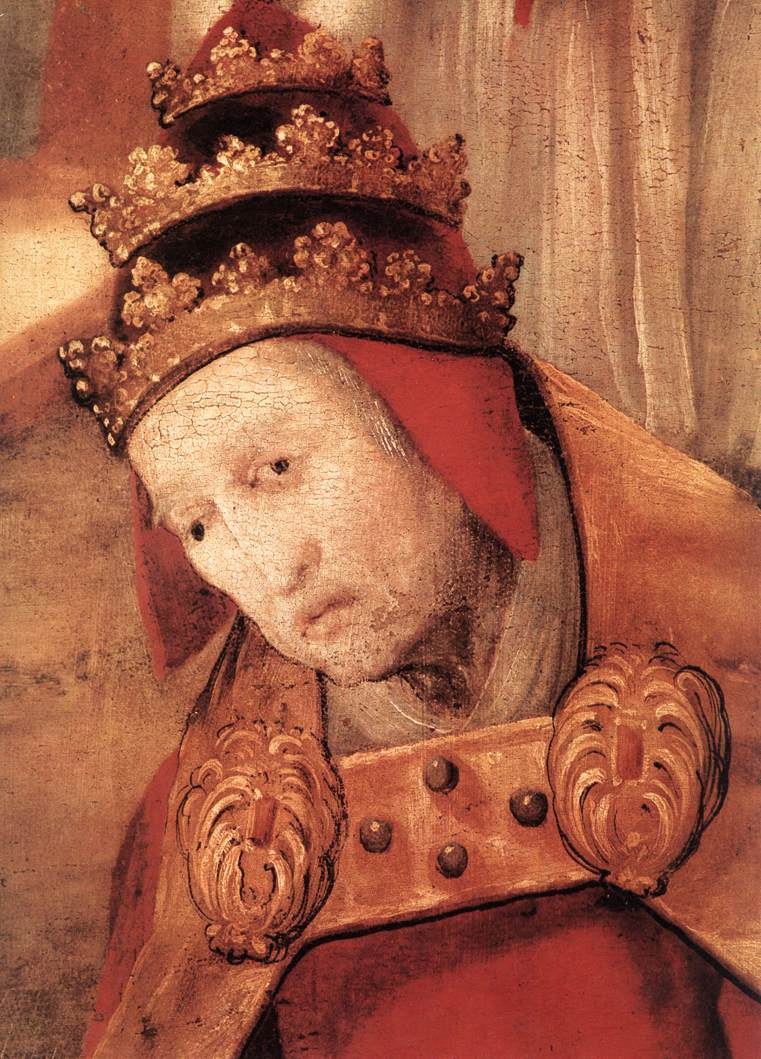
Liberius is painted, where he is painted at all, as a bishop of the Roman rank: elderly, short-bearded or white-bearded, in phelonion and omophorion, blessing and holding the Gospel. He has no attribute of his own. In western art he appears almost exclusively in the legend of the snowfall on the Esquiline, tracing the ground-plan of Santa Maria Maggiore with a hoe in the snow — a scene painted many times from the fifteenth century onwards (Masolino, Murillo and others), which belongs to the medieval legend and not to the historical man, and which has no Orthodox iconographic counterpart.
The stored candidate below is western, as expected: a woodcut in the Nuremberg Chronicle of 1493, which uses a stock papal block reused for several popes and is therefore not a portrait in any useful sense, and Baroque paintings of the snow legend. Neither serves as an icon of the saint.
The stored image is a Western work per §34: Grünewald's panel of the miracle of the snows (1517–1519), the pope tracing the plan of Santa Maria Maggiore where the August snow fell. An Eastern image remains wanted and is listed among the upgrade-wanted icons.
Disputed questions
- What did Liberius sign? The question is old and unresolved. The four "Liberian letters" preserved in Hilary's fragments are the only direct evidence, and their authenticity has been contested since the sixteenth century; some scholars hold them genuine, others regard them as wholly or partly forged by the Arianising party or by later Luciferians hostile to Liberius. Even if genuine, they show subscription to the first Sirmian formula of 351, which no council ever anathematised, rather than to the "blasphemy" of 357 which Hosius was made to sign. The Church's commemoration of him as a confessor presumes the milder reading; the difficulty is recorded here, not resolved.
- The Liberian basilica and the miracle of the snow. The great Roman basilica of Santa Maria Maggiore is sometimes called the Liberian basilica, and a medieval legend attaches its foundation to Liberius and to a summer snowfall on the Esquiline that traced the plan of the church (kept in the West on August 5). The legend is many centuries later than Liberius, is not attested before the high Middle Ages, and forms no part of the eastern commemoration; it is noted here only because it is the form in which his name is most often met in art.
- Felix II. The rival consecrated in Liberius' absence was himself later confused with a martyr Felix and entered in some western lists as a saint and pope, an error that has since been corrected. He has no place in the Orthodox calendar.