
Longinus the Centurion
The Holy Martyr Longinus the Centurion, who stood at the Cross of the Lord
Martyr
Commemorated 16 October — Martyrdom in Cappadocia, with the two soldiers who suffered with him
Longinus the Centurion (1st century) is, in the tradition of the Church, the Roman officer who commanded the execution detail on Golgotha and confessed at the death of Christ, "Truly this was the Son of God" (Matthew 27:54). The tradition further knows him as the soldier who pierced the Lord's side with a spear, and as head of the watch at the Tomb who refused the Sanhedrin's silver rather than deny the Resurrection. Returning to his native Cappadocia, he preached Christ and was beheaded through Pilate's machinations; the finding of his head by a blind widow, who received her sight at its touch, made him the saint invoked above all for afflictions of the eyes. His feast is October 16.
.jpg)
The centurion of the Gospels
Longinus enters history anonymously, in the three sentences the Synoptic Gospels give to the officer in charge of the Crucifixion. Matthew writes that "the centurion, and they that were with him, watching Jesus, saw the earthquake, and those things that were done," and "feared greatly, saying, Truly this was the Son of God" (Matthew 27:54). Mark sets the confession at the moment of Christ's death-cry (Mark 15:39); Luke gives it the form "Certainly this was a righteous man" (Luke 23:47). The fourth Gospel adds, without a name, the soldier who "with a spear pierced his side, and forthwith came there out blood and water" (John 19:34).
The Church's tradition gathered these figures into one man. The centurion who confessed and the soldier who pierced are identified with each other from an early date, and the guard set over the Sepulchre (Matthew 27:62–66) is placed under the same officer's command: when the soldiers of the watch fled into the city to report the Resurrection and the chief priests "gave large money unto the soldiers" to say the disciples had stolen the body (Matthew 28:11–15), Longinus and two comrades, the tradition holds, refused the bribe and would not be silent about what they had seen. The three notices — the confession at the Cross, the piercing, and the refused silver of the Tomb — form the whole scriptural dossier of the saint, and the hymnography of his feast draws on each in turn.
The name itself is first transmitted outside the Gospels. The apocryphal Acts of Pilate (the core of the later Gospel of Nicodemus) names the soldier who pierced the Lord's side "Longinus," and it is from this tradition that the name passed to the whole figure. Scholars have long observed that the name may itself derive from the spear — λόγχη (lonchē) in the Greek of John 19:34 — though Longinus was also a perfectly ordinary Roman cognomen. The earliest surviving labelled image, the Crucifixion miniature of the Syriac Rabbula Gospels (A.D. 586), already writes ΛΟΓΙΝΟΣ above the soldier thrusting the lance: by the sixth century, name and figure were fixed together across the Christian world.
From Golgotha to Cappadocia
The hagiographic tradition — transmitted in the encomium of Hesychius, presbyter of Jerusalem (5th century), in the Synaxarion of Constantinople, and in the Lives descending from them — makes Longinus a Cappadocian by birth, serving in Judea in the auxiliary forces under the governor Pontius Pilate. A late and much-loved strand of the tradition, preserved in the Russian prayers to the saint, relates that Longinus suffered from a disease of the eyes, and was healed when blood and water from the pierced side of the Lord fell upon them: the man who gave the Savior his wound was the first to be healed by it, receiving bodily sight and spiritual sight together.
After the Resurrection and Ascension the tradition has Longinus baptised with his two faithful comrades by the apostles. Leaving military service, and with it the danger and the profit of Pilate's court, he returned to his Cappadocian homeland with his two companions and preached there what he had seen with his own eyes: the darkness, the earthquake, the opened graves, the empty tomb. The witness of a Roman officer who had himself commanded on Golgotha carried extraordinary weight, and the accounts speak of the rapid spread of the faith in his district of Cappadocia.
Martyrdom
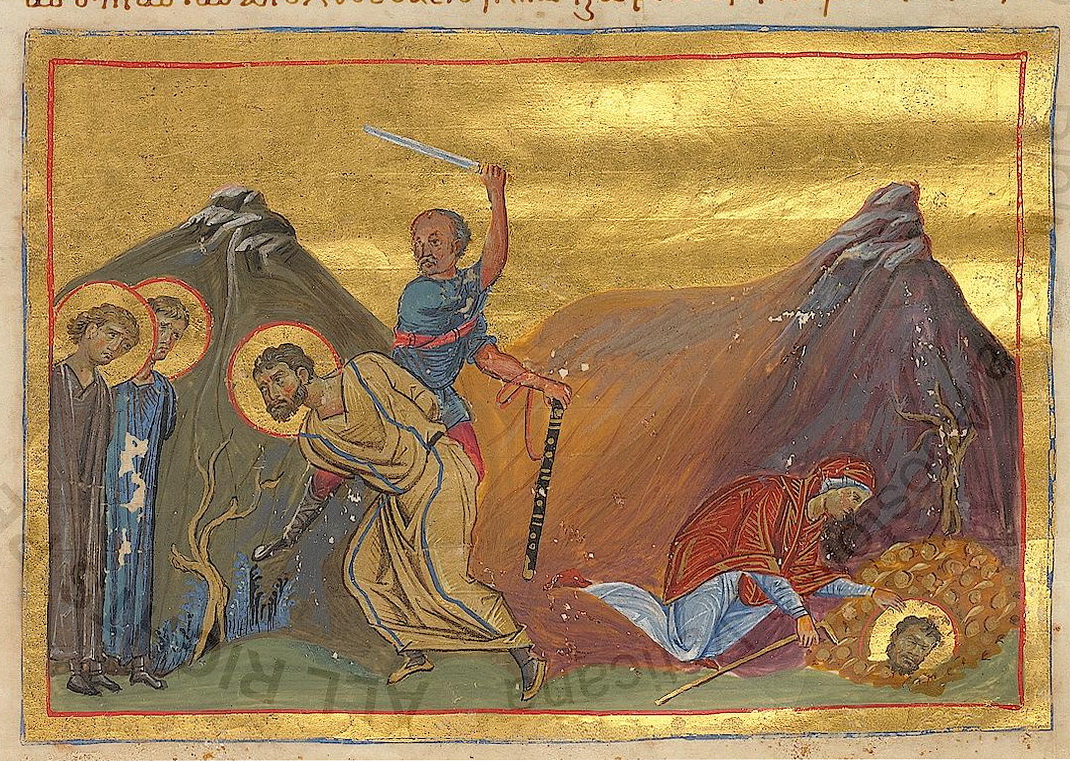
The success of the mission was reported back to Judea. The elders in Jerusalem, the accounts relate, persuaded Pilate that the fugitive centurion was spreading sedition, and — by the machinations of Pilate and, in the fuller Lives, with a condemnation procured from the emperor Tiberius — a detachment of soldiers was sent to Cappadocia to behead Longinus and his two companions. What follows is one of the most humane scenes in the martyrology: the soldiers, arriving at his village, were met by Longinus himself, who welcomed them into his house, fed them, and lodged them, without telling them who he was. When at table they disclosed their errand, he revealed himself and presented his two companions. The startled soldiers wished to let the three escape; Longinus refused, put on his burial garment, and directed them to carry out their orders. The three were beheaded, and the bodies buried at the place of martyrdom; the head of Longinus was carried back to Pilate as proof, and by his order cast on a refuse heap outside the walls of Jerusalem.
No year is transmitted for the martyrdom; it belongs, in the logic of the accounts, to the years while Pilate still held office (he was recalled in 36/37), within a few years of the Crucifixion itself.
The finding of the head
The synaxarion account continues with the miracle that fixed the character of the saint's later veneration. A certain widow of Cappadocia, who had lost her sight and found no help from physicians, made her way to Jerusalem to pray at the holy places, led by her only son; in Jerusalem the boy fell ill and died. The martyr appeared to the grieving woman in a dream, comforted her, and directed her to the refuse heap outside the walls, telling her she would find there the head of Longinus and, with it, her sight. Led by companions to the place, she dug with her own hands, and at the touch of the martyr's head her eyes were opened. In a second vision she saw the martyr in glory with her son beside him, radiant, and heard him say that God had numbered the boy in His kingdom; she was to bury the head with her son's body in one coffin, and grieve no more. She carried both back to Cappadocia and buried them there, and the tomb became a place of healing.
From this account flows the saint's standing patronage: in Greek and Russian practice alike, Longinus is the martyr invoked for diseases and afflictions of the eyes, and the Russian Book of Needs tradition carries proper prayers to him for those "ailing in their eyes" — prayers which retell the whole story, from the drop of blood at the Cross to the widow at the refuse heap.
Relics and later cultus
The primary tomb of the tradition is the Cappadocian one, holding the head and the widow's son; the sanctuaries of Jerusalem also kept his memory, and a chapel of Saint Longinus stands to this day in the ambulatory of the church of the Holy Sepulchre, hard by the traditional places of the events in which he took part. In the medieval West a divergent legend grew up around Mantua, which claimed that Longinus had come to Italy bearing earth soaked with the Blood of Christ and had been martyred there; the basilica of Sant'Andrea in Mantua keeps relics under his name, and the Roman calendars long commemorated him on March 15 (the Byzantine East knows nothing of the Italian journey; see Disputed questions). At Rome, Bernini's colossal statue of Longinus — lance-armed, arms flung wide at the moment of confession — stands in one of the four piers under the dome of St. Peter's, where the Vatican's portion of the lance relic was kept.
The spear itself, the "Holy Lance," has a long relic-history of its own, which is noted here with reserve. A lance venerated as the one of John 19:34 is attested at Jerusalem from the sixth century (the Piacenza pilgrim saw it about 570); its point was later taken to Constantinople, passed to the Latin kings of France in the thirteenth century with the relics bought by Louis IX for the Sainte-Chapelle, and disappeared in the French Revolution; a larger portion, kept at Constantinople until the Ottoman conquest, was sent by Sultan Bayezid II to Pope Innocent VIII in 1492 and remains at St. Peter's. Rival lances — the imperial "Holy Lance" of Vienna, the lance dug up at Antioch by the First Crusade in 1098, and the Armenian lance of Geghard now at Etchmiadzin — testify to the breadth of the devotion rather than to any verifiable connection with the centurion, and none of these claims is adjudicated by the Church's calendar, which venerates the man and not the weapon.
Hymnographic and literary legacy
The oldest substantial literary monument of the cult is the encomium on the martyr by Hesychius, presbyter of Jerusalem (first half of the 5th century), which transmits the Cappadocian martyrdom and the finding of the head; the synaxarion notices are abridgements of the same tradition. In the Menaion, the canon of the saint is the work of Joseph the Hymnographer (9th century), in Tone 4, with the acrostic "I shall hymn the great glory of Longinus"; the doxastika of Vespers are ascribed to John the Monk. The hymnography returns again and again to the paradox of the executioner turned confessor: the sticheron of the aposticha has the Savior himself answer the centurion's cry with "Blessed art thou, Longinus, and thy memorial from generation to generation." Dimitri of Rostov retold the Life at length in the Slavic Menologion, and the Russian prayer tradition, as noted, composed proper prayers to the saint for the healing of the eyes.
Feast and commemoration
October 16 (church date; Old Calendar civil October 29), kept universally in the Byzantine rite as the day of the martyr's beheading in Cappadocia. The Greek synaxarion of the day appends a separate notice, with its own verses, for "the two holy Martyrs who were slain with Saint Longinus" — the comrades of the watch who followed him from Golgotha to Cappadocia; they have no independent cultus and are commemorated with him (and in this entry). The Slavic calendars keep the same feast, and the Russian tradition surrounds it with the two monastic Longini named above, who took the martyr's name. In the West the Roman Martyrology long commemorated Longinus on March 15, with the Mantuan tradition noted above.
Hymns
Troparion — Tone 4
Thy Martyr, O Lord, by his contest received an incorruptible crown from thee, our God; for possessing thy strength he cast down the tyrants and broke the powerless insolence of the demons. By his intercessions, O Christ God, save our souls.
Original translation from the Greek
Kontakion — Tone 4
With gladness the Church rejoiceth today on the memory of the far-famed athlete Longinus, crying aloud: Thou art my might, O Christ, and my firm support.
Original translation from the Greek
Stichera
In thy Passion, O Christ, Longinus the Centurion, beholding the veil of the temple rent asunder, proclaimed to the Jews that thou art the Son of God. Wherefore the wicked cut off his sacred head with the sword and cast it on a dunghill; but a woman found it, and the closed pupils of her eyes were opened. With her we also cry to thee: O thou who didst crown him that contended for thee, at his entreaties enlighten the eyes of our hearts also, that we may glorify thee, our God, nailed to the Cross for our salvation.
Iconography
Longinus is the rare saint whose image belongs first of all to another icon: he appears in virtually every Orthodox Crucifixion, either as the soldier driving the lance into the Savior's right side, or — the subtler type — as the officer standing among the soldiers at the right of the Cross, his hand raised toward the Crucified in the gesture of his confession, often nimbed and sometimes labelled by name. The Rabbula Gospels miniature of 586 already names him; the type runs unbroken through Cappadocian fresco, Byzantine mosaic, and the Cretan and Russian schools.
His own festal image takes two principal forms. The menologion type shows the martyrdom: the stored primary image is the miniature of the Menologion of Basil II (c. 985; Vat. gr. 1613, p. 117), whose Greek title — "the contest of the holy martyr Longinus the Centurion" — stands legibly above a single composition uniting the beheading (Longinus bowing beneath the sword, his two haloed companions waiting behind him) with the sequel: at the right, the widow in red bends over the refuse heap and draws out the martyr's nimbed head. The identification is secured by the manuscript folio itself; the Commons file description mislabels the image in Russian as "Jonah the presbyter" (a copy-paste error — Jonah's miniature is a different folio of the same manuscript), and the file carries a faint diagonal watermark from its source scan, to be replaced if a cleaner reproduction surfaces.
The portrait type, beloved in Russia, shows a soldier in armor with the martyr's cross, a cloak, and the distinctive white kerchief bound about his head. The stored variant is of this type: the temple icon of the martyr painted in the 1680s by the tsar's iconographer Fyodor Zubov for the Verkhospassky cathedral of the Moscow Kremlin, photographed with its chased metal revetment and frame (identity per the museum attribution and the Slavonic titulus; the revetment is itself pre-modern work). Variant provenance: Wikimedia Commons, File:LonginusFyodorZubov.jpg (PD-Art, pd-old-work basis).
Disputed questions
- One figure or several. Matthew's confessing centurion, Luke's centurion who "glorified God," and John's anonymous lance-bearer are distinct notices which the tradition has read as one man; the identification is devotional and ancient, not demonstrable from the text. Luke's form of the confession ("a righteous man") differs from Matthew's and Mark's ("the Son of God"), and the hymnography quotes the stronger form.
- The name. "Longinus" first appears in the Acts of Pilate tradition, and its resemblance to λόγχη (lance) has suggested to many scholars that the name grew out of the story; the tradition transmits it as the man's name, and this entry records both facts.
- East and West. The Byzantine tradition martyrs Longinus in Cappadocia; the Mantuan legend martyrs him in Italy. The two are irreconcilable and are recorded here without harmonisation; the Byzantine calendar keeps October 16, the Roman Martyrology kept March 15.
- "Longinus of Asistavi." The OCA calendar for October 16 carries, beside the centurion, a separate line "Martyr Longinus of Asistavi," with no biography ("no information available") and the general hymns of a martyr. In Georgian, asistavi (ასისთავი, "head of a hundred") is simply the word for centurion — the term the Georgian calendar uses for this very saint. The listing is therefore almost certainly a doublet of Longinus the Centurion received through a Georgian-calendar source with the office-word mistaken for an epithet or place. No separate entry is made in this collection; the question is flagged for verification against Georgian calendar sources.
- Same-name, same-day. Not to be confused with the two Russian monastic saints who share his day: Longinus the Gatekeeper of the Kiev Caves (13th–14th century) and Longinus of Yarenga (†1544–45), both venerated on October 16 precisely because it is the centurion's feast (the Kiev Caves entry is pending; the Yarenga saint is filed with his companion John at their joint July 3 feast). Distinct also from Cornelius the Centurion of Acts 10 (September 13), the other centurion-saint of the apostolic age.