
John and Longinus of Yarenga
The Holy and Righteous John and Longinus, the Newly-Manifest Wonderworkers of Yarenga
Righteous · Wonderworker · d. mid-16th century — both drowned in the White Sea; John's body found in 1544
Commemorated 24 June — Local feast of John alone, on the day of his name (the Nativity of the Forerunner), 3 July — Joint commemoration; translation of the relics at Yarenga (3 July 1638), 16 October — Local feast of Longinus alone, on the day of his name (Longinus the Centurion)
Two men of the White Sea coast — John and Longinus — of whom nothing whatever is transmitted except how they died and what happened afterwards. Both were drowned at sea, at different times, near the village of Yarenga on the Summer Coast of the White Sea, in the middle of the sixteenth century; both bodies were washed ashore and buried by the local people where they were found; and both, from their graves, began to appear to the living, to name themselves, and to heal — above all the possessed, and sailors caught in the storms of that sea. Their relics were gathered at the church of St Nicholas at Yarenga and, on 3 July 1638, translated in procession to a new church of Zosimas and Sabbatius built for them, in a ceremony described in detail by an eyewitness. They are among the very few saints of the Russian calendar whose entire hagiography is posthumous.

Two drowned men
The Skazanie — the "Account of the manifestation, and the finding, and the miracles, and the translation of the honourable relics of the holy and righteous John and Longinus, the newly-manifest wonderworkers of Yarenga" — survives in four redactions compiled across the sixteenth and seventeenth centuries, and it is candid about what it does not know: it says nothing of their earthly life. They were two men who drowned in the White Sea near Yarenga at different times. Everything else is what happened to their bodies and what came of it.
In the spring of 1544 three old inhabitants of Yarenga — Semyon Podleshei, Kozma Tonkoi and Ivan Surovets — found on the bank of the river Syarta, six versts from the village, the remains of a man drowned at sea, and buried him there in a log crib. Afterwards he began to appear to the people of the place, naming himself John, and healing grave illnesses. A woman of Yarenga who went to sit down on the grave without knowing what it was was thrown back from it.
Twenty-five years after that burial, John appeared to a sick woman of the village named Akilina, told her to come to his tomb and promised her deliverance, and charged her to report her healing to Varlaam, priest and superior at the church of St Nicholas in Yarenga, and to tell him to bring the relics in from the crib on the Syarta. "And they took the crib apart, and it appeared at once, and it was known that he lay in the flesh."
Some time later, near the village of Una, the relics of Longinus came to light in the same way. A trader named Yakov Sokolyakov, about to bathe in the river Sosnovka, sat down on Longinus's grave and was punished for it; Longinus then appeared to him and charged him, with Peter, the priest of Una, to carry the relics to Yarenga, to the church of St Nicholas. A cross was set over the grave, and the relics were brought.
Both were laid under the floor of a chapel built beside the church of St Nicholas at Yarenga, with carved wooden shrines over the graves.
The wonders
The veneration grew from the moment the relics were gathered. The healings recorded in the Skazanie and in the depositions are overwhelmingly of the possessed, and of the sick of Yarenga and the Dvina country; and beside them stands the second and characteristic gift of these two saints, help to seafarers in the storms of the White Sea. On 9 July 1622 a boatload of pilgrims bound for Solovki was saved from destruction at their invocation.
In 1607 the Solovetsky icon-painter, the monk Feodorit Gubastyi, painted the first icon of John, after the saint had appeared to him three times. Feodorit told the story on his deathbed to his confessor the hieromonk Pamva and to the elder Arkhip: John had warned him of his own approaching death and told him to paint quickly. He began on the Sunday; by Tuesday before the Liturgy the icon was finished; on the Wednesday he died, without having managed to varnish it. The document recording the commission is quoted word for word in the first redaction of the Skazanie. The icon itself has not survived.
Investigation and translation
A monastery grew up at the church of St Nicholas at the beginning of the seventeenth century. On 27 July 1624 the elder Iliya (Telov) of the Yarenga monastery laid before Patriarch Filaret a petition for the veneration of the two, with a register of the miracles worked at their graves. The patriarch appointed a commission; on 16 August 1624 the metropolitan of Novgorod, Makarius, instructed the abbot of the Korelsky monastery on the Dvina to conduct the enquiry; and from 13 November to December 1625 sworn depositions were taken at Yarenga and the surrounding villages. On the strength of that enquiry local celebration was established.
In 1635 the Yarenga monastery was attached to Solovki. On 3 July 1638 the relics of both saints were carried in solemn procession from the old chapel into a newly built tent-roofed church of Zosimas and Sabbatius of Solovki, raised for them at Yarenga. The Solovetsky abbot Bartholomew led the procession, and beside him walked the cathedral elder Sergius (Shelonin), who wrote down what he saw. Of John: "the flesh as of a living man down to the waist, and from the waist to the feet the bones only, undissolved; and the shroud and the pall as though laid yesterday, only yellowed. The head of the saint was parted from the body, but held by the shroud and not separated, the neck having given its part to the earth; but the face of the saint whole and unharmed, only gone yellow as wax, and the hair dried fast to the head and to the face." Of Longinus, whose old coffin had rotted and whose remains had fallen out and mixed with the earth, so that they had to be gathered up and wrapped in birch bark: the abbot's first instruction was to return them to the ground, and it was only at the priests' entreaty that he ordered them laid in a shrine — "and the relics of the holy Longinus not only did not decay, but his teeth had not fallen from the bone of the skull."
John's shrine was set on the right side of the new church, Longinus's on the left.
Afterwards
The Yarenga monastery was abolished in 1764 and the church of Zosimas and Sabbatius became a parish church. In 1841 John's relics were laid in a new cypress shrine, on whose side was carved the chronicle account of the manifestation and on the other side his troparion; in 1868 a gilt copper shrine was made for Longinus by the Archangel craftsman D. D. Terentyev, its lid chased with his image and its sides with the scenes of the carrying of his relics from the sea-shore to the church of St Nicholas.
In 1923 both shrines were opened by the Soviet authorities and the relics taken away; in 1947 they were in the regional museum at Arkhangelsk, and a petition of Patriarch Alexis I in May 1948 for their return to the diocese went unanswered. The Yarenga church of Zosimas and Sabbatius burned in 1944. General canonisation came by the inclusion of their names in the Synaxis of the Saints of Novgorod (kept on the third Sunday after Pentecost), the Synaxis of the Saints of Karelia (May 21, established 1974) and the Synaxis of the Saints of Solovki (August 9, established 1993).
Feast and commemoration
July 3 (church date; New Calendar civil July 3, Old Calendar civil July 16). Russian usage — the Archangel and Karelian north above all — kept also by ROCOR and the OCA, which lists the two separately as "Venerable John, Wonderworker of Yarenga, Solovki" and "Venerable Longinus, Wonderworker of Yarenga, Solovki." They are commemorated further in the Synaxis of the Saints of Novgorod (third Sunday after Pentecost), the Synaxis of the Saints of Karelia (May 21) and the Synaxis of the Saints of Solovki (August 9); those three are movable or belong to other days and are not entered in the frontmatter here. In the seventeenth-century icon-painters' manuals they are regularly styled "the new wonderworkers."
Hymns
Troparion — Tone 8
Given up by the sea and made known by God, O righteous John and Longinus, ye were laid in the sand of a strange shore and there glorified: for from your graves ye healed the sick and drove out unclean spirits, and ye stand by those in peril upon the waters. Wherefore we keep the day of the translation of your relics and cry: entreat Christ our God that our souls may be saved.
Original translation from the Slavonic
Iconography
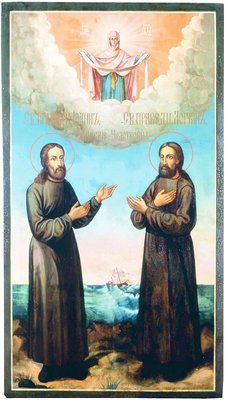
The two are painted as a pair of laymen, not as monks in the strict sense: in long dark garments with the hair to the shoulders, bare-headed, standing side by side with hands raised in prayer, John ordinarily the elder and darker of the two and Longinus the younger. Their invariable setting is the one thing that identifies them — the sea. They stand on the shore of the White Sea, with a ship on the water behind them, and above, in a cloud, the Mother of God or the Saviour; the sea is not a background but the whole of their story. Their earliest image was the lost icon painted at Solovki by the monk Feodorit Gubastyi in 1607; the type is fixed in the Siya icon-painters' manual of the second half of the seventeenth century, and the fullest surviving cycle is the hagiographical icon of 1695 now in the Severodvinsk museum, whose border scenes include the dormition of John and the miracle of Yakov Nosyrev.
The stored image is an icon of the second half of the nineteenth century from the icon-painting workshop of the Solovetsky monastery: the two stand on the strand in dark robes with hands lifted, a sailing vessel on the green sea between them, and above, in the clouds, the Protection of the Mother of God spread out over them with the saints' names inscribed on the band beneath.
Disputed questions
- Were they Solovetsky monks? The hagiographical literature, following a tradition that arose at Solovki, makes them trudniki — lay labourers — and hermits of that monastery; the fourth redaction of the Skazanie says so outright, and the Solovetsky Chronicle identifies them with the lay brethren who in 1561 were carrying lime by karbas from the mouth of the Dvina together with Ss Vassian and Jonah of Pertominsk when the boat went down in a storm. That identification cannot stand: it is seventeen years later than the finding of John's body in 1544. And in 1638 the priest of the Yarenga church of St Nicholas, Dionysius Telov, petitioning the patriarch against the pressure of Solovki over the ownership of Yarenga, wrote that the Solovetsky monks called John and Longinus their labourers "falsely" (облыжно). The Solovetsky claim looks like what it is — a great monastery annexing the cult of two saints in a village it wanted. The nineteenth-century reliquary inscription, which makes John a monk of Solovki drowned in 1566, carries the same tradition forward and is later still. This entry therefore follows the Skazanie and leaves their state of life unknown.
- Patriarch Adrian's refusal. In June 1691 Athanasius (Lyubimov), archbishop of Kholmogory, sent Patriarch Adrian the service of the two saints with an account of the miracles, and asked leave to canonise them and to translate the relics to his new Transfiguration cathedral. Adrian refused. He judged that the writing about them "is put together with little truth," and cast doubt both on the incorruption of the relics and on whether the relics were theirs at all. It is one of the frankest hagiographical judgements in the Russian record, delivered by a patriarch about saints his own Church now keeps, and it is set down here without being explained away: the cult rested on local witness and on the depositions of 1625, and it was by the synaxes of Novgorod, Karelia and Solovki, not by an act of Adrian's, that it became general.
- The dates. The Description of the Russian Saints enters them under July 3 and dates their repose to 1542; the Skazanie dates the finding of John's body to the spring of 1544 (some copies erroneously 1574); the calendars give "1544–1545." Nothing fixes Longinus's death at all.
- Why July 3? Their own name-days were kept locally at Yarenga — John on June 24, the Nativity of the Forerunner, and Longinus on October 16, the feast of Longinus the Centurion. The joint commemoration on July 3 is the anniversary of the translation of 1638, and it is this that became the general feast.
- Not to be confused with Longinus the Centurion (October 16), from whom this Longinus takes his name-day, nor with Longinus the Gatekeeper of the Kiev Caves, who shares that October date for the same reason.