
Macarius of Kalyazin
Our Venerable Father Macarius, Abbot and Wonderworker of Kalyazin
Venerable · Wonderworker · b. c. 1400, at Kozhino near Kashin (baptised Matthew) — d. March 17, 1483, at the Kalyazin monastery
Commemorated 17 March — Repose at the Holy Trinity Kalyazin monastery, 1483, 26 May — Uncovering of his incorrupt relics, 1521
Macarius of Kalyazin (c. 1400–1483) was one of the great monastic founders of fifteenth-century Russia — a wonderworker of the Tver land whose monastery on the Volga became a centre of the Russian North. Born Matthew Kozhin to a pious boyar family, he was married at his parents' wish but widowed within a few years and left an orphan; freed of every earthly tie, he took the monastic habit at Kashin and then withdrew into the forest between the lakes above the Volga, where he built a cell and, drawing disciples, founded the Holy Trinity monastery later called after Kalyazin. Famed for a humility so deep that he named his own monastery after the very landowner who had first opposed it, and for the gift of healing, he governed his brotherhood into great old age and reposed in 1483. His relics were found incorrupt in 1521 and he was numbered among the saints of the Russian Church; his monastery stood until it was drowned by the waters of the Volga in 1940.

Origins and early life
Macarius was born about the year 1400 in the village of Kozhino (Gribkovo) near the town of Kashin, in the principality of Tver, and given in baptism the name Matthew (Matvei). His parents — the tradition names his father Basil Kozha, a boyar in the service of the princes of Tver, and his mother Irina — were people of piety who later themselves ended their lives in the monastic habit. From boyhood Matthew was drawn to the church and to the monastic life, but at his parents' insistence he married, taking to wife a young noblewoman named Helena. The marriage was short: within a few years his wife died, and about the same time his parents also reposed, so that Matthew found himself, still young, alone in the world and released from every bond that had held him back. He saw in his sorrows the hand of God clearing his path, distributed his inheritance, and went to become a monk.
Monastic beginnings
He received the tonsure at the Nikola Klobukov monastery in Kashin, taking the name Macarius, and gave himself to the ascetic labours of the community with such fervour that he soon outran his brethren in humility, obedience, and prayer. Seeking a stricter solitude than a town monastery could give, he obtained his abbot's blessing and withdrew, with a few like-minded companions, into the forest some eighteen versts down the Volga from Kashin, into a wild and uninhabited tract of woodland and marsh between two small lakes near the river's bank. There he raised a cross and built himself a cell, and there he meant to live out his life unknown.
Founding of the Kalyazin monastery, and the name
Solitude did not last, for disciples gathered to him as they always gathered to a true ascetic, and Macarius — reluctantly, in obedience to their need — became the father of a community. They built a wooden church of the Holy Trinity, and about the year 1434 the Holy Trinity monastery was established, with Macarius as its abbot.
The monastery's very name preserves the story of its founder's humility. The land on which it rose belonged to a local landowner named Ivan Kolyaga (Kalyaga), who at first bitterly opposed the monks, fearing they would swallow up his estates, and even, the tradition says, plotted against the saint's life. But misfortune fell upon Kolyaga's house — sickness carried off his family — and, brought low, he came to Macarius, repented, confessed his enmity, and gave over all his land to the monastery, himself entering it as a monk. Macarius received him with such gentleness that, rather than let the memory of the man's sin be perpetuated, he directed that the monastery be called not by his own name but "Kalyazin," after Kolyaga — so that the house of God should bear the name of the sinner it had reconciled rather than the saint who had founded it. From the monastery grew, in time, the town of Kalyazin on the Volga.
Ascetic struggle and the gift of wonders
As abbot, Macarius was known for a poverty and simplicity of life that set him apart even among ascetics: he wore the meanest clothing, laboured with his own hands alongside the brethren, and bore himself so lowly that visitors could not tell the abbot from the least of the monks. His rule was strict but tempered with mercy, and his fame for holiness spread through the Tver land and beyond; the tradition records that even Joseph of Volokolamsk, the great organiser of Russian coenobitic monasticism, visited Kalyazin and praised its order and the spirit of its founder. To his ascetic gifts was joined the gift of healing: the sick who came to the monastery were cured at his prayer, and the wonders that attended him in life multiplied at his tomb. He governed his monastery into deep old age and reposed on March 17, 1483, having lived, the tradition says, some eighty-three years, and was buried in the monastery he had founded.
Relics and glorification
In the year 1521, when the brethren were digging the foundations of a new stone church of the Holy Trinity, the relics of Macarius were uncovered and found incorrupt, with his very vestments preserved and a fragrance rising from them; healings followed at once. The uncovering was received as the seal of his sanctity, and Macarius was glorified among the saints of the Russian Church, his canonisation confirmed at the great councils of Moscow under Metropolitan Macarius in the mid-sixteenth century (1547). His monastery became one of the most honoured of the region, a place of pilgrimage for tsars and people, and his relics its chief treasure, kept in a rich shrine in the cathedral of the Holy Trinity.
Later history of the shrine
The Trinity Kalyazin (Makaryev) monastery flourished for four and a half centuries. Its end came not from persecution of the old kind but from engineering: in 1940 the damming of the Volga for the Uglich reservoir flooded the town of Kalyazin and the monastery with it, and the ancient buildings were demolished or drowned — the half-submerged bell-tower of Kalyazin, standing alone above the waters, became one of the melancholy emblems of the Soviet era. The relics of Saint Macarius had been removed before the flooding and were kept through the Soviet years in Tver (in the cathedral of the White Trinity); a portion has since been returned toward the restored veneration at Kalyazin. His memory remains one of the pillars of the sanctity of the Tver land.
Feast and commemoration
Macarius is kept on March 17 (church date; Old Calendar civil March 30), the day of his repose in 1483, and again on May 26 (Old Calendar civil June 8) for the uncovering of his relics in 1521. His is a Russian commemoration, kept by the Moscow Patriarchate and the OCA and among the assembled Saints of Tver (Собор Тверских святых). Because the March feast falls within Great Lent, whose bounds are movable, on the weekdays of the fast his office is sung within the Lenten services; the May commemoration of the relics falls in the Paschal season and is kept with its full festal office.
Hymns
Troparion — Tone 8
The mindings of the flesh, O father Macarius, thou didst put to death by fasting and by vigil; for the place whereon thou didst pour out thy sweat cries aloud like a trumpet to God who glorifieth thee; and after thy death thou didst receive the gift of wonders from Him who grants incorruption to all. Wherefore we cry to thee: Intercede with Christ our God, that our souls may be saved.
Original translation from the Slavonic
Kontakion — Tone 2
Yearning for the things on high, and finding thy delight in abstinence and toil and sweat, thou didst bridle the desire of thy flesh, and didst receive the gift of wonders, to heal the sicknesses of them that run to thee in faith, O father Macarius. Wherefore we cry to thee: Rejoice, O most radiant lamp.
Original translation from the Slavonic
Iconography
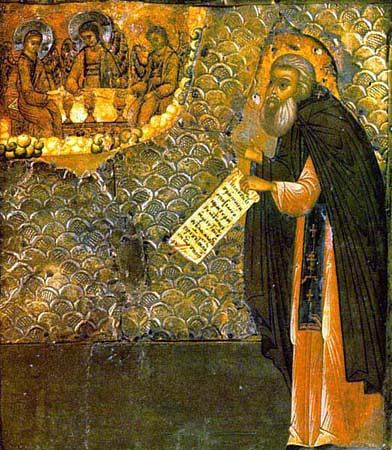
Macarius is depicted as an aged monk — long white beard, in the monastic mantiya and analavos, the koukoulion thrown back or covering his head — holding a scroll and blessing, in the settled Russian type of the venerable abbot and wonderworker. A common variant sets him against the Holy Trinity Kalyazin monastery, which he holds in his hand or which rises behind him on the bank of the Volga, marking him as its founder; vita-icons surround the central figure with scenes of his life — the tonsure, the building of the cell, the reconciliation of Kolyaga, the uncovering of the incorrupt relics.
The stored image is a late-eighteenth-century Russian panel icon of the saint with a metal riza, "Venerable Macarius, abbot of Kalyazin, wonderworker" (source, public domain as a faithful reproduction of a pre-1900 work, pd-old-work).
Disputed questions
- Distinguishing the many Macarii. "Macarius" is among the commonest of monastic names, and the calendars carry a great company of saints who bear it — above all Macarius the Great of Egypt (†c. 390) and Macarius of Alexandria, the desert fathers, but also numerous Russian namesakes. This Macarius is the fifteenth-century founder of Kalyazin on the Volga, kept on March 17; he is not to be confused with the Egyptian desert fathers of January, nor with the Metropolitan Macarius of Moscow who oversaw his glorification, nor with the several other Russian Macarii of the calendar. His fixed epithet, "of Kalyazin," belongs to him alone.