
Macarius of Serbia
Our Father among the Saints Macarius Sokolović, Archbishop of Peć and Patriarch of the Serbian Land
Patriarch · Bishop · d. 1574, at Peć
Commemorated 30 August — Commemorated with the Synaxis of the Serbian Hierarchs
Macarius Sokolović was the hierarch who, in 1557, brought the Patriarchate of Peć back into existence after nearly a century in which the Serbian Church had been dismembered among Ottoman jurisdictions, and he governed it until 1574. The restoration was made possible by his kinsman Mehmed-paša Sokolović, the Serbian-born Grand Vizier of the Ottoman Empire, and Macarius used the opening to the utmost: he rebuilt and re-endowed monasteries and churches, restored the patriarchal house at Peć, and above all pushed hard at education and the printing of church books, so that the Serbian Church in the second half of the sixteenth century — a subject church in a conquered land — was better supplied with service books than it had been for generations. He is commemorated on August 30 with the Synaxis of the Serbian Hierarchs.

The restoration of the Patriarchate of Peć
The Serbian patriarchate, founded in 1346, had effectively ceased with the Ottoman conquest; by the early sixteenth century Serbian dioceses were divided between the archbishopric of Ohrid and other jurisdictions, and there was no Serbian primate. In 1557 a berat of the Porte re-established the Patriarchate of Peć with jurisdiction over the Serbian lands, and Macarius Sokolović was enthroned as its patriarch.
The instrument of this was family. Macarius belonged to the Sokolović kindred of eastern Bosnia, and his brother — or, in the usual reckoning, his cousin — was Mehmed-paša Sokolović, taken as a boy in the devşirme, raised in the palace school, and by the 1550s one of the most powerful men in the empire; he became Grand Vizier in 1565 and held that office until his assassination in 1579. The sources are frank about the mechanism: the patriarch's kinsman was vizier under the sultan, and it was he who obtained the charter and afterwards protected and assisted the work of restoring the monasteries and churches "despoiled by Muslim fanaticism," and the patriarchal house at Peć itself.
The moral of the arrangement is not simple, and the Serbian tradition has never pretended it was: the Church regained its head through the good offices of a man who had been taken from it as a child. What it did with that head is what the Church commemorates.
The work of the patriarchate
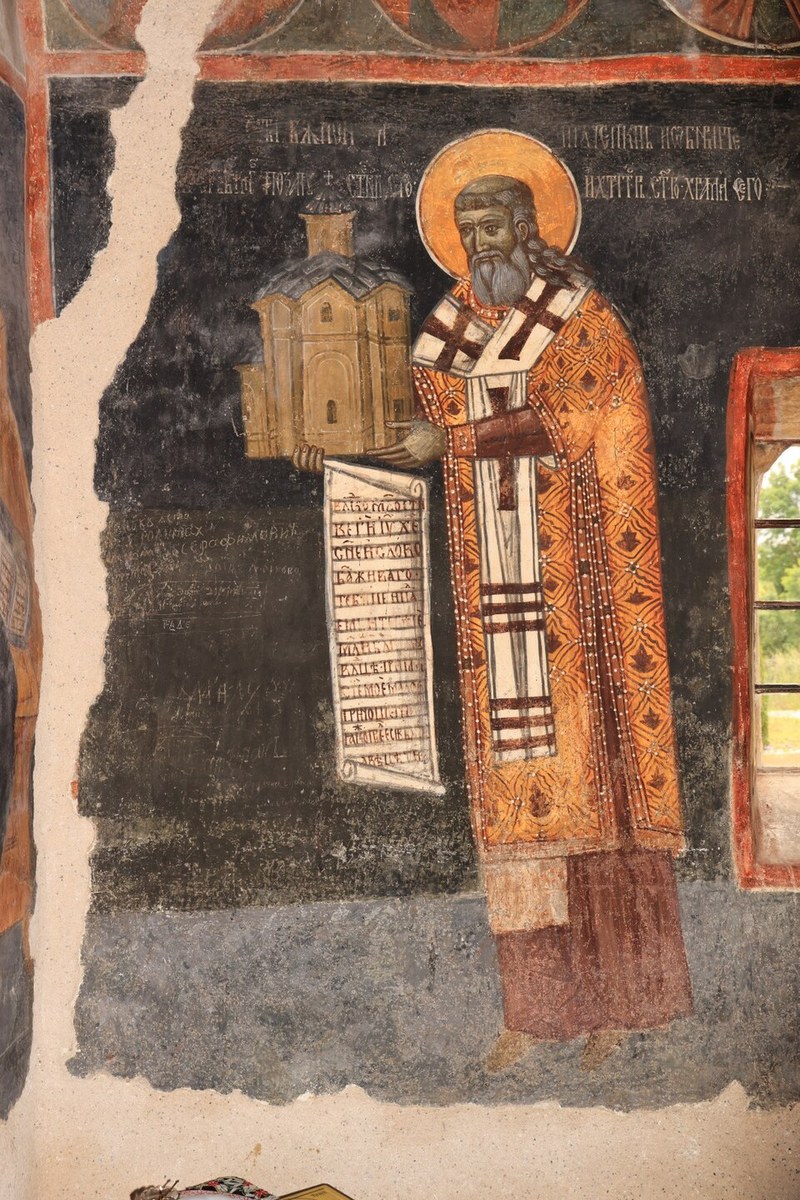
Macarius's seventeen years were years of building. He restored the fabric of the Patriarchate of Peć and painted or repainted its churches; his founder's portrait survives at Budisavci in Kosovo, where he is shown holding the model of the church. He re-established the diocesan structure across the Serbian lands, from the Danube to the Adriatic and northward into the Habsburg borderlands where Serbs had settled.
He is remembered chiefly, however, for letters. The tradition states plainly that he "toiled in particular for the spread of education in Serbia" and that many church books were printed in his time — the Serbian presses of the mid-sixteenth century, at Mileševa and elsewhere, and the manuscript workshops of the restored monasteries, belong to his patriarchate. In a church with no schools of its own and no state behind it, the supply of service books and the training of clergy to use them was the whole of the possible programme, and Macarius carried it out.
He died in 1574 and was succeeded, in what became almost a family patriarchate, by other Sokolovići.
Feast and commemoration
August 30 (church date; Old Calendar civil September 12), within the Synaxis of the Serbian Hierarchs. He has no separate day and no proper office of his own; the OCA gives him a notice of his own on this date, and the Russian calendar names him — "Macarius (1574)" — inside the collective entry. Kept by the Serbian Church, the Moscow Patriarchate and the OCA.
Hymns
Apolytikion — Tone 4 (common of a hierarch)
The truth of things revealed thee to thy flock as a rule of faith, a model of meekness and a teacher of temperance; therefore thou hast achieved the heights by humility, riches by poverty. O Father and Hierarch Macarius, intercede with Christ our God that our souls may be saved.
Iconography
Macarius is painted as a Serbian patriarch of the post-Byzantine centuries: standing, in the richly patterned sakkos or the polystavrion with the crossed omophorion, bare-headed, with a full grey beard. His distinctive type is the ktetor or founder's portrait — the hierarch holding out on his palms a model of the church he has built or restored, with a scroll of dedication unrolled beside him, offering it toward Christ or the Theotokos. He appears in this form in more than one of the churches he restored.
The stored image is the founder's portrait from the church at Budisavci in Kosovo, painted in 1568 during his own lifetime: the patriarch in an ochre-and-crimson patterned sakkos under a broad white crossed omophorion, his beard grey and rounded, holding the little gold-roofed church on his left palm, with a long inscribed scroll hanging beside it and the dedicatory inscription in Church Slavonic running above his head. The photograph is a modern one and is used under its CC BY 4.0 licence; the fresco beneath it is of 1568 and out of copyright.
Disputed questions
- Brother or cousin? The older accounts, including the OCA's, call Mehmed-paša Sokolović the brother of the patriarch; Serbian and Ottoman historiography generally makes them cousins or more distant kin of the same clan. The relationship is certain, its degree is not.
- The date of the restoration. 1557 is firm; the older Serbian literature occasionally gives 1555 or 1559, reflecting the difference between the issuing of the berat and the enthronement.
- Not to be confused with the many other hierarchs named Macarius — Macarius of Kiev and the Russian metropolitans of that name are the likeliest confusion in a Slavonic calendar, and there are also Macarius the Great of Egypt (January 19) and Macarius of Alexandria (January 19). This Macarius is always "of Peć" or "Sokolović."