
Martinian of Caesarea
Our Venerable Father Martinian of Caesarea in Palestine
Venerable · b. c. 397, at Caesarea in Palestine — d. c. 422, at Athens
Commemorated 13 February — Repose at Athens; kept with the penitents Zoe and Photina
Martinian (c. 397 – c. 422) was a hermit of Caesarea in Palestine, one of the best-loved of the ascetic saints for the story of the temptations he fled. From the age of eighteen he lived twenty-five years alone on a mountain near the city, gifted with the healing of the sick and the casting-out of demons. When a courtesan named Zoe, wagering to seduce him, came to his hut feigning a lost and storm-caught traveller, Martinian mastered the temptation by standing barefoot in the fire he had kindled, that the pain of earthly flame might remind him of the eternal — and the sight so pierced Zoe that she repented and became a nun. Fleeing thereafter to a lonely rock in the sea, he was tempted again by a shipwrecked woman, Photina, cast up on his island; he saved her, gave her his provisions, and threw himself into the waves rather than sin, leaving her the rock for her own hermitage. From then he would not settle anywhere, but wandered from city to city "for the love of God," owning nothing and fleeing every occasion of sin, until he reposed at Athens about the year 422. Zoe and Photina, whom his flight turned to God, are commemorated with him on February 13.
.jpeg)
The hermit of Caesarea
Martinian was born about the year 397 in or near Caesarea in Palestine, the Roman capital of the province and a great centre of Christian learning. Drawn young to the ascetic life, he withdrew at the age of eighteen into the wilderness outside the city, to a solitary mountain that the tradition calls "the Place of the Ark" (Kivotos), and there for twenty-five years he lived alone in fasting, silence, and prayer, wrestling with the passions and hardening himself against the world. God rewarded his labour with the gifts of healing and of exorcism, so that the sick and the demon-possessed were brought to his cell and went away whole; and his fame, which he had not sought, spread through the country round about — a fame that would become the occasion of his first and greatest trial.
The temptation by Zoe, and the fire
Among those who heard of the holy hermit were certain dissolute men of the city, who mocked at the notion that any man could be proof against the flesh; and a courtesan named Zoe, notorious in Caesarea, wagered with them that she could seduce even Martinian. On a night of storm and rain she made her way to his mountain and knocked at his hut, feigning to be a traveller lost in the darkness, benighted and perishing of cold, and begged him for the shelter of his roof. Martinian, unwilling to leave a soul to die in the tempest, took her in, set her by the fire in the outer part of his cell, and withdrew to pray. But in the morning the woman put off her disguise: she had dressed herself in fine and alluring clothes hidden beneath her rags, and she set herself to tempt him with every art, that he might fall.
The hermit was shaken — the sources do not hide that he felt the fire of the temptation — but he did not fall. Making as though to yield, he went out of the cell; and there, having kindled a great fire, he stepped with his bare feet into the flames and stood in the burning, saying to himself that if he could not bear this little fire, how should he bear the everlasting fire prepared for the unchaste? The pain scorched the lust out of him and brought him to his senses; and when he came back, burned and steadfast, and set before Zoe what he had done and what fire awaited them both, the sight of the charred feet of the man who would sooner burn than sin struck her to the heart. Zoe repented then and there, weeping, and begged him to show her the way of salvation. Martinian sent her to Bethlehem, to the convent that the Roman matron Paula had founded, and there she was received as a nun and lived out her days in penitence and tears — some twelve years, the tradition says — and reposed a saint, the harlot whom the hermit's fire had made a bride of Christ.
The rock in the sea, and Photina
Martinian's burned feet kept him long in healing; and he saw that so long as he lived where people could reach him, women and the world would find him out. To flee every occasion of the temptation he had barely survived, he abandoned the mainland altogether and had a boatman carry him to a bare rock in the sea, a wave-washed crag far from any shore, and there he made his hermitage — the sea itself his wall against the world. A god-fearing sailor supplied him, bringing him bread and water and the palm-leaves he wove into baskets two or three times a year, and carrying away his work; and so Martinian lived, alone with God upon his rock, for some years.
But the tempter found him even there. A ship was wrecked in a great storm near his crag, and a young woman, Photina, the sole survivor, was cast up half-drowned upon his rock, clinging to a plank and crying for help. Martinian drew her from the sea and saved her life; and then, seeing that he could not remain alone with a woman on so small a place without peril to them both, he made a hard and generous choice. He gave Photina his provisions and his shelter, told her that the sailor would come and would thereafter care for her as he had cared for him, and, commending her to God, he threw himself into the sea — choosing the waves and whatever God should send rather than the occasion of sin. The tradition says that dolphins bore him up and carried him safely to the shore. Photina remained upon the rock in Martinian's place, took up his manner of life as a solitary, and lived there in prayer and abstinence for some six years until her repose; she too is numbered among the saints, the second woman whom the hermit's flight from her turned toward heaven.
The wanderer for God, and repose at Athens
Cast back upon the mainland, Martinian resolved never again to bind himself to any one place, where the enemy might learn his haunt and the world lay hold of him. Instead he became a wanderer for the love of God (a xeniteia, a self-imposed exile), going on foot from city to city and country to country, owning nothing, staying nowhere more than a night or two, begging his bread and giving away what he did not need, and fleeing at the first sign that men were gathering to him. For some two years he journeyed thus — through, the tradition says, more than a hundred and sixty towns — a homeless pilgrim seeking only to keep his soul unentangled. At last, worn out, he came to Athens, and there fell mortally ill; foretelling his own end, he was tended and buried by the bishop of the city, and reposed about the year 422. So the hermit who had fled every settled place found his grave in the city of the philosophers, having outrun to the last the two things he feared — the temptation of the flesh and the praise of men.
Zoe and Photina
The two women whose lives his own holiness redeemed are kept in the Church's memory beside him. Zoe, the courtesan of Caesarea who came to destroy him and was herself saved, ended a nun of Bethlehem in twelve years' penitence. Photina, the shipwrecked survivor whom he saved from the sea and then fled, lived out six years a solitary on his very rock. Neither is remembered for any deed of her own beyond her conversion; but the tradition holds them together with Martinian precisely because his sanctity was the instrument of theirs — the one turned from harlotry, the other raised from despair — so that the feast of the hermit who fled women is, by a fitting irony, the feast of two women he brought to God.
Feast and commemoration
Martinian is commemorated on February 13 (church date; New Calendar civil February 13, Old Calendar civil February 26), together with the penitents Zoe and Photina whom his life turned to God. He is kept universally in the Byzantine churches — the Greek Menaion leads its synaxarion of the day with "the Righteous Martinian" — and his story is a favourite of the ascetic literature, read as a model of chastity and of the flight from every occasion of sin. On the same day the calendar keeps also the appearance of Christ to Martin of Tours (of whom the West tells the vision of the beggar with whom he had shared his cloak), so that the day carries two saints of the one name.
Hymns
Troparion — Tone 8
The flame of temptation thou didst quench with the streams of thy tears, O blessed Martinian; and thou didst still the surging of the sea and bridle the assaults of the beasts, crying aloud: Glory to thee, O Almighty, who hast saved me from the fire and from the storm. Intercede with Christ our God that our souls may be saved.
Original translation from the Greek
Kontakion — Tone 2
Let us who love the virtues worthily praise in hymns the ever-venerable Martinian, the tried and noble ascetic and willing martyr, the dweller of the wilderness who trampled the serpent beneath his feet; for having conquered the flame of the passions, he now entreateth the Lord that we may be delivered from corruption.
Original translation from the Greek
Iconography
Martinian is depicted as a monk and hermit — thin and grave with the marks of ascetic labour, bearded, in the dark monastic habit, sometimes bare-footed in token of the fire he stood in — usually in the frontal portrait type of the venerable fathers, holding a scroll or making the sign of blessing. Where his Life is told in narrative — as in the menologia — the characteristic scenes are the hermit standing in the fire before the temptress Zoe, and his casting himself into the sea from the rock, borne up by dolphins, with Photina left upon the crag.
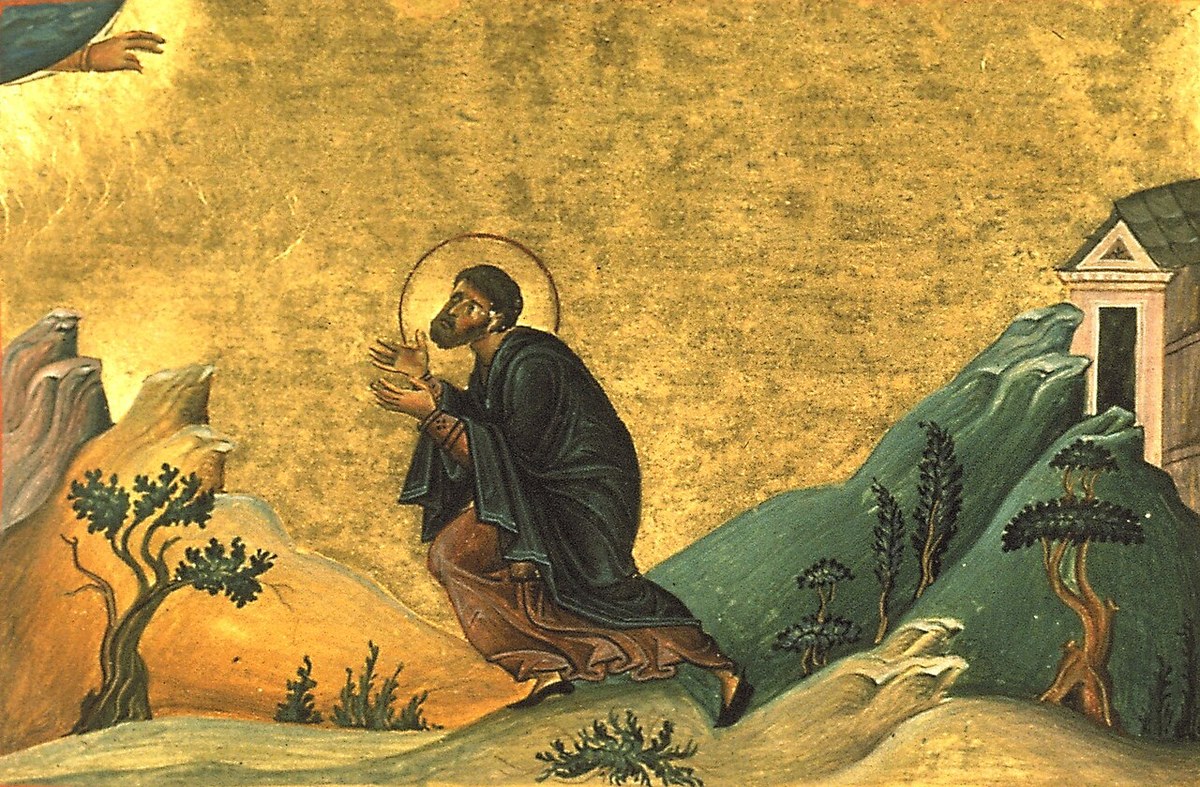
The stored image is the miniature for February 13 from the Menologion of Basil II (Constantinople, c. 985; Vatican, Vat. gr. 1613) — Martinian, "monk of Caesarea in Palestine," shown as a standing ascetic in the manuscript's settled type for the fathers of the wilderness.
Disputed questions
- The dates. Martinian's life is transmitted through the synaxaria and the hagiographic tradition rather than a securely dated chronicle; his repose is placed in the early fifth century, commonly c. 422, and his birth reckoned back from the ages given in the Life (eighteen at his withdrawal, twenty-five years on the mountain). The Greek notices call him simply "the Righteous" (hosios); the OCA and azbyka assign the fifth century.
- The nature of the account. The Life of Martinian is an edifying ascetic romance of the classic desert type — the temptation resisted, the harlot converted, the flight to sea and land — of a kind common in the literature of the Egyptian and Palestinian fathers, and its details (the wager, the dolphins, the count of cities) are told with the freedom of that genre. The Church transmits it as a parable of chastity and of flight from temptation as much as a chronicle; the entry relates it as the tradition gives it.
- Not to be confused with Martinian of the Kiev Caves (a Russian venerable of the monastery of the Caves, of a wholly later age); nor with the several soldier-martyrs and others named Martinian; nor — despite the shared root — with the western hierarch Martin of Tours, whose appearance of Christ is also commemorated on this day. "Martinian of Caesarea," the hermit tempted by Zoe, is this saint.
- The Photina converted here by Martinian — the harlot who came to tempt him and became a nun — is not to be confused with Photini the Samaritan Woman, the Great-Martyr of the well of John 4 (kept February 26), nor with the other saints of the name.