
Martin of Tours
Our Father among the Saints Martin the Merciful, Bishop of Tours
Bishop · Wonderworker · b. c. 316 — d. 397
Commemorated 12 October — The Byzantine-Slavic commemoration of the bishop of Tours
Martin of Tours (c. 316–397), whom the Orthodox calendars style "the Merciful," was the soldier who divided his cloak with a freezing beggar at Amiens and saw Christ wearing the half he had given; discharged from the army with the words "I am a soldier of Christ — it is not lawful for me to fight," he became a disciple of Hilary of Poitiers, founded at Ligugé the first monastery in Gaul, and as bishop of Tours from 371 evangelised the pagan countryside, raised the dead, and pleaded — against bishops and emperor alike — for the lives of heretics. The most beloved saint of the pre-schism West, he is commemorated in the Byzantine-Slavic tradition on October 12.

Origins and soldiering
Martin was born about 316 at Sabaria in Pannonia (Szombathely in modern Hungary), the son of a pagan tribune of the army, and was raised at Pavia in Italy where his father was posted. Against his parents' will he entered his name as a catechumen at the age of ten; at fifteen, as a soldier's son legally bound to service, he was enrolled in the cavalry of the imperial guard, and served — his biographer Sulpicius Severus insists — less as a soldier than as a monk in armour, humble to his own orderly, giving away all but a bare portion of his pay.
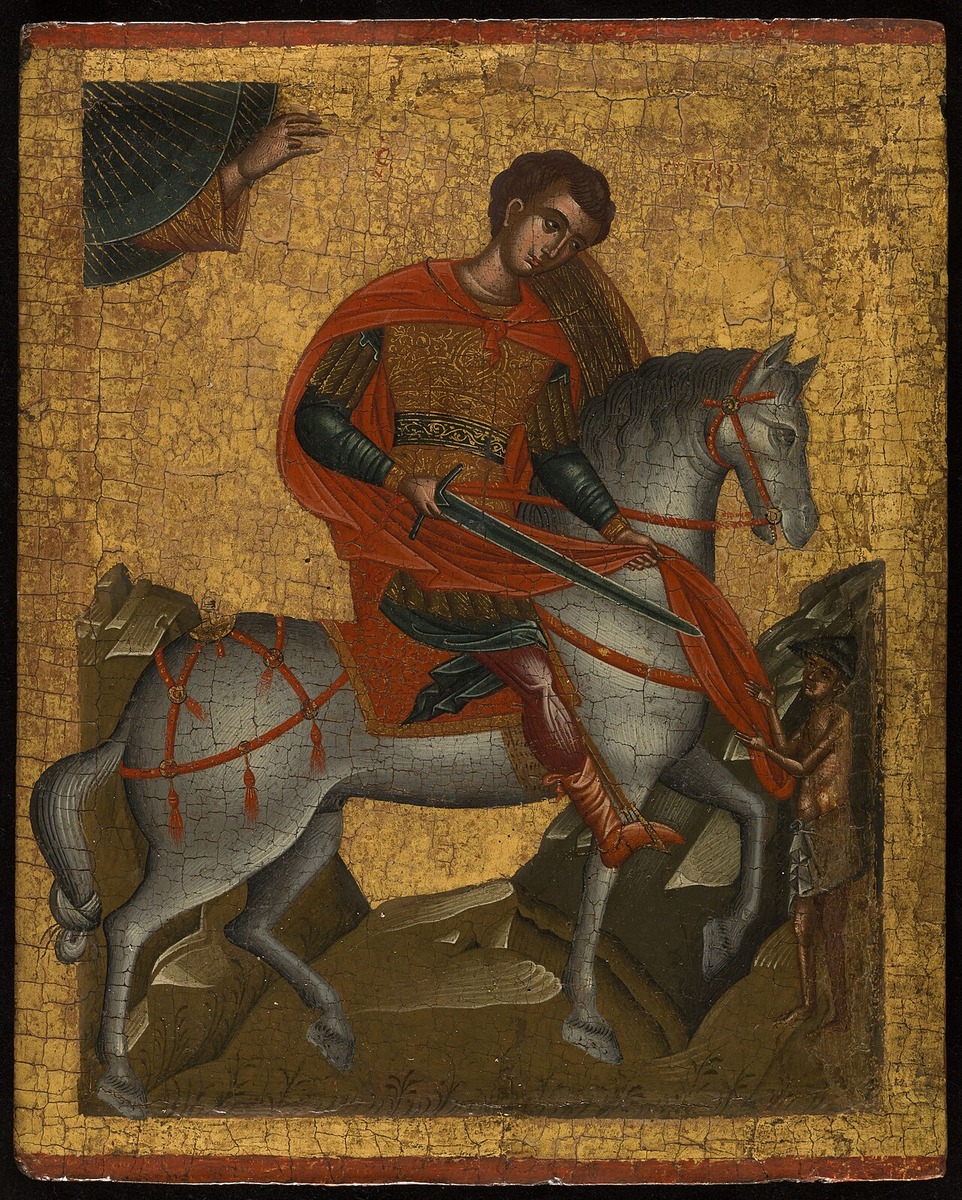
The scene by which the whole world knows him belongs to these years. At the gate of Amiens, in the depth of an exceptionally hard winter, Martin met a naked beggar whom the passers-by ignored. Having nothing left but his weapons and his military cloak, he drew his sword, cut the cloak in two, and gave half to the beggar, wearing the remnant amid the laughter of the bystanders. That night in his sleep he saw Christ clothed in the half-cloak, saying to the angels about him: "Martin, though still a catechumen, has covered me with this garment." He was baptised soon after, being about eighteen, but remained in the army — Sulpicius says at the plea of his tribune — for some years more, until, on the eve of a battle against the barbarians in Gaul, when the Caesar Julian was distributing the donative to the troops, Martin refused his share: "Hitherto I have served you as a soldier; let me now be a soldier of God... I am a soldier of Christ: it is not lawful for me to fight." Accused of cowardice, he offered to stand unarmed before the battle line protected by the sign of the Cross; the next day the enemy sued for peace without battle, and Martin received his discharge.
Disciple, hermit, monk
Martin sought out Hilary, bishop of Poitiers, the great Western defender of the Nicene faith, who wished to ordain him deacon and, when Martin refused out of humility, made him an exorcist. A journey home to Pannonia won his mother for Christ, though not his father; caught there in the Arian ascendancy of the Illyrian churches, he confessed the Nicene faith and was publicly scourged and expelled. At Milan, where the Arian bishop Auxentius held the see, he was likewise driven out, and withdrew as a hermit to the island of Gallinaria off the Ligurian coast, living on roots — the Life recalls he was poisoned by hellebore and healed by prayer. When Hilary returned from exile (360), Martin rejoined him and established himself in a hermitage at Ligugé near Poitiers, where disciples gathered around him: the first monastery of Gaul, and the seed of Western monasticism a generation before Cassian. At Ligugé the first two of his famous miracles of raising occurred: a catechumen of the community who died unbaptised, over whose body Martin stretched himself in prayer until the man revived, and a slave who had hanged himself.
Bishop of Tours
In 371 the see of Tours fell vacant, and the people, knowing the monk would refuse, drew him from his cell by a stratagem — the plea of a sick wife — and carried him to the city, where against the objection of some visiting bishops (who found the shabby, unkempt little man beneath the office) he was consecrated bishop by overwhelming acclamation. He changed nothing of his life: unable to endure the town, he established himself in a hermitage that became the great monastery of Marmoutier across the Loire, living in a timber cell among some eighty disciples in caves and huts, and governing his diocese from a monastery — the pattern, centuries early, of the monk-bishop the Christian East has always honoured.
His episcopate of twenty-six years was an unbroken missionary campaign into the pagan countryside of Gaul, where the villages had scarcely heard the Gospel. Sulpicius records it as a chain of confrontations and wonders: sacred trees felled and temples pulled down, with the saint unharmed by a falling pine his adversaries had cut toward him; the fire from a burning shrine turned back by his prayer; healings of paralytics and lepers; a third raising of the dead at Chartres; visions of angels, and open struggles with the devil, who appeared to him in many forms and to whom the saint's recorded answer was mercy itself — that even Satan might find pardon if he would repent. From these wonders the Orthodox calendars draw his double epithet: the Merciful and, in some listings, the Wonderworker.
The Priscillianist affair
Martin's last years were shadowed by the first execution of Christians for heresy. When the Spanish ascetic teacher Priscillian and his followers, condemned by a synod at Bordeaux, appealed to the usurper-emperor Magnus Maximus at Trier, the bishops Ithacius and Idacius pressed for their death. Martin, present at Trier, extracted from Maximus a promise of clemency and refused communion with the accusing bishops; after his departure the emperor broke his word, and Priscillian and six companions were beheaded (385) — to Martin's grief and horror. Returning to Trier to beg pardon for other condemned men, he was cornered into a single act of communion with the Ithacian party as the price of their lives, and reproached himself for it ever after; Sulpicius records his saying that he felt his spiritual power diminished from that day, and he attended no more synods. In an age when church and empire were learning to coerce, the monk-bishop of Tours stood — almost alone, and by instinct — for the older way.
Repose
Martin died on November 8, 397, at Candes, a village church of his diocese where he had gone to reconcile quarrelling clergy, lying on sackcloth and ashes and answering those who begged him to ease his last hours: "Allow me, brethren, to look toward heaven rather than to earth, that my spirit may be on the right course." His body was carried by river to Tours amid the mourning of the whole province and buried on November 11 — the date the West has kept ever since.
Veneration and later cultus
The cultus of Martin was immediate, vast, and durable beyond any Western confessor before him: the basilica over his tomb at Tours became the chief pilgrimage shrine of Gaul, his half-cloak (cappa) preserved by the Frankish kings gave its name to the chapels and chaplains of Christendom, Gregory of Tours wrote four books of his posthumous miracles, and thousands of churches across Europe bear his name. His Life, written by his friend and disciple Sulpicius Severus even before the saint's death and continued in letters and dialogues, became the model of Latin hagiography and carried his fame east as well as west: the Byzantine tradition received him — one of a handful of Western fathers with a fixed place in its calendars — and the Russian Church keeps him on October 12 as Martin the Merciful. Orthodox veneration of Martin has revived strongly wherever Orthodoxy has returned to Western Europe, on the same footing as the other pre-schism saints of the West in this collection (compare Ludmila of Bohemia and Theodore of Tarsus).
Feast and commemoration
October 12 (church date; Old Calendar civil October 25) in the Byzantine-Slavic tradition: the Russian calendars list "Martin the Merciful, Bishop of Tours" on this day, and the OCA follows. The Greek Menaion for October 12 does not include him, and no proper service is appointed in the books consulted; the common of a hierarch is used where his memory is kept. In the West his feast is November 11 — Martinmas — one of the great fixed points of the medieval year. The pre-schism principle applies as with the other Western saints of this collection: a saint of the undivided Church, recorded here with his actual jurisdictional footprint in Orthodox calendars stated honestly.
Hymns
Troparion — Tone 4 (from the common of a hierarch)
The truth of thy deeds revealed thee to thy flock as a rule of faith, an image of meekness, and a teacher of temperance; wherefore by humility thou didst gain the heights, by poverty the riches. O father and hierarch Martin, intercede with Christ God that our souls may be saved.
Original translation from the Greek
Iconography
In Western art Martin's image is dominated by the charity of Amiens — the mounted soldier dividing his cloak — and by the vested bishop with a goose (the bird of Martinmas folklore) at his feet. Orthodox iconography paints him either as a hierarch, in omophorion with the Gospel book among the holy bishops, or receives the charity scene into icon form. The stored image is of the second kind and from the meeting-point of the two traditions: a Cretan-Venetian icon of about 1500 (Petit Palais, Paris), showing the young soldier on a grey horse in Byzantine gold ground, cutting his red cloak with his sword for the beggar at the right, while Christ appears in blessing from heaven at the upper left — the dream of Amiens and the deed compressed into one image.
Disputed questions
- Birth year and army chronology. Sulpicius's data yield a birth about 316, but his account of Martin's discharge before Julian at Worms (356) implies either a much longer military service than the Life suggests or a later birth; a scholarly minority therefore dates the birth to about 336. The conventional c. 316 is kept here with the difficulty recorded.
- The Eastern date. The Byzantine-Slavic commemoration on October 12 does not correspond to the Western anniversaries (death November 8, burial and feast November 11, translation July 4), and its origin is not securely explained; it is the date transmitted by the Russian calendars and kept by the OCA, and is followed here.