
Photini the Samaritan Woman
The Holy Great-Martyr and Equal-to-the-Apostles Photini the Samaritan Woman, and her Companions
Great Martyr · Equal to the Apostles · Martyr · b. 1st century, Samaria — d. c. 66, at Rome
Commemorated 26 February — Martyrdom at Rome under Nero, with her sons and sisters, 20 March — Slavonic/Russian commemoration of her martyrdom, with her sons and companions, Sunday of the Samaritan Woman. The day is dominical and resurrectional rather than a proper feast of Photini, so her fixed commemoration remains primary; but this is the Sunday on which her Gospel (John 4) is read and by which she is most widely known.
Photini (first century – c. 66) is the name the Church gives to the Samaritan woman whom Christ met at Jacob's Well near Sychar and to whom, alone among all to whom he spoke, he openly declared himself the Messiah (John 4). Tradition holds that she was baptized with the name Photini, "the enlightened," and became a fearless preacher of the Gospel — carrying it, with her two sons and her five sisters, as far as Carthage and at last to Rome in the days of Nero. There, the tradition relates, the whole company confessed Christ before the emperor, converted his daughter Domnina and the officer Sebastian sent to break them, and after fearful tortures were martyred about the year 66 — Photini herself, it is said, cast at the end into a dry well, the well of her witness answering the well of her calling. She is honoured as Great-Martyr and Equal-to-the-Apostles. Her fixed commemoration is February 26; her principal feast is the movable Sunday of the Samaritan Woman, the fourth Sunday after Pascha, on which the Church reads the Gospel of the Well.
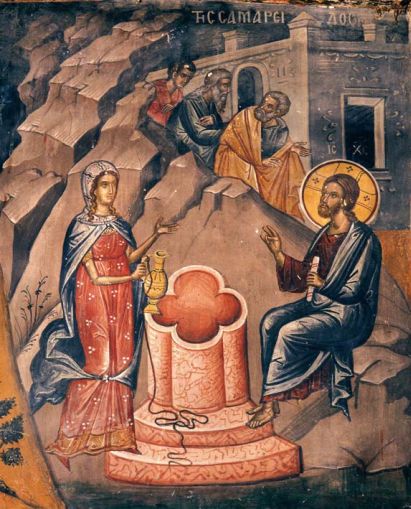

The woman at the well
The one certain and scriptural fact of her life is the greatest: she is the woman of the fourth chapter of John's Gospel. Wearied with his journey, Jesus sat by Jacob's Well outside the Samaritan town of Sychar and asked drink of a woman who had come to draw water at the sixth hour. From that request grew the longest recorded conversation of Christ with any single person in the Gospels — on the water that he gives, "a well of water springing up into everlasting life"; on her own life, which he knew without being told, that she had had five husbands and the man she then had was not her husband; on the true worship "in spirit and in truth," neither on Gerizim nor in Jerusalem; and at the last his open word, given to this Samaritan and to no other in so many words before his Passion: "I that speak unto thee am he" — the Messiah (John 4:5–26). Leaving her waterpot, she ran to the town and became the first to bring her people to Christ: "Come, see a man which told me all things that ever I did: is not this the Christ?" — and "many of the Samaritans of that city believed on him for the saying of the woman" (John 4:29, 39). In her, the tradition sees the first fruits of the nations gathered to the Gospel, and the pattern of the soul enlightened at the well of Baptism; and it is from this enlightenment that her baptismal name is drawn — Photini, from phōs, light (rendered in Slavic as Svetlana, in Latin tradition Photina).
Preaching, and the company of martyrs
Scripture names neither the woman nor her later history; all that follows belongs to the hagiographic tradition, transmitted in the Byzantine synaxaria and the Menaia, and it is given here as the Church has received it. After Pentecost, the account runs, Photini was baptized with her household and gave herself wholly to the preaching of Christ. With her she had her two sons — Victor, a soldier, afterward named Photinus, and Joses (Josiah) — and her five sisters, Anatole (Anatolia), Photo, Photis, Paraskeve, and Kyriake. The company preached first in their own country and then, the tradition says, went to Carthage in Africa, where Photini boldly proclaimed the Gospel.
Her son Victor, meanwhile, had risen in the army and was posted to the East; there he too confessed Christ, and the duke Sebastian (the dux Sebastianus), sent by the authorities to turn him from the faith, was himself converted — the tradition tells that he was struck blind for his threats and healed on believing. Word of these confessions reached Rome and the ears of Nero, and the whole family was summoned to the capital.
Martyrdom at Rome
At Rome, before the emperor, Photini and her sons and sisters and the converted Sebastian confessed Christ without flinching. The synaxarion recounts a long sequence of tortures borne and survived — the crushing of hands, the furnace, the cauldron, the flaying and the pit — through which the martyrs were preserved, and in the course of which their constancy won yet more converts, among them, the tradition says, Nero's own daughter Domnina with a hundred of her maidservants, who were baptized by Photini. The sisters and the sons were each put to death; Sebastian and Victor-Photinus and Joses gave up their lives; and Photini herself, last and chief of the company, was at the end cast into a dry well (or, some tell, drawn up and cast down again), where she yielded her soul to God about the year 66, in the persecution of Nero. So the woman first met by Christ at a well of living water finished her course at a well, a great-martyr and equal to the Apostles.
The names of the company
The synaxaria transmit the company as: Photini herself; her sons Victor (renamed Photinus) and Joses; her sisters Anatole, Photo, Photis, Paraskeve, and Kyriake; and the duke Sebastian. As with many such companies the manuscript tradition varies in the spelling and even the number of the names — "Anatole" appears as Anatolia, "Photo" and "Photis" are easily confused with one another and with their mother's name, and some lists add or drop a figure — and the roll is given here as the Menaia most commonly present it, without pressing a definitive count where the sources differ.
Feast and commemoration
Photini and her company are commemorated on February 26 (church date; Old Calendar civil March 11), the fixed day kept in the Greek Menaion — where she is styled Great-Martyr (Μεγαλομάρτυς) and, for her preaching, Equal-to-the- Apostles — and on this day her whole company is named: the sons Victor (Photinus) and Joses, the sisters Anatole, Photo, Photis, Paraskeve, and Kyriake, and the duke Sebastian. The Antiochian and Greek calendars keep the February 26 memory; some Slavic calendars note it, and the day is shared with Porphyrius of Gaza.
The Russian Church, however, keeps her fixed commemoration not on February 26 but on March 20 (Old Calendar civil April 2), and there names her company — the sons Victor (Photinus) and Joses and the duke Sebastian — on that day. On the Slavonic calendar for March 20 her memory is further joined to, and sometimes conflated with, the fourth-century Virgin-Martyrs of Amisus (Alexandra, Claudia, Euphrasia, Matrona, Juliana, Euphemia and Theodosia), a distinct company of Pontus whose names some books list within Photini's own — the two are different martyrs of different ages, drawn together only by the shared day (see Disputed questions). Her February 26 (Greek) and March 20 (Slavonic) fixed feasts thus commemorate the same saint on the two dates her mother-Churches have kept.
Her principal celebration, however, is not fixed but movable: the Sunday of the Samaritan Woman, the fourth Sunday after Pascha (the fifth Sunday of the Paschal season), on which the Church reads John 4 and keeps the Gospel of the Well as one of the great Paschal Sundays. That Sunday's proper hymns are dominical and Paschal — celebrating the risen Christ and the living water — rather than a martyr's office; but it is there that the woman of the well is chiefly honoured, and her name is joined to it. The fixed February 26 entry and the movable Sunday thus commemorate the same saint under her two aspects: the martyr of Rome, and the Samaritan enlightened at the well.
Hymns
Troparion — Tone 4
Thy ewe-lamb, O Jesus, cries out with a great voice: O my Bridegroom, thee I love, and seeking thee I struggle, and I am crucified and buried together with thee in thy baptism; I suffer for thy sake, that I may reign with thee; I die for thee, that I may live in thee. Receive me as a spotless sacrifice, offered to thee with love. By her intercessions save thou our souls, O thou who art merciful.
Original translation from the Greek
Iconography
Two images belong to Photini. The first and older is the Gospel scene: Christ seated at the well — the round or cruciform wellhead between them — in conversation with the Samaritan woman, who stands with her waterpot and her hand raised in wonder or discourse, the disciples returning in the background; it is one of the most widely painted narratives of the Byzantine cycle, found in mosaics, frescoes, and manuscript Gospels. The second is the portrait of the saint: a woman crowned and robed as a martyr, often holding the cross of witness and sometimes a vessel of water, in later Greek icons that honour her as Great-Martyr and Equal-to-the-Apostles.
The stored image is a fresco of the Gospel scene by Theophanes the Cretan (Theophanes Strelitzas Bathas) in the Monastery of Stavronikita on Mount Athos, of the sixteenth century: the Samaritan woman standing with her jug at the well as Christ, seated and blessing, speaks the words of living water, with the returning disciples above and the Greek inscription "Ἡ Σαμαρεῖτις," the Samaritan Woman (source, public domain, pd-old-work).
Disputed questions
- Scripture and tradition. The Gospel names neither the woman nor her later life. Her name Photini, her preaching, her family, and her martyrdom at Rome are the deposit of the hagiographic tradition — the Byzantine synaxaria and the Menaia — not of the New Testament, and are received as such: the entry above marks the scriptural core (John 4) off from the martyrological account that follows. The martyrdom under Nero, the conversion of Domnina, and the precise roll of the companions are traditional and are transmitted with the usual manuscript variation.
- Not to be confused with the several other saints named Photini or Photina. Distinct from her are the Photina and Zoe, the two women of ill life converted by Martinian of Caesarea (kept February 13); the martyr Photini of Palestine and other later martyrs of the name; Photini of Blachernae, the martyr of August 20 whose synaxis was kept at a martyrion beside the Blachernae church in Constantinople, and whom some have proposed identifying with the Samaritan — the calendars keep them separate and so does this reference; and her own sisters and sons Photo, Photis, and Photinus (Victor), who belong to her company and are commemorated with her. "The Samaritan Woman" belongs to this Photini alone. Distinct again are the fourth-century Virgin-Martyrs of Amisus (Alexandra, Claudia, Euphrasia, Matrona, Juliana, Euphemia and Theodosia), whom the Slavonic books for March 20 sometimes fold into her company but who are a separate group of Pontus, of a different name and a different age.