
Mary Magdalene
The Holy Myrrhbearer and Equal-to-the-Apostles Mary Magdalene
Equal to the Apostles · Myrrhbearer · b. 1st century, at Magdala in Galilee — d. 1st century, at Ephesus, in peace
Commemorated 22 July — Repose at Ephesus, Pascha offset 14
Mary of Magdala, the fishing town on the western shore of the Sea of Galilee, was delivered by Christ from seven demons and thereafter followed Him and ministered to Him of her own substance. She stood by the Cross when the disciples had fled, watched where the Lord was laid, and came at first light on the third day with the spices — and so became the first human being to see the risen Christ and the first to be sent with the news of the Resurrection. For this the Church calls her ἰσαπόστολος, Equal-to-the-Apostles, and the Fathers name her apostle to the apostles. Tradition carries her afterwards to Rome, where she is said to have testified of the Resurrection before Tiberius with a red egg in her hand, and then to Ephesus, where she laboured beside the Apostle John and reposed in peace; her relics were translated to Constantinople by the emperor Leo VI the Wise.
.png)
Magdala and the seven demons
She is named for her town: Magdala (Aramaic Migdal, "tower"), on the Galilean lake between Capernaum and Tiberias, a place of fisheries and salting-houses. The Gospels never give her father's name or a husband's — she is simply "Mary who is called Magdalene," and the epithet distinguishes her from the several other Marys of the evangelical history.
Saint Luke introduces her in a single, decisive sentence. Jesus went through the cities and villages preaching, "and certain women, which had been healed of evil spirits and infirmities, Mary called Magdalene, out of whom went seven devils, and Joanna the wife of Chuza Herod's steward, and Susanna, and many others, which ministered unto Him of their substance" (Luke 8:1–3; cf. Mark 16:9). Everything the Church knows of her before the Resurrection stands on that verse. She was possessed — grievously, the number seven signifying in Scripture a fullness of affliction — and she was freed; and the freeing was so total that she attached herself to the Lord for the remainder of His earthly ministry and supported that ministry out of her own means, which suggests a woman of some independent substance.
The Fathers are careful with the seven demons. Possession is an affliction, not a sin, and nothing in the text makes her a sinner beyond the common condition of humanity. The reading that turns the seven demons into seven vices, and the vices into a career of prostitution, belongs to a later Western development and not to the Eastern reading of the passage (see Disputed questions below).
Following the Lord: the Cross and the tomb
From that healing she is found wherever the Gospel narrative reaches its extremities. When the Twelve had scattered, she stood by the Cross: "Now there stood by the cross of Jesus His mother, and His mother's sister, Mary the wife of Cleophas, and Mary Magdalene" (John 19:25); the Synoptics place her among the women "beholding afar off" (Matt. 27:55–56; Mark 15:40–41; Luke 23:49). She did not go away when the Body was taken down: "Mary Magdalene and Mary the mother of Joses beheld where He was laid" (Mark 15:47; Matt. 27:61). The hymnography of Great Friday and Great Saturday makes much of this constancy — that the women's love did not calculate, and that they kept watch at the sepulchre through the sabbath rest.
Then, "when the sabbath was past," she bought spices with the others that they might come and anoint Him (Mark 16:1). This is the act that gives her the title myrrhbearer (μυροφόρος): she came to a corpse with the honours due to the dead, expecting nothing, and found instead the stone rolled away.
The first witness of the Resurrection
All four Gospels name Mary Magdalene at the empty tomb; John gives the encounter in full (John 20:1–18). She comes "early, when it was yet dark," sees the stone taken away, and runs to Peter and John with the only conclusion available to grief: "They have taken away the Lord out of the sepulchre, and we know not where they have laid Him." The two apostles run to the tomb, see the linen clothes, and go home again. She stays. She stands without at the sepulchre weeping, stoops down, and sees two angels in white sitting where the body had lain. They ask why she weeps; she answers them as she had answered the apostles. Then she turns back, and sees Jesus standing, "and knew not that it was Jesus." He asks the second question of the passage — "Woman, why weepest thou? whom seekest thou?" — and she, supposing Him to be the gardener, offers to carry the body away herself if He will only tell her where it is.
And He says one word: "Mary." She turns and says "Rabbouni" — Teacher. This is the first recognition of the risen Christ by any human being.
There follows the saying the West has fixed under the Latin tag noli me tangere, and the Greek Church knows as Μή μου ἅπτου: "Touch me not; for I am not yet ascended to my Father: but go to my brethren, and say unto them, I ascend unto my Father, and your Father; and to my God, and your God" (John 20:17). The Greek verb (ἅπτου, present imperative) carries the sense "do not go on clinging to me"; the Fathers read it not as a rebuke of her love but as its redirection — the old bodily familiarity is finished, and what is now given is a commission. "Go to my brethren, and say" is the whole of her apostolate in five words. "Mary Magdalene came and told the disciples that she had seen the Lord, and that He had spoken these things unto her" (John 20:18).
From this the Latin Fathers coined apostola apostolorum, apostle to the apostles — a title used of her by Hippolytus in the third century in his commentary on the Song of Songs, and taken up widely afterwards. The Greek Church says the same thing in its own idiom by ranking her among the Equals-to-the-Apostles. That the risen Lord entrusted the first proclamation to a woman, in a legal culture where a woman's testimony carried little weight, is a point the Fathers press deliberately: as the message of death came through Eve, the message of life came through a woman; the Paschal hymnography sings this reversal openly.
Preaching, and the red egg before Tiberius
The canonical record ends with John 20:18. What follows is tradition — old, widely attested in the East, and treated by the Church as tradition rather than as Scripture.
Mary is numbered among those who remained in Jerusalem after the Ascension and received the Spirit at Pentecost, and she is said afterwards to have gone out to preach. The most famous of the traditions brings her to Rome, and to the emperor Tiberius himself. Coming before him, as custom required, with a gift — and being poor, with nothing but an egg — she greeted him with the Paschal announcement, Christ is risen. Tiberius answered that a man could no more rise from the dead than the egg in her hand could turn red; and while he spoke, the egg turned red. From this, the tradition says, comes the custom of the red eggs of Pascha, and from this the iconographic detail of the egg in Mary Magdalene's hand. Some recensions add that she used the audience to lay before the emperor the injustice of Pilate's judgment, and that Pilate was in consequence recalled from Judaea.
The story cannot be traced to a first-century source and is not found in the earliest synaxaria; it circulates in the medieval Greek tradition and is deeply rooted in Greek and Slavic popular piety. It is recounted here as the Church recounts it — as an eloquent tradition about the boldness of the first witness — without being made to bear the weight of history.
Ephesus and repose
The steadier tradition, and the one the synaxaria carry, takes Mary Magdalene finally to Ephesus, where she assisted the Apostle and Evangelist John the Theologian in his labours and where she reposed in peace and was buried. Ephesus in the apostolic and sub-apostolic age was the great centre of the Johannine tradition and the city that also received the Theotokos in the same tradition; that Mary Magdalene should have ended her days there, in the household of John to whom the Lord had given His Mother from the Cross, is entirely coherent with the rest of the record. The Eastern Church has therefore never counted her a martyr: she is honoured for apostolic labour and a peaceful end.
Relics and translation to Constantinople
Her tomb at Ephesus was shown at the entrance of the cave of the Seven Sleepers, and the relics remained there until the ninth century. The emperor Leo VI the Wise (886–912) had them translated to Constantinople, where they were enshrined in the monastery church of Saint Lazarus which he had built — a fitting house, since Lazarus too was a friend of the Lord raised from the dead. This translation is the anchor of her later Byzantine cultus, and the reason her relics were in the capital at the time of the Fourth Crusade.
After 1204 portions were carried west, and relics claimed as hers came to rest at the Lateran in Rome and elsewhere; a substantial and independent Western tradition centred on Provence (Saint-Maximin-la-Sainte-Baume and Vézelay) claims her body outright, on the strength of the legend that she was set adrift from Palestine and evangelised Gaul. That Provençal legend is a medieval Western growth with no Eastern support, and it presupposes the conflated Magdalene discussed below. Fragments venerated as her relics are today kept in several Athonite houses — Simonopetra keeps a left hand honoured as hers — and in other Orthodox monasteries.
Feast and commemoration
July 22 (church date; New Calendar civil July 22, Old Calendar civil August 4) is her principal feast, kept as the day of her repose at Ephesus. She is honoured throughout the Orthodox world; among the Greeks she is a great patronal saint, and among the Slavs her name is one of the most widely borne.
She is also commemorated, together with the other women who came to the tomb, on the Sunday of the Myrrhbearers — the second Sunday after Pascha, and therefore a movable feast which belongs to the movable cycle and not to any fixed calendar day. On that Sunday the whole company is sung: the Magdalene, Mary of Cleopas, Joanna, Salome, Mary and Martha the sisters of Lazarus, Susanna and the rest, with the noble Joseph of Arimathea and Nicodemus.
A further commemoration, kept in Byzantine usage on May 4 in some books, marks the translation of her relics to Constantinople under Leo the Wise; the observance is not universal and the Menaia differ.
Her name is inseparable from Pascha in practice as well as in text: the red eggs of the Paschal table are attached in popular memory to her testimony before Tiberius, and the Paschal greeting she is said to have used before the emperor is the one every Orthodox Christian uses for forty days.
Hymns
Apolytikion — Tone 1
Christ, who for our sake was born of the Virgin, thou didst follow, O honourable Magdalene Mary, keeping His ordinances and His laws; wherefore, keeping festival today on thine all-holy memorial, we receive by thine intercessions the forgiveness of our sins.
Kontakion — Tone 4
The God who transcends all being, when He came into the world through the Theotokos, found in thee, O Mary, a second light, shining with the radiance of thy deeds; wherefore we cry to thee: Rejoice, O Magdalene, glory of the myrrhbearing women.
Original translation from the Greek
Iconography
Mary Magdalene is written in Orthodox iconography as a mature woman of grave bearing, in the red mantle over a dark tunic which is her constant attribute, with her head covered in the manner of the myrrhbearers. She is shown in four principal ways:
- As a standing saint, holding the alabaster vessel of myrrh — the flask, not the sinner's jar of the Western type — and often, in Greek and Russian usage, the red egg, in memory of the testimony before Tiberius. The scroll, where she bears one, carries the Paschal announcement.
- In the Myrrhbearers at the Tomb, one of the fixed compositions of the Paschal cycle: the women approaching the open sepulchre with their vessels, the angel seated on the rolled stone, the grave-clothes lying folded within.
- In the Crucifixion, among the standing figures at the foot of the Cross — and in the more emotive Palaiologan and Cretan versions, with her arms flung upward in lament, which is the one place Byzantine art permits her a gesture of abandon.
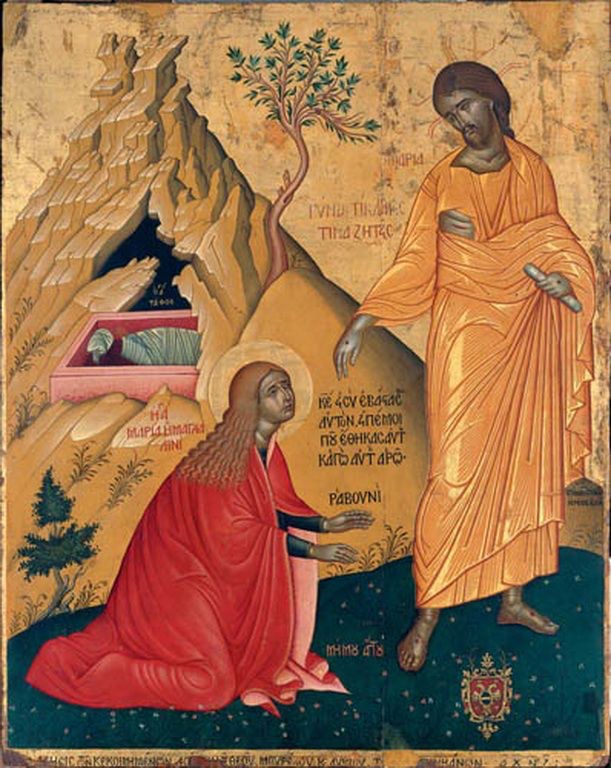
- In the Μή μου ἅπτου (Noli me tangere), the meeting in the garden: Christ turning, often in movement, with His hand raised or withheld; Mary kneeling or reaching toward His feet; behind them the rock-cut tomb.
The stored image is a Cretan-school panel of 1657 by Emmanuel Tzanes (1610–1690), now in the Byzantine Museum of Antivouniotissa on Corfu, showing the Μή μου ἅπτου: Mary kneeling in the red mantle with her hands extended, inscribed beside her Η ΑΓΙΑ ΜΑΡΙΑ Η ΜΑΓΔΑΛΗΝΗ; the risen Christ standing in gold with the Greek text of John 20:17 written in the field between them and her answer, ΡΑΒΒΟΥΝΙ, set below; at the left the cave with the grave-clothes and the angel. It is a straightforward faithful photograph of a seventeenth-century panel.
A second stored image (icons/m/mary-magdalene-2.jpg) is a Russian panel of the 1670s from the Kremlin Armoury workshop, now in the Kolomenskoe museum-reserve, painted as a patronal icon for the family of Bogdan Khitrovo: Mary Magdalene stands at the left, inscribed in Slavonic and holding a small vessel of myrrh, with Saint Eudokia in the monastic schema at the right and Christ the Great High Priest above. It is included as the standing-saint type; the second figure is a patronal pairing and has no hagiographic connection to the Magdalene.
Both stored images are of the Eastern type. The Western "penitent Magdalene" — the half-clothed woman with loosened hair in a cave, with a skull, a scourge and a crucifix, of which Titian's and Georges de La Tour's versions are the best known — is a product of the conflated identification described under Disputed questions and is not an Orthodox image of this saint; images of that type are excluded from this entry on principle, not merely on licence grounds.
Disputed questions
The Western conflation: Mary Magdalene, Mary of Bethany, and the sinful woman of Luke 7. This is the single most consequential question about her, and the Orthodox position on it is unambiguous. The East has always kept three women distinct:
- Mary Magdalene of Galilee, freed of seven demons, myrrhbearer, first witness of the Resurrection (Luke 8:2; John 20).
- Mary of Bethany, the sister of Martha and of Lazarus, who sat at the Lord's feet and who anointed Him before the Passion (Luke 10:38–42; John 11–12) — commemorated with her sister as Mary and Martha, Sisters of Lazarus on June 4.
- The unnamed sinful woman who washed the Lord's feet with her tears in the house of Simon the Pharisee (Luke 7:36–50) — commemorated anonymously, and remembered liturgically in the hymnography of Great Wednesday, above all in the celebrated hymn of Kassiani, where she is never called Magdalene.
Three separate women; three separate commemorations; no Eastern service book identifies them. The Byzantine liturgical year keeps this distinction visibly: the sinful woman is sung in Holy Week, Mary of Bethany on her own day and at the raising of Lazarus, and Mary Magdalene on July 22 and on the Sunday of the Myrrhbearers.
How the Western identification arose. The Latin West blurred them gradually, largely for homiletic convenience. The bridge is the two anointings: an unnamed sinful woman anoints the Lord's feet in Galilee in Luke 7, and Mary of Bethany anoints Him in Bethany in John 12, and preachers who read the two as one episode had already merged two of the three. Mary Magdalene was drawn in by proximity — Luke names her immediately after the anointing story, in Luke 8:2 — and by the seven demons, which were reinterpreted morally as seven vices. The identification was made explicit by Pope Saint Gregory the Great in a homily of the year 591 ("we believe that this woman, whom Luke calls a sinner and John calls Mary, is that Mary from whom seven demons were cast out"), and Gregory's authority fixed it for the Latin Middle Ages. From it grew the whole Western iconography of the penitent Magdalene — the repentant prostitute with loosened hair, the alabaster jar, the skull and the desert cave — and, at several removes, the Provençal legend of her voyage to Gaul. The Roman Church itself revised the identification in 1969, restoring the Magdalene of the Calendar to the disciple of the Resurrection alone.
Two points of fairness are worth making. First, the Western tradition was never a doctrinal definition but an exegetical habit; Gregory was preaching, not legislating. Second, some Eastern and Latin-influenced popular retellings — including certain modern Orthodox synaxarion translations, which repeat the phrase that she "led a sinful life" before her healing — have absorbed the Western reading second-hand. Such phrasing has no Eastern liturgical or patristic foundation, and where it appears it should be read as a late importation. The service texts of July 22 know only a woman freed of demons and made the first herald of the Resurrection.
Popular and fictional claims. Assertions of a marriage or a bloodline connecting Mary Magdalene to Christ have no basis in Scripture, in the Fathers, or in any Orthodox tradition; they derive from the Gnostic Gospel of Philip and from twentieth-century fiction, and require no engagement beyond noting that they are foreign to the Church's memory of her.
Mary Magdalene and Mary of Cleopas. These too are distinct: Mary of Cleopas is commemorated on May 23, and the two stand side by side at the Cross in John 19:25, which alone settles the matter.