
Maximus the Confessor
Our Venerable and God-bearing Father Maximus the Confessor
Venerable · Confessor · b. c. 580, at Constantinople — d. 13 August 662, in exile at Lazica (Schemaris, in the Caucasus)
Commemorated 21 January — Principal commemoration (repose kept on this day, Aug 13 being the leavetaking of the Transfiguration), 13 August — Repose (662) and translation of his relics
Maximus the Confessor (c. 580 – 662) is the supreme theologian of the seventh century and one of the greatest fathers of the Church. A high official at the court of the emperor Heraclius who left the world for the monastic life, he became the tireless defender of the full humanity of Christ against Monotheletism — the imperial doctrine that the incarnate Word had but one (divine) will and one operation — insisting that because Christ is truly God and truly man he possesses two natural wills and two natural energies, human and divine, the human freely and always conformed to the divine. In the Ambigua, the Questions to Thalassius, and the Mystagogy he drew the Chalcedonian and Cyrilline inheritance into a single cosmic vision of creation, incarnation, and deification. For refusing communion with the heresy — and for the Lateran Council of 649, which condemned it — he and his disciples were tried at Constantinople, and, when he would not yield, his tongue and right hand were cut off so that he could neither speak nor write the truth; he was exiled to Lazica in the Caucasus, where he died on 13 August 662. Twenty years later the Sixth Ecumenical Council (680–81) vindicated his theology as the faith of the Church. His principal feast is January 21; August 13 keeps his repose and the translation of his relics.

Origins and early life
Maximus was born about the year 580, and the received tradition — the Greek Life that long shaped his memory — makes him a native of Constantinople, of a noble and pious family, given the finest education the capital could offer: grammar, rhetoric, and above all philosophy, in which he was steeped in the whole inheritance of Greek thought, Platonic and Aristotelian alike, and in the Christian fathers before him — the Cappadocians, Gregory the Theologian and Gregory of Nyssa, and the Corpus of Dionysius the Areopagite, whose language he would make his own. So evident were his gifts and his integrity that the emperor Heraclius (610–641) took him into the imperial service and made him prōtoasēkrētis — first secretary of the imperial chancery, the head of the emperor's writing office and one of the great officers of state, a post that set him at the very centre of affairs.
(A rival, hostile Syriac Life, composed by a Monothelite opponent, makes him instead a Palestinian, born near the Golan of scandalous parentage and reared in a monastery of the Origenist party. Modern scholarship weighs the two accounts against each other; the Greek tradition, followed here, is the one the Church has received, and the Palestinian polemic is treated as what it is — a tract written to discredit him. Either way, the decisive facts of his public life are secure and independently attested.)
Whatever the place of his birth, Maximus did not remain in the world. About the year 613–614, at the height of a career that promised every honour, he left the court and became a monk, entering the monastery of Philippikos at Chrysopolis (Scutari), across the Bosphorus from the capital, where in time he was made abbot. He fled the honour as he had fled the court; humility, he taught and lived, is the ground of all the virtues. The Persian invasions that overwhelmed the East in these years drove him westward — first to a monastery at Cyzicus, then, as the armies advanced, across the sea to Africa and ultimately to Carthage and its neighbouring monasteries, where by about 630 he had settled and where he found his great friend and correspondent, the abbot Sophronius — the future Patriarch of Jerusalem, and the first to sound the alarm against the new heresy.
The Monothelite controversy
The controversy into which Maximus poured the second half of his life grew out of the wreckage of the Christological quarrels of the fifth and sixth centuries. The Council of Chalcedon (451) had confessed Christ as one person in two natures, divine and human, "without confusion, without change, without division, without separation"; but great populations of Syria and Egypt had never accepted it, holding instead to a single nature (the Monophysite or Miaphysite confession). In the 620s and 630s the emperor Heraclius, desperate to reunite an empire bleeding from the Persian war and about to be overrun by the Arabs, sought a formula of reunion with the aid of Sergius, Patriarch of Constantinople. The formula was this: grant the two natures of Chalcedon, but confess in Christ a single energy (mia energeia) — one activity, one operation — and later, when that word was challenged, a single will (monon thelēma): hence Monoenergism and Monotheletism. To many it seemed a harmless bridge; to Maximus it was the collapse of the whole edifice of salvation.
His answer went to the root. A nature that has no will and no operation of its own is not a real nature but a name. If Christ's humanity has no human will and no human energy, then his humanity is a fiction, and the redemption is a mime: for what is not assumed is not healed, and it is precisely the human will — the faculty that fell in Adam, that says "not my will but thine" only under grace — that most needed to be taken up and set right. Therefore, Maximus argued, in the one person of the incarnate Word there are two natural wills and two natural energies, divine and human, unconfused and undivided as the two natures themselves; and the human will of Christ, real and entire, is never in conflict with the divine but is perfectly, freely, and always conformed to it — most of all in Gethsemane, where "not my will, but thine, be done" (Luke 22:42) is the very confession the Monotheletes could not explain, the human will of the Saviour freely embracing the Father's design. Here Maximus made a distinction that has shaped all later theology: between the natural will (thelēma physikon), the God-given inclination of a nature toward its own good, which Christ possesses whole and unfallen, and the gnomic will (gnōmē), the deliberative, wavering choice of fallen persons torn between goods, which Christ does not have — for there is in him no hesitation, no ignorance, no drama of decision, but a human freedom wholly transparent to God. The heresy, by denying the human will, had denied the reality of the humanity and the reality of the healing; Maximus restored both.
He carried the argument across the Mediterranean. In 645, at Carthage, he met in public disputation with Pyrrhus, the deposed Patriarch of Constantinople and a champion of the one-will doctrine, and — the record of the debate survives — brought him, at least for a time, to confess the two wills. From Africa Maximus went to Rome, where he found in Pope Martin I a hierarch of his own resolve. Together, in 649, they convened the Lateran Council, a synod of a hundred and five bishops that condemned Monoenergism and Monotheletism and their imperial documents — the Ecthesis of Heraclius and the Typos of Constans II, the latter of which had forbidden all discussion of the question — and set out the orthodox confession of the two wills and two energies. Maximus, though a simple monk and never a bishop, was the theological mind of the council; its very definitions bear the stamp of his thought.
Trial, mutilation, and exile
The emperor Constans II answered the Lateran Council with force. Pope Martin was seized at Rome, carried to Constantinople, condemned, and exiled to the Crimea, where he died of ill usage in 655 — a martyr-confessor of the same cause. Maximus was arrested with his disciples and brought to the capital, where he was tried — not, his judges insisted, for doctrine, but for treason: it was charged that his opposition had helped lose Egypt and Africa to the Saracens, that he had prophesied against the emperor, that he had set the see of Rome against the throne. Maximus answered every charge and would not be moved from the one thing that mattered. When it was urged that the whole East, and the emperor with the patriarch, now held the one will, and that he alone divided the Church, he gave the answer that has become the emblem of the confessor's loneliness: that if the whole universe should communicate with the heretics, he would not — for the truth is not established by numbers, and "the catholic Church is the right and saving confession of the faith." Pressed to accept the Typos, which merely commanded silence, he refused even silence: a truth suppressed by imperial order is a truth denied.
He was exiled first to Bizya in Thrace, then recalled and pressed again, and again refused. At last, about 662, the tribunal, unable to break him by argument, resolved to silence him by mutilation. His tongue was cut out by the root, that he might no longer speak the truth, and his right hand was cut off, that he might no longer write it — the two instruments of the confessor's whole warfare, taken from an old man of eighty. With him suffered his two disciples, both named Anastasius — Anastasius the Monk, his companion of many years, and Anastasius the Apocrisiarius, the papal legate — who were mutilated in the same way. So maimed, they were paraded through the city and sent into their final banishment, to the remote and barbarous land of Lazica on the eastern shore of the Black Sea, in the Caucasus. There Maximus was shut in the fortress of Schemaris, and there, worn out by suffering and by the road, he reposed on 13 August 662, in about his eighty-second year. The tradition relates that the tongue and hand were restored to him by a wonder, so that he spoke and wrote again before the end, and that on the night of his death three lamps were seen burning of themselves over his grave — signs, the Church read them, that the God whose two wills he had confessed had glorified his confessor.
Vindication: the Sixth Ecumenical Council
Maximus died condemned and in exile, excommunicated by the very authorities of the Church he had served; his vindication was posthumous and total. Within a generation the political calculation that had bred the heresy had failed — Egypt, Syria, and Africa were lost to Islam regardless, and the union-formula had bought nothing. In 680–681 the emperor Constantine IV summoned to Constantinople the Sixth Ecumenical Council (the Third of Constantinople), which solemnly condemned Monotheletism and Monoenergism, anathematised Sergius, Pyrrhus, Honorius of Rome, and the other authors of the heresy, and defined precisely what Maximus had taught and suffered for: that in the one Christ there are two natural wills and two natural operations, undivided, unchanged, unseparated, unconfused, the human will "following, and not resisting or reluctant, but rather subject to his divine and almighty will." The council did not name Maximus — the memory of a condemned monk was still delicate — but its definition is his theology, almost his very words; the Church had ratified the confession for which his tongue and hand were cut off. From that vindication his veneration spread unhindered through East and West, and the calendars have kept him ever since as Maximus the Confessor, "the Confessor" being precisely the title of one who suffered for the faith without dying under the sword — though his sufferings brought him, in the end, to his death.
Theological and literary legacy
Maximus is one of the most profound and difficult writers in the whole Christian tradition, and his influence on all later Orthodox theology is hard to overstate. His works are not a system but a vast, interlocking meditation on the mystery of Christ:
- The Ambigua (the "Difficulties") — two great collections resolving hard passages in Gregory the Theologian and in Dionysius the Areopagite — are his cosmic masterpiece: here he sets out the doctrine of the logoi, the divine "words" or purposes according to which each created thing is made and toward which it moves, all held in the one Logos, the Word of God, so that the whole creation is a book and a liturgy whose meaning is Christ. Here, too, he quietly corrects Origenism: against the myth of a pre-existent unity of souls that fell into bodies, he sets the true order — creation, movement, rest (genesis, kinēsis, stasis) — the creature made good, moving through history, and coming to rest not by returning to a lost beginning but by attaining its end in God.
- The Questions to Thalassius (Quaestiones ad Thalassium) — sixty-five searching answers on hard places of Scripture — are the summa of his mystical and ascetic exegesis.
- The Mystagogy is his great commentary on the Divine Liturgy, reading the church building and the eucharistic rite as an image of the cosmos, of the soul, and of the whole economy of salvation — the single most influential work in the Byzantine tradition of liturgical interpretation.
- The Chapters on Love (four "centuries") and the Chapters on Theology and the Economy are gathered into the Philokalia and are read to this day as spiritual classics; the Ascetic Life and the letters and the Opuscula (the dogmatic-polemical works on the wills and energies) complete the corpus.
Through all of it runs a single vision. Creation exists to be united to God; the Word became flesh so that man might be deified — the axiom Maximus states with unmatched boldness: "God became man that man might become god," by grace and participation, not by nature. Man is set at the centre of the cosmos as its priest and mediator, called to gather up the divided orders of being — male and female, paradise and world, heaven and earth, sensible and intelligible, created and uncreated — and to offer them, reconciled, to God; the fall shattered that vocation, and Christ, the new and true Man, accomplishes it, uniting in himself all that sin had sundered. It is a theology in which dogma, cosmology, liturgy, and the ascetic life are one seamless whole — and it is why the Church honours Maximus not only as a confessor but as a theologian of the first rank, the equal of the greatest fathers.
Feast and commemoration
Maximus is kept universally on January 21 (church date; Old Calendar civil February 3), his principal commemoration. He reposed on August 13, but because that day is the leavetaking of the Transfiguration, his chief feast was fixed on January 21, and August 13 keeps his repose and the translation of his relics — the arrangement the Menaia and the OCA calendar both follow. The Antiochian, Greek, and Slavic calendars agree on the January day; his two disciples Anastasius the Monk and Anastasius the Apocrisiarius are commemorated with him. He is honoured through the whole Orthodox world not only as a confessor who suffered mutilation and exile but as one of the Church's greatest theologians, whose vindication is written into the definition of the Sixth Ecumenical Council.
Hymns
Troparion — Tone 8
O guide of Orthodoxy, teacher of piety and holiness, luminary of the Church, God-inspired adornment of monastics, O wise Maximus: by thy teachings thou hast enlightened all, O lyre of the Spirit. Intercede with Christ our God, that our souls may be saved.
Original translation from the Greek
Kontakion — Tone 8
Let us the faithful worthily praise the lover of the Trinity, great Maximus, who taught clearly the God-inspired faith — to glorify Christ in two natures, with twofold energies and wills alike — and let us cry aloud to him: Rejoice, O herald of the Faith.
Original translation from the Greek
Appointed readings
Epistle — Philippians 1:12–20
12But I would ye should understand, brethren, that the things which happened unto me have fallen out rather unto the furtherance of the gospel; 13So that my bonds in Christ are manifest in all the palace, and in all other places; 14And many of the brethren in the Lord, waxing confident by my bonds, are much more bold to speak the word without fear. 15Some indeed preach Christ even of envy and strife; and some also of good will: 16The one preach Christ of contention, not sincerely, supposing to add affliction to my bonds: 17But the other of love, knowing that I am set for the defence of the gospel. 18What then? notwithstanding, every way, whether in pretence, or in truth, Christ is preached; and I therein do rejoice, yea, and will rejoice. 19For I know that this shall turn to my salvation through your prayer, and the supply of the Spirit of Jesus Christ, 20According to my earnest expectation and my hope, that in nothing I shall be ashamed, but that with all boldness, as always, so now also Christ shall be magnified in my body, whether it be by life, or by death.
Gospel — Luke 12:8–12
8Also I say unto you, Whosoever shall confess me before men, him shall the Son of man also confess before the angels of God: 9But he that denieth me before men shall be denied before the angels of God. 10And whosoever shall speak a word against the Son of man, it shall be forgiven him: but unto him that blasphemeth against the Holy Ghost it shall not be forgiven. 11And when they bring you unto the synagogues, and unto magistrates, and powers, take ye no thought how or what thing ye shall answer, or what ye shall say: 12For the Holy Ghost shall teach you in the same hour what ye ought to say.
Iconography
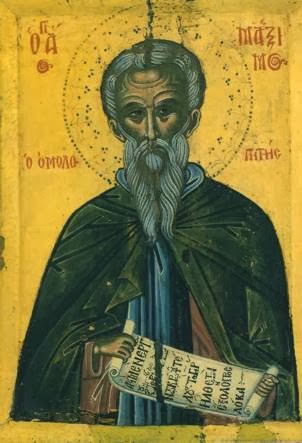
Maximus is depicted as an aged monk — a long, tapering grey or white beard, the high forehead of the sage, vested in the monastic mantiya and often the analavos, holding a scroll or a Gospel-book. Because his memory is bound to his mutilation, some icons show him with the right hand cut off or bandaged, or holding a scroll inscribed with his confession of the two wills; a distinct narrative type depicts the cutting off of his tongue and hand. The stored image is a Greek icon of the saint of the sixteenth or seventeenth century, in the settled portrait type of the monastic father and theologian, holding the scroll of his teaching.
Disputed questions
- Birthplace: Constantinople or Palestine. The Greek Life makes him a well-born Constantinopolitan and imperial secretary; the hostile Syriac Life (by George of Reshʿaina, a Monothelite) makes him a Palestinian of low and scandalous birth, reared among Origenist monks near the Jordan. The polemical purpose of the Syriac account is transparent, and the Church has received the Greek tradition, which is followed here; scholars note the Syriac text as a witness to how bitterly he was hated by the party he defeated, not as a reliable biography.
- The date and manner of his death, and the "restoration." That his tongue and right hand were cut off, and that he died in exile in Lazica in 662, is the constant tradition; the Relatio Motionis and the Disputatio (the records of his trial and of the Bizya interrogation, kept by his own circle) are the primary sources. The pious tradition that his tongue and hand were miraculously restored so that he preached again is honoured as tradition; the fact of the mutilation is not in doubt.
- Pope Honorius. Maximus laboured to exculpate Honorius of Rome, whose incautious letter to Sergius had spoken of "one will," reading it in an orthodox sense; the Sixth Council nonetheless anathematised Honorius by name. The tension between Maximus's charitable reading and the council's condemnation is a standing question of the history, noted here without resolution.
- Not to be confused with the several other Maximi of the calendar: with Maximus the Greek, the sixteenth-century Athonite scholar of Moscow kept on this same day, January 21 (a different saint of a different millennium, with whom the shared feast most invites confusion); with Maximus Kavsokalyvites, the Athonite fool-for-Christ and "Hut-burner" (†c. 1365, January 13); and with Maximus of Moscow, the fool-for-Christ of Moscow (†1434, November 11). "The Confessor," and the theology of the two wills, belong to this Maximus alone.