
Maximus of Moscow
Our Venerable Father Maximus of Moscow, Fool-for-Christ and Wonderworker
Fool for Christ · Wonderworker · d. 1434
Commemorated 13 August — Uncovering of the relics (1547), 11 November — Repose
Maximus of Moscow (died 1434) was a fool-for-Christ of medieval Russia who bore the hardest form of ascetic self-emptying, walking about Moscow almost naked summer and winter, homeless and enduring heat and frost alike. Comforting the poor amid the calamities of the Tatar yoke, famine, and plague, and rebuking the rich and powerful for hardness of heart, he spoke his wisdom in the proverbs of the common people. Buried at the Moscow church of Saints Boris and Gleb, he was glorified as a wonderworker in 1547 and his relics uncovered the same year.
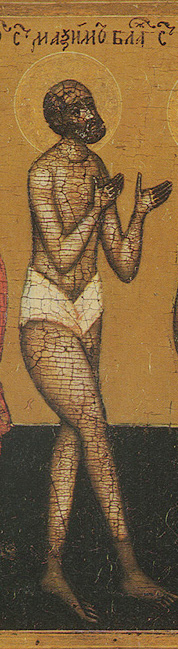

Nothing is recorded of the parents of Blessed Maximus, nor of the time or place of his birth. He chose one of the most difficult and thorny of all paths to salvation, the feigned folly for Christ's sake (Church Slavonic yurodstvo), taking upon himself the guise of a madman to conceal his virtue and to rebuke the wisdom of the world. Summer and winter alike he went about almost naked, bearing the scorching heat and the bitter Russian cold; his remembered saying was, "The winter is fierce, but Paradise is sweet."
He lived in a hard time for the Russian land, when Tatar incursions, drought, famine, and epidemic recurred and the people perished in multitudes. To the suffering Maximus spoke words of endurance and hope, urging patience and humility under affliction: "Let us bear all with patience, and in this at least we shall be human... Even green wood will burn in time; God will grant salvation if we endure all with patience." But his was not only a voice of consolation: his sharp denunciations frightened the mighty of his world, and he reproached the rich and illustrious for the hypocrisy of an outward piety joined to an unjust and covetous life — "The house has its icon-corner, but the conscience is for sale... God sees every wrong; He will not be deceived." Russia loved and heeded its holy fools, esteeming their humility and their homely wisdom, and all listened to them, from the Grand Princes down to the poorest beggar.
Repose, relics, and glorification
Blessed Maximus died on November 11, 1434, and was buried at the church of the Holy Princes Boris and Gleb in Moscow. Miraculous healings soon began to occur at his grave. In an encyclical of 1547, Metropolitan Macarius of Moscow — at the council that formally glorified a number of Russian saints — enjoined "the singing and celebration at Moscow for the new wonderworker Maximus, Fool-for-Christ." That same year, on August 13, his incorrupt relics were uncovered. When the church of Saints Boris and Gleb, where he lay, burned in 1568, a new church was built on the site and consecrated in the name of Saint Maximus the Blessed, and there his relics were enshrined.
Feast and commemoration
November 11 (church date; Old Calendar civil November 24), the day of his repose, kept in the Russian Church, on which he is commemorated together with the great-martyr Menas and the venerable Theodore the Studite. The uncovering of his relics is kept on August 13. As a locally arisen Russian saint his cultus is proper to the Russian Church, though his memory falls on a day universally kept for the martyrs of the East.
Blessed Maximus the Fool-for-Christ is a distinct saint from Maximus the Greek (the sixteenth-century scholar-monk of Moscow, commemorated January 21) and from Maximus the Confessor; the shared name and city are a frequent source of confusion.
Hymns
Troparion — Tone 5
By nakedness of body and by patience thou didst lay bare the wiles of the enemy, rebuking his ungodly deeds; grievously suffering the sun's scorching heat and the great and bitter cold, thou didst feel neither frost nor fire, sheltered by the help of God, O most wise Maximus. Pray for those who faithfully and with honour keep thy memory and who fervently draw near to thy relics, that they be delivered from misfortunes and escape from falling.
Original translation from the Slavonic
Kontakion — Tone 2
Desiring the beauty of the world on high, thou didst count as nothing the sweetness below and the raiment of the body, and thou didst love non-acquisitiveness more than the vain world. Passing through an angelic manner of life, thou didst reach thine end, O blessed Maximus; with the angels pray thou unceasingly to Christ for us all.
Original translation from the Slavonic
Iconography
Maximus is depicted as a fool-for-Christ: an emaciated figure, naked or nearly so, with long hair and beard, sometimes shown against the towers and churches of medieval Moscow, one hand raised in prayer or blessing; he is often paired in icons with the more famous Basil the Blessed, the other great fool-for-Christ of Moscow. The stored image is a Russian icon of the saint of the eighteenth or nineteenth century.
Disputed questions
- Not to be confused with his contemporary and namesake Maximus Kavsokalyvites, the Athonite fool-for-Christ and "Hut-burner" (†c. 1365, January 13): the two share the name, the century, and the way of feigned folly, but this Maximus is the naked fool-for-Christ of Moscow, that one the hesychast of the Holy Mountain.