
Maximus the Greek
Our Venerable Father Maximus the Greek
Venerable · Confessor · b. c. 1470, at Arta in Epirus (as Michael Trivolis) — d. 21 January 1556, at the Trinity–St Sergius Lavra
Commemorated 21 January — Repose at the Trinity–St Sergius Lavra, 1556, 21 June — Finding of his relics at the Lavra, 1996 (Julian June 21; civil July 4)
Maximus the Greek (c. 1470 – 1556) was an Athonite scholar-monk sent from Vatopedi to Muscovite Russia as a translator, who became one of the most learned men of his age and a confessor imprisoned for decades. Born Michael Trivolis at Arta in Epirus and educated in Renaissance Italy — Florence, Venice, Padua — he returned to Orthodoxy and became a monk on Mount Athos. Summoned to Moscow in 1516 to translate and correct the Slavonic service-books and Scriptures, he laid the foundations of Russian humanist learning; but his rebukes of injustice and avarice, his links to the "non-possessor" party, and errors seized upon from his corrections brought him, at councils of 1525 and 1531, condemnation on charges of heresy, sorcery, and treason. He was imprisoned in the monasteries of Volokolamsk and Tver for more than twenty years, cut off for long stretches from the sacraments, yet never ceased to write. Released at the last to the Trinity–St Sergius Lavra, he reposed there on January 21, 1556, and was glorified by the Russian Church in 1988.

Michael Trivolis: Greece and Renaissance Italy
The saint was born about the year 1470 at Arta in Epirus, of a distinguished and wealthy Greek family; his name in the world was Michael Trivolis. In an age when Byzantium had fallen and Greek learning was fleeing westward, the young Michael went to Italy for his education, and there passed some of the most formative years of his life amid the high Renaissance. He studied at Florence, Venice, Padua, Ferrara, and Milan; learned Latin as well as his native Greek; moved in the circles of the great humanists and printers — associated with the scholar-publisher Aldus Manutius of Venice, whose press was making the Greek classics available to Europe; and in Florence heard the preaching of Girolamo Savonarola, whose fiery denunciations of luxury and corruption left a deep mark on him. For a time he entered the Dominican convent of San Marco in Florence, Savonarola's own house, as a novice — a fact he never concealed and later frankly repented. But the pull of his Orthodox and Greek inheritance proved the stronger, and about 1505–1506 he left Italy and the West for the Holy Mountain.
Monk of Vatopedi
On Mount Athos Michael entered the great monastery of Vatopedi and was tonsured a monk with the name Maximus. There, in one of the richest libraries of the Orthodox world, he steeped himself in the fathers and the ascetic tradition, and there he found the peace of the monastic life he would look back on as the happiest of his years. He became known for his learning and his translations, and it was his Athonite reputation that drew upon him the summons that would change — and darken — the rest of his life.
The mission to Moscow
In 1516 the Grand Prince of Moscow, Vasili III, wrote to the Protaton and to Vatopedi asking that a learned translator be sent to Russia to render the Greek books of the Church into Slavonic and to correct the liturgical texts, which generations of copying had filled with errors. Vatopedi sent Maximus. He reached Moscow in 1518 and was received with honour and set to work — first on the great commentated Psalter, then on the Acts of the Apostles, the commentaries on the Gospels, and the correction of the service-books. Not yet knowing Church Slavonic, he worked through Latin as an intermediary language, with Russian assistants — among them Dmitry Gerasimov — who turned his Latin into Slavonic; the method was laborious and, as events proved, dangerous, for a mistranslation could be read as a heresy. Around him gathered a circle of the educated and the devout, and his cell became a centre of learning; he wrote against the errors he found in the Russian books, against astrology and the "Judaizers," against Islam and the Latins, and on the moral and spiritual life.
Confessor: the councils, and the long imprisonment
Maximus's downfall was as much political as doctrinal. He had come to share the convictions of the "non-possessors" — the followers of Nil Sorsky, who held that monasteries ought not to own great estates and villages — against the dominant "possessor" party; he rebuked the avarice and the injustices of the powerful with the boldness he had learned from Savonarola; and, most dangerously, he was drawn into the great scandal of the reign, opposing the Grand Prince's determination to put away his barren wife Solomonia and marry Elena Glinskaya, a divorce Maximus and the non-possessors condemned as uncanonical. Enemies were not wanting. At a council in 1525 he was condemned on charges built partly on errors in his corrected translations — read, or misread, as deliberate heresies touching the eternity of Christ's reign — partly on accusations of sorcery and of treasonous dealings with the Turkish ambassador. He was excommunicated, forbidden the sacraments, and shut up in the Joseph-Volokolamsk Monastery in cruel conditions — cold, hunger, smoke, and the prohibition even of his books and writing. A second council in 1531 renewed and hardened the sentence.
He was afterward moved to Tver, to the Otroch Monastery, under the more humane Bishop Akakios, who eased his confinement and allowed him to read and write again; and it was in these long years of imprisonment — more than two decades in all — that Maximus, cut off from the altar and from his homeland, produced much of his large body of writing and bore his captivity with a patience the Church remembers as the substance of his sanctity. The tradition relates that, denied the Eucharist and comfortless, he composed in his cell a canon to the Holy Spirit, writing the verses (some say) with a piece of coal upon the wall when he was allowed no ink — a canon still sung, and the emblem of his confession. He petitioned repeatedly for release and for permission to return to Athos, and was repeatedly refused; the Patriarchs of the East interceded for him in vain for years.
Release and repose
Only in his old age did his sufferings end. About 1551, under the young Tsar Ivan IV and through the good offices of the abbot Artemy and of Metropolitan Macarius, Maximus was at last set free and allowed to settle at the Trinity–St Sergius Lavra, the heart of Russian monasticism, honoured now as the venerable elder and scholar he had always been. There he lived out his last years in peace, still writing, consulted by the great — the tradition tells of his meeting with the young Tsar Ivan, whom he warned against a rash pilgrimage. He reposed at the Lavra on January 21, 1556, and was buried there, by the north-west wall of the Church of the Holy Spirit, where his tomb became a place of veneration.
Veneration and glorification
Maximus's memory was honoured at the Lavra and among the learned from soon after his death; miracles were reported at his grave, and he was long revered as a locally venerated saint and a father of Russian letters. His formal glorification by the Russian Orthodox Church came only in 1988, in the celebrations of the millennium of the Baptism of Rus, when he was numbered among the saints of the whole Russian Church. His relics were uncovered at the Lavra in 1996 and enshrined there. He is honoured as a confessor — one who suffered long imprisonment and deprivation for righteousness without dying by the sword — and as one of the founders of the Russian tradition of scholarship, whose vast corpus of translations, polemics, and moral and spiritual writings is a monument of sixteenth-century Orthodox learning.
Feast and commemoration
January 21 (church date; Old Calendar civil February 3), the day of his repose, kept in the Russian Church — the same day as his great namesake Maximus the Confessor, with whom he shares both the name and the feast. The finding of his relics at the Trinity–St Sergius Lavra in 1996 is kept on June 21 as a church date (Old Calendar civil July 4 — the civil date by which the commemoration is usually cited in Russian sources). As a saint of the Russian Church his cultus is proper to the Slavic world, though his origins are Greek and Athonite; the Greek calendars have increasingly taken up his memory as Maximos the Hagiorite.
Iconography
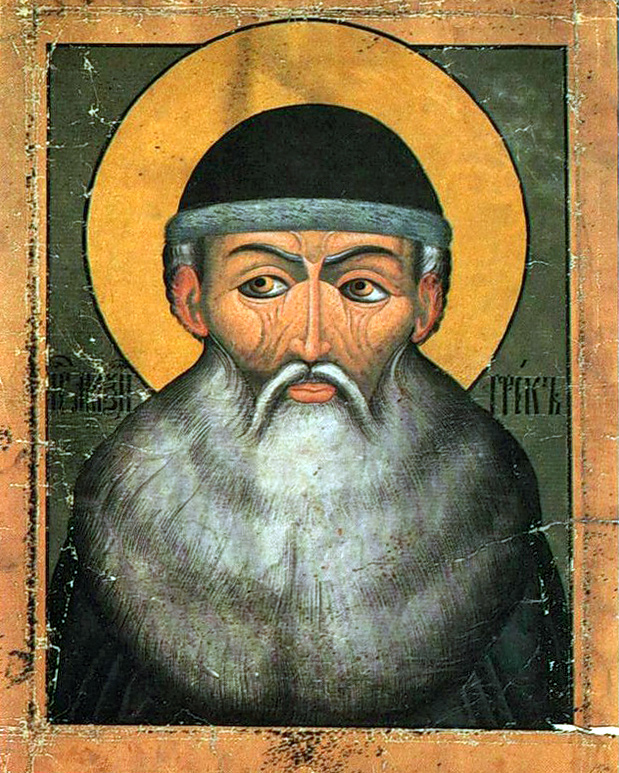
Maximus the Greek is depicted as an aged monk of striking presence — a long, full, grey or white beard reaching to his breast, a high domed forehead, deep-set eyes, in the dark monastic mantiya and koukoulion or skoufos, most often holding a scroll or an open book, the sign of the scholar and translator. The type is remarkably individual, and appears already in manuscript portraits of the sixteenth and seventeenth centuries — for Maximus, unusually among saints, was drawn from something close to life. The stored image is such an early Russian depiction of the sixteenth or seventeenth century, the learned elder with his book.
Disputed questions
- The translation "errors." How far the charges of heresy rested on genuine mistakes, and how far on the deliberate misreading of a foreigner's imperfect Slavonic by his political enemies, is debated; the modern judgement, and the Church's, is that Maximus was condemned unjustly, his corrections misconstrued and his real offence being his rebukes of the powerful and his stand against the Grand Prince's divorce.
- Not to be confused with the other Maximi of the calendar, above all with Maximus the Confessor, the seventh-century theologian kept on this same day, January 21 — the shared feast being the chief occasion of confusion between the two; and with the two fools-for-Christ, Maximus Kavsokalyvites of Athos (†c. 1365, January 13) and Maximus of Moscow (†1434, November 11). This Maximus is the scholar-confessor, "the Greek."