
Melania the Younger
Our Venerable Mother Melania the Younger, the Roman
Venerable · b. c. 383, at Rome — d. December 31, 439, at Jerusalem
Commemorated 31 December — Repose at Jerusalem
Melania the Younger (c. 383 – 439) was a Roman noblewoman of one of the greatest senatorial fortunes of the late empire who, with her husband Pinian, renounced the whole of it for Christ. Married against her will at fourteen and bereaved of both her children, she persuaded Pinian to a life of continence, and together they freed thousands of slaves and sold estates scattered across Italy, Sicily, Spain, Gaul, Britain, and North Africa — a renunciation so vast it entangled the Senate and the imperial court. Fleeing the Gothic sack of Rome, they passed through Sicily and Campania to North Africa, where they knew Augustine of Hippo, and thence to the Holy Land. At Jerusalem Melania founded a convent of ninety virgins on the Mount of Olives, and later a men's monastery near the place of the Ascension. A staunch opponent of Nestorius, she won her pagan uncle Volusianus to baptism at Constantinople and was honoured by the empress Eudocia. She reposed at Jerusalem on December 31, 439. She is not to be confused with her grandmother, Melania the Elder (†c. 410, kept June 8), who likewise renounced a Roman fortune and likewise founded a monastery on the Mount of Olives, and who returned to Rome in old age expressly to bring her granddaughter out of the world.
.jpg)
The life of Melania the Younger is among the best documented of any woman of Christian antiquity, for it was written down soon after her death by Gerontius, the priest who was her disciple and the superior of her monasteries, in a Vita that survives in both a Greek and a Latin recension; it is supplemented by the notices of Palladius in the Lausiac History, by the letters and writings of Augustine and Paulinus of Nola, and by the chronicles of the age. What the record shows is a single, radical act — the stripping-away of one of the largest private fortunes in the Roman world — worked out over a lifetime and across three continents.
Origins: the house of the Valerii
Melania was born about the year 383 at Rome, the only surviving child of Valerius Publicola and his wife Caeionia Albina. Through her father she belonged to the gens Valeria, and to the tight circle of ancient pagan-turned- Christian senatorial houses — the Valerii, the Ceionii, the Anicii — that stood at the very summit of the Roman aristocracy; her family's wealth was proverbial even among that class, its estates spread across Italy, Sicily, Campania, Apulia, Spain, Gaul, Britain, and the provinces of North Africa, and its yearly income reckoned by the sources at some 120,000 gold pieces (solidi), apart from the value of the land itself. Her grandmother was Melania the Elder (commemorated June 8), who a generation before had left Rome for Egypt and the Holy Land and founded a monastery on the Mount of Olives — a towering example whose name and vocation the granddaughter would take up and surpass. Melania's parents, though Christian, were set on the ordinary destiny of their rank for her: an advantageous marriage, heirs, and the perpetuation of the family's estates and honours.
Marriage and the loss of the children
From childhood, the Vita says, Melania longed to consecrate herself to God in virginity, after the pattern of her grandmother; but her father, determined to continue the line, gave her in marriage at about fourteen to a young kinsman of equal rank, Valerius Pinianus — Pinian — son of a prefect of the City, himself about seventeen. Melania begged her husband to live with her in chastity, or else to let her go; Pinian answered that he would consent once they had two children to inherit their estates. A daughter was born, whom Melania at once dedicated to God as a virgin. Then, in a second and difficult childbirth — the tradition sets it on the vigil of the feast of the martyr Laurence, before whose shrine she had kept watch — she bore a son, who was baptised and died almost at once; and Melania herself came near to death. The infant son's death, and soon afterward the death of the little daughter, broke the last resistance: Pinian, moved by his wife's near-martyrdom and by grief, agreed at last to the life of continence she had sought. Melania was then about twenty. From that day the two lived as brother and sister and turned, with a single will, to the disposal of everything they had.
The great renunciation and its drama
The renunciation of the Younger Melania was not a quiet withdrawal but a public event that shook Roman society, precisely because the fortune was so enormous and so entangled in law. The couple began by pouring out gold: they clothed the poor, ransomed prisoners and debtors, relieved the sick, and sent money to churches and monasteries across Mesopotamia, Syria, Egypt, Palestine, and the West. They freed their slaves in great numbers — the sources give figures from eight thousand upward, one branch of the tradition naming an improbable twenty-four thousand; the exact count is uncertain, but the scale was such that it disrupted the management of whole estates. On one suburban property the slaves themselves, rather than be sold to a new master, rose in revolt, preferring to pass to Pinian's brother Severus, who — with other kin who stood to lose by the dispersal of the family lands — contested the sales and appealed to have the estates kept in the family.
Because the properties lay across many provinces and the sums were beyond any private buyer, the affair reached the Senate and the court. Melania and Pinian appealed to Serena, the influential niece of the emperor Theodosius and wife of the general Stilicho, who took their part and obtained from the emperor Honorius an order that their estates might be sold through the imperial administration and the proceeds given as they wished. So the machinery of the Roman state was turned, for once, to the liquidation of a great house for the poor. The land was sold off province by province — some of it, in the chaos of the following years, for a fraction of its worth or lost altogether — and the palace of the family on the Caelian Hill, so grand that no purchaser could be found, stood empty until the Gothic sack. The Roman biographer notes, with a kind of awe, that the pair who had commanded the revenues of a kingdom went about at last in the plainest clothing, Melania having exchanged her silks for a coarse tunic.
Flight from Rome: Sicily, Campania, and Africa
The renunciation coincided with the collapse of the Western empire's security. As Alaric and the Goths closed on Rome (the City fell in 410), Melania, Pinian, and Melania's widowed mother Albina left Italy — passing first into Campania, where they were near Paulinus of Nola, the former senator turned monk and bishop who was their friend and kinsman in spirit, and then, by way of Sicily (where they held estates and lingered), taking ship across the Mediterranean to North Africa about the year 410. Their crossing, the Vita relates, was caught in a storm and driven to an island then under barbarian blockade, whose people Melania ransomed from the besiegers with her gold — one of many such acts on the road.
In Africa they settled for some seven years, chiefly at Thagaste in Numidia, the home town of Augustine, and at Carthage. Here they entered the circle of the great African bishops — Augustine of Hippo, Alypius of Thagaste, and Aurelius of Carthage — who received them with honour but also with a pastor's prudence: rather than let so much wealth be scattered at random, the bishops counselled them to endow the churches and monasteries of Africa in a lasting way. Augustine's own writings glance at the sensation their arrival caused and at the question their fortune raised; the couple founded and endowed monasteries of men and of women in Africa and continued their almsgiving, while Melania gave herself to fasting, to the copying of manuscripts — she was a trained calligrapher who wrote out books in a fine hand — and to the study of the Scriptures in both Greek and Latin.
Jerusalem and the monasteries of the Mount of Olives
About the year 417 they sailed east, touching at Alexandria — where they were received by its clergy (the tradition names the patriarch Cyril) — and came at last to Jerusalem, the goal of the whole pilgrimage. There Melania chose deliberate poverty, living at first in a bare cell near the Holy Sepulchre, giving away what little remained, and devoting herself to vigil, fasting, and the reading of the word; she visited the monks of the Egyptian desert and the holy places, and at Bethlehem she came to know the aged Jerome, then in the last years of his labours. After the deaths of her mother Albina and, about 431/432, of her husband Pinian — whom she buried and mourned — Melania withdrew to the Mount of Olives, and there entered on the work for which she is chiefly remembered.
She founded, near the place of the Lord's Ascension, a convent for some ninety virgins, gathering and governing them in strict community, though in humility she refused the title and office of abbess, appointing another and serving as the least. She built an oratory (martyrium) and afterward, with the wealth that still came to her, a monastery for men — an apostoleion — near the Ascension, so that the daily and nightly offices might be sung on the holy mountain without ceasing. Over these houses she set her disciple Gerontius, her biographer, who continued them after her. Her own regime was of the sternest asceticism — long fasts, nights without sleep, a hair shirt, and the copying of Scripture — yet the Vita insists on her gentleness and discretion as a mother to her nuns, and on her refusal ever to lay on others the severities she embraced herself.
Constantinople, Volusianus, and the empress Eudocia
Two episodes of her last years show the range of her influence. About 436 she travelled to Constantinople to seek the conversion of her uncle Volusianus — Rufius Antonius Agrypnius Volusianus, a distinguished pagan senator and former prefect, who was in the capital as envoy for the marriage of the western emperor Valentinian III to Licinia Eudoxia. Melania nursed him in his last illness and brought him, on his deathbed, to baptism and to the confession of the Orthodox faith; and at Constantinople, where the controversy over Nestorius was still fresh, she stood firmly for the faith of Ephesus and the title Theotokos, confirming the wavering and contending against the heresy. On her return she received in Jerusalem the empress Eudocia (Athenais), consort of Theodosius II, on the empress's pilgrimage to the Holy Land, and accompanied her among the holy places — the granddaughter of a Roman senator now the honoured hostess of the Augusta at the tomb of Christ.
Repose
Melania fell ill of a pleurisy after keeping the feast of the Nativity and the memory of the Protomartyr Stephen at Bethlehem and Jerusalem. Knowing her end near, she gathered her nuns, exhorted them to perseverance, received the Holy Mysteries, and gave up her spirit in peace at Jerusalem on December 31, 439, in about her fifty-seventh year. She was buried on the Mount of Olives, in the monastery she had raised; and the Church, East and West alike, keeps her memory — the great lady who, in the phrase of her own tradition, "was rich and became poor for the sake of Christ, that by her poverty many might be made rich."
Feast and commemoration
Melania is kept on December 31 (church date; New Calendar civil December 31, Old Calendar civil January 13), the day of her repose — the last day of the church-year month of December, which is also the Leavetaking of the Nativity of Christ. The Greek Menaion, the Slavic books, and the Orthodox Church in America agree on the day, so that her memory is sung amid the closing festal hymns of the Nativity. Her feast adjoins that of the virgin-martyr Anysia of Thessalonica (December 30), and Greek use has a proper apolytikion that joins the two (see below). In the Roman Martyrology she is likewise honoured (on December 31), her cultus in the West never having lapsed, and her Vita was among the texts that carried the ideal of aristocratic renunciation into Latin monasticism.
Hymns
Troparion — Tone 8
In thee, O Mother, was the image of God preserved with exactness; for thou didst take up the Cross and follow Christ, and by thy deeds thou didst teach us to despise the flesh, for it passeth away, but to care for the soul, a thing immortal. Therefore doth thy spirit, O venerable Melania, rejoice together with the Angels.
Original translation from the Greek
Iconography
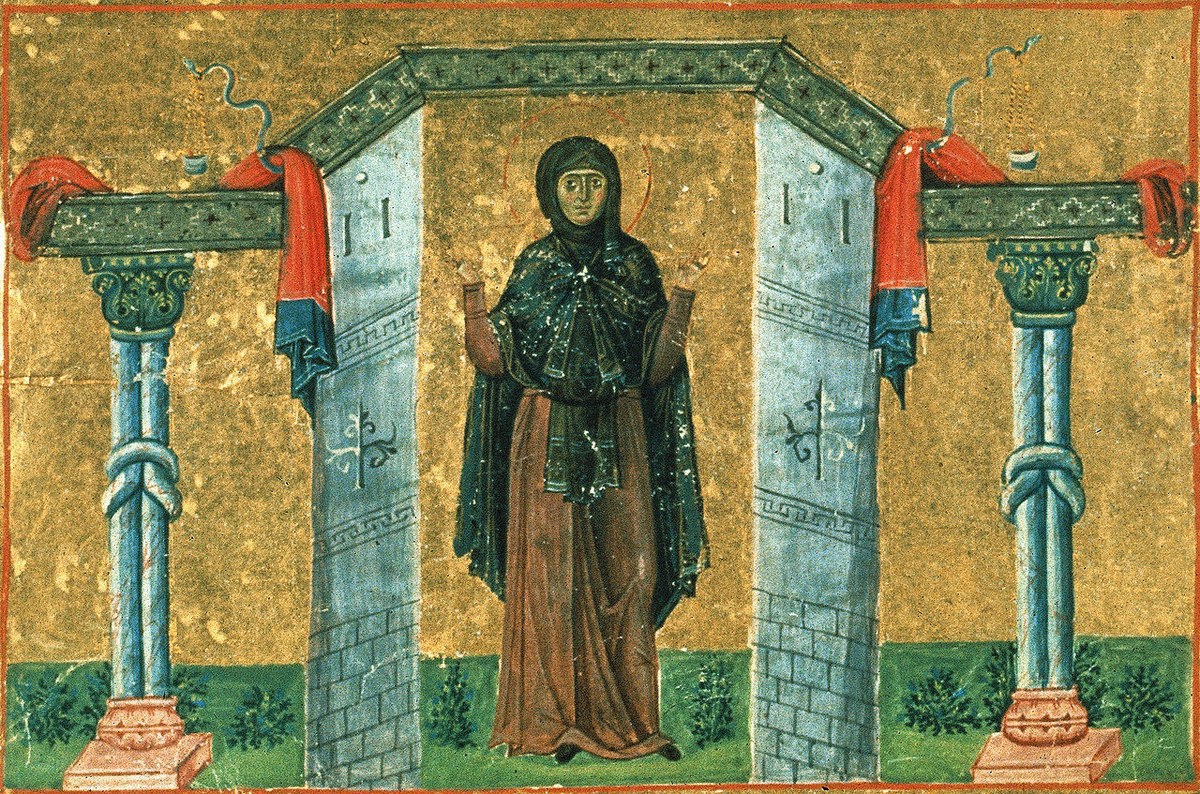
Melania is depicted as a nun — an aged, veiled woman in the dark monastic mandyas and koukoulion, her right hand raised in prayer or holding a scroll, in the settled type of the venerable ascetic mother. The earliest surviving image is the menologion miniature described below; later Greek and Slavic icons keep the same type, sometimes setting her against the Mount of Olives or with a scroll bearing a sentence on the vanity of riches, the mark of the great heiress who gave all away.
The stored image is the miniature for December 31 from the Menologion of Basil II (Constantinople, c. 985; Vatican, Vat. gr. 1613), inscribed as Melania the Younger, nun of Rome: the saint stands veiled in monastic habit before an architectural ground, her hands raised — the oldest datable portrait of her and a first-resort public-domain witness (source, public domain, pd-old-work).