
Melania the Elder
Our Venerable Mother Melania the Elder, the Roman
Venerable · b. c. 350, in Spain, of a Roman senatorial house — d. c. 410, at Jerusalem
Commemorated 8 June — Repose at Jerusalem
Melania the Elder (c. 350 – c. 410) was a Roman noblewoman, widowed at twenty-two, who took ship for Egypt in the reign of Valens, spent half a year among the fathers of Nitria, followed the exiled Orthodox monks into Palestine disguised as a slave-girl to serve them, and then settled for twenty-seven years on the Mount of Olives, where with Rufinus of Aquileia she governed a house of fifty virgins and a companion monastery of men and kept open house for every pilgrim who came to Jerusalem. She was the friend of Evagrius of Pontus and Palladius, the teacher of Olympias, and a reader of Origen on a scale that astonished her contemporaries — which drew on her the anger of Jerome and set her at the centre of the first Origenist controversy. Returning to Rome in old age she carried her granddaughter Melania the Younger and half her kindred out of the world before the Gothic sack; she reposed at Jerusalem forty days after her final arrival, about the year 410.

Origins and early widowhood
Palladius, who knew her circle intimately, says plainly that Melania was "a Spaniard by origin, but afterwards belonged to Rome" — a daughter of the provincial senatorial aristocracy of Hispania whose family had risen into the highest ranks of the capital. Her father was Marcellinus, of consular rank; she was married very young to "a certain man of high official rank" whose name Palladius admits he cannot remember (later sources give him as Valerius Maximus). Of three sons, two died with their father, and Melania was left a widow at twenty-two, still enormously rich, with one surviving child, Valerius Publicola.
At that moment, Palladius says, she was "favoured with the divine love." She told nobody — "for she would have been prevented" — appointed a guardian for her son, loaded her movable wealth onto a ship, and sailed for Alexandria, taking with her a company of highborn women and children. This was in the reign of Valens, about 372: the decisive act of an independently wealthy Roman widow choosing the desert over the Senate, and the beginning of the Latin aristocratic pilgrimage to the East.
Nitria and the exiled fathers
At Alexandria she converted her goods into money and went up to the mountain of Nitria. Palladius lists the fathers she met there, and the list is a roll of the founders of Egyptian monasticism: Pambo (July 18), Arsisius, Serapion the Great, Paphnutius of Scete, Isidore the Confessor, bishop of Hermopolis, and Dioscorus. She stayed half a year, travelling in the desert and visiting all the saints. A famous exchange is preserved: she brought Abba Pambo three hundred pounds of silver, and the old man, without so much as looking up from the plaiting of his rope, told his disciple to take it, and said to her only, "May God reward you" — refusing to weigh her gift by its size, since God who accepts the widow's mite needs no accountant.
Then the persecution fell. After the death of Athanasius (373) the prefect of Alexandria banished a company of Orthodox monks and bishops — Isidore, Pisimius, Adelphius, Paphnutius, Pambo, Ammonius Parotes, "and twelve bishops and priests" — into Palestine, to the neighbourhood of Diocaesarea. Melania followed them and supported them out of her own purse. Because servants were forbidden to the exiles, she put on the dress of a young slave and carried them what they needed in the evenings herself. The consularis of Palestine heard of it, and thinking to frighten a poor woman and fill his own pocket, had her arrested and thrown into prison "ignorant that she was a lady." Her answer to him is one of the great sentences of the Lausiac History: she was, she said, the daughter of one man and the wife of another, "but I am Christ's slave" — let him not despise the cheapness of her clothes, for she could exalt herself when she chose, and he could neither terrify her nor take anything from her; she was telling him this only so that he should not, in ignorance, incur a prosecution. The judge apologised, honoured her, and gave orders that she should assist the exiles unhindered.
Twenty-seven years on the Mount of Olives
When the exiles were recalled, Melania settled at Jerusalem, and there founded her monastery — Palladius says she spent twenty-seven years in charge of a community of fifty virgins. With her, from about 380, lived Rufinus of Aquileia, "a man similar to her in character and very stedfast," afterwards ordained priest: Palladius adds that a more learned or a kinder man was not to be found. Rufinus governed the men's house beside hers, and out of that double foundation on the Mount of Olives — one of the earliest monastic establishments in the Holy Land — came the great Latin translations by which the Greek fathers, and above all Origen, reached the West.
For twenty-seven years the two of them received at their own charges everyone who came to Jerusalem on pilgrimage: "bishops and monks and virgins." Two fruits of that hospitality are singled out. They reconciled the schism of Paulinus, bringing over some four hundred monks — that is, the long schism of Antioch, in which the Nicene party of the city was divided between the followers of Paulinus and those of Meletius and Flavian, and which outlasted three generations of bishops: Melania's house on the Mount of Olives was one of the quiet places where that quarrel was healed. And they won back to the Church every Pneumatomachian they met — those who denied the divinity of the Holy Spirit. They honoured the local clergy with gifts and food, Palladius says, "and so continued to the end, without offending anyone."
Her own asceticism was severe and unadvertised. In a chapter that the manuscripts head with another name but which is plainly hers, Palladius reports her rebuking a young deacon for bathing his hands and feet in cold water, with the words that she was then in her sixtieth year, and that except for her fingertips neither her feet nor her face nor any part of her had touched water; that she had never in all her travels rested on a bed or used a litter, and had refused every concession the doctors urged on her for her ailments. He records also that for thirty-seven years she gave hospitality out of her own income, until she "possessed not even a span of land," and that her benevolence reached East and West, North and South, to churches, monasteries, strangers and prisoners alike.
A reader of Origen; Evagrius; Olympias
Melania was, Palladius says, "very learned and loving literature," and turned night into day going through the ancient commentators — three million lines of Origen, two and a half million of Gregory, Stephen, Pierius, Basil and the other standard writers, and each book not once but "seven or eight times." He draws the conclusion that this immense reading was precisely what freed her from "knowledge falsely so called" (1 Tim. 6:20).
Her judgement of persons was as decisive as her reading. When Evagrius of Pontus fled Constantinople and lay in Jerusalem sick in body and divided in soul, unable to break with the world he had left, it was Melania who drew his confession out of him, put the monastic habit on him, and sent him to Egypt — so that the whole later tradition of Evagrian spirituality passes through her hands. Olympias the deaconess of Constantinople, Palladius says, "followed the counsel of Melania, attending to her precepts and walking in her footsteps"; and Palladius himself belonged to her circle. Paulinus of Nola, a kinsman by marriage, received from her a fragment of the True Cross, and left the memorable picture of her on her journey west: a tiny old woman in black on a scrawny horse, in the middle of the glittering cavalcade of her senatorial relations, worth more than all of them together.
The return to Rome and the repose at Jerusalem
Late in life she learned how things stood with her granddaughter and namesake. Melania the Younger, married at fourteen to Pinian, had lost both her children and was pressing her husband to a life of continence; the elder Melania, "an old woman of sixty years," was afraid that so great a resolution would be spoiled by bad teaching, heresy or soft living. She flung herself onto a ship, sailed from Caesarea, and reached Rome in twenty days — about the year 400.
What she did there Palladius sets down as a campaign. She converted the pagan Apronianus, husband of her niece Avita, and persuaded him to continence; she strengthened the resolve of Melania the Younger and Pinian; she instructed her daughter-in-law Albina; she induced the whole connection to sell their estates, and led them out of Rome into "the holy and calm harbour" of the monastic life. In doing it, Palladius says, she "fought with beasts in the shape of all the senators and their wives," who saw where such renunciations would end. To them she said: "Little children, it was written four hundred years ago, It is the last hour. Why do you love to linger in life's vanities? Perchance the days of antichrist will surprise you, and you will cease to enjoy your wealth and your ancestral property."
She took Publicola's younger son to Sicily, sold the last of her possessions, and came back to Jerusalem. There, having stripped herself of everything, within forty days she fell asleep, "in a good old age and profound meekness," leaving behind her monastery and an endowment for it. The date is about 410. Palladius sets the sack of Rome immediately after: the storm of barbarians that spared not even the bronze statues of the Forum fell on the city Melania had emptied of her own kindred, and both those who had listened to her and those who had opposed her glorified God, "in that, when all the other families had been made prisoners, these ones only were preserved."
The Origenist controversy
Melania's name is inseparable from the first great quarrel over Origen. Rufinus, her companion of twenty-seven years, was the chief Latin translator and defender of Origen's works; when Epiphanius of Salamis opened the attack, and Jerome — settled at Bethlehem, a few miles from the Mount of Olives — turned against his old friend, the Origenist party in Palestine gathered around John, bishop of Jerusalem, Rufinus, and Melania's monastery. The pamphlet war that followed was among the bitterest in Christian letters.
Jerome had once written of Melania with admiration, entering her praise in his Chronicle; in the heat of the controversy he removed the notice, and is reported to have turned her name against her with a pun on the Greek μέλας, "black" — black in name and black in treachery. The Orthodox tradition, which commemorates both Melania and (on other days) the saints on the other side of the dispute, has never taken Jerome's polemic as a verdict. Palladius' own remark is the sounder judgement: her reading of Origen was so thorough that it delivered her from false knowledge rather than delivering her to it. She died before the condemnations of the sixth century, and neither the synaxaria nor the councils charge her with the errors later drawn out of Origen's system by his followers.
Feast and commemoration
June 8 (church date; New Calendar civil June 8, Old Calendar civil June 21). Greek synaxaria enter her for this day as Ὁσία Μελάνεια, immediately after the translation of the relics of Theodore Stratelates, which is the day's principal commemoration and carries its service. She is not on the OCA or Slavic lists for June 8, and no proper hymns are appointed her: the common of a venerable woman serves. Her granddaughter's feast on December 31 is the better-known of the two, and the December 31 entry already carries the distinction between them; the Antiochian usage keeps the Elder in the synaxarion reading only. Her true monument is the Mount of Olives, where her double foundation stood, and the endowment Palladius says she left behind her.
Hymns
Troparion — Tone 8 (common of a venerable woman)
In thee, O Mother, was the image of God preserved with exactness; for thou didst take up the Cross and follow Christ, and by thy deeds thou didst teach us to despise the flesh, for it passeth away, but to care for the soul, a thing immortal. Therefore doth thy spirit, O venerable Melania, rejoice together with the Angels.
Original translation from the Greek
Kontakion — Tone 4
Forsaking the wealth and the glory of Rome as a burden, thou didst put on the dress of a slave to serve the confessors in their exile, and upon the Mount of Olives thou didst gather a lamp-stand of virgins; O Mother Melania, thou didst keep open house for the whole Church, entreat Christ God that our souls may be saved.
Original translation from the Greek
Iconography
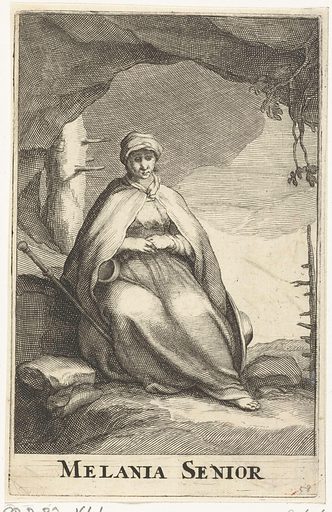
There is no established Byzantine iconographic type of Melania the Elder distinct from her granddaughter's; where she is painted in Orthodox usage she takes the standard form of a venerable woman-ascetic — dark monastic mantle and veil, hands raised or holding a scroll, face aged and thin — and the two Melanias are told apart only by the inscription. The West, which kept her feast on the same day, produced a small devotional literature of her: the stored image belongs to it. It is a seventeenth-century engraving by Frederick Bloemaert after Abraham Bloemaert, from the Netherlandish series of desert ascetics, and is lettered plainly MELANIA SENIOR — the saint seated at the mouth of a rock cave in a hooded mantle, a pilgrim's staff and water-flask laid beside her and a book at her feet: the type of the learned anchoress, and an accurate emblem for the woman Palladius describes reading Origen seven times over. It is stored as a pre-1900 work in the public domain, not as an icon, and a pre-modern Greek or Palestinian icon of her would be an upgrade.
A second Commons candidate, a file uploaded from a modern archdiocesan web page and tagged "PD-Art" with no date given for the underlying painting, was rejected: the uploader's public-domain claim covers only the photograph, and the icon beneath it appears to be a modern work whose iconographer's rights are untouched by that tag.
Disputed questions
- Not to be confused with Melania the Younger (†439, commemorated December 31), her granddaughter and namesake. The two are constantly conflated, and the resemblance is real: both were Roman noblewomen of the same family who liquidated colossal senatorial fortunes, both left Italy for the Holy Land, and both founded monastic houses on the Mount of Olives. They are certainly distinct. The Elder is the widow who went east about 372, lived twenty-seven years with Rufinus of Aquileia, and died about 410; the Younger is her granddaughter, the wife of Pinian, who fled the Gothic sack, knew Augustine in North Africa, opposed Nestorius, and died on December 31, 439. The Elder was the grandmother who came back to Rome expressly to bring the Younger out of the world; their two Lives interlock, and the older woman is the hinge of the younger one's conversion.
- The chapter of the Lausiac History headed "Silvania." In the Greek manuscripts the chapter containing the rebuke about washing and the account of the three million lines of Origen is variously attributed to Melania and to a Silvania/Silvia, sister-in-law of the prefect Rufinus (a different Rufinus from the priest of Aquileia). Editors and translators differ; the internal evidence — the sixtieth year, the refusal of litters and beds, the Origenist reading — matches Melania's other chapters closely, and the material is treated here as hers, with the doubt recorded.
- Origin and family. Palladius calls her a Spaniard; later Latin sources make her a Roman of the gens Antonia, granddaughter of a consul, and give her husband's name as Valerius Maximus. The two statements are compatible if her family was a Spanish branch of the Roman senatorial nobility, as with the house of Theodosius.
- Date of repose. Palladius' sequence puts her death shortly before the sack of Rome (August 410), which gives c. 409–410; some reckonings, counting from other fixed points in her granddaughter's Life, place it as late as c. 417. The synaxaria give only the day.
- A Western, not a Byzantine, cultus. June 8 is her day in the Greek synaxaria and in the Roman Martyrology alike, but she has no proper office in the printed Menaia and does not appear in the Slavic calendars for the day; her commemoration is a synaxarion notice rather than a served feast.