
Methodius of Patara
The Holy Hieromartyr Methodius, Bishop of Patara
Hieromartyr · Bishop · d. c. 311–312
Commemorated 20 June — Martyrdom by beheading at Chalcis
Methodius (†c. 311–312) is the bishop, theologian and martyr whom the Church honours as the first great critic of Origen. Called in the Greek books Bishop of Patara and in the older Latin witness Bishop of Olympus in Lycia, he wrote in a polished Platonic Greek that no other Christian of his generation matched: above all the Symposium, or Banquet of the Ten Virgins, the only one of his works to survive whole in the original, in which ten virgins in a garden deliver ten speeches in praise of virginity and end by singing an alphabetical hymn to Christ the Bridegroom. Against Origen he defended the resurrection of this body, the goodness of the material creation, and the beginning of souls in time, refusing the doctrine that souls pre-existed their bodies and fell into them. He was beheaded in the persecution of the early fourth century, and is commemorated on June 20.

The bishop and his see
Almost nothing of Methodius' life is transmitted apart from his books, and even the see he held is disputed (see Disputed questions below). Jerome, our earliest witness, calls him "bishop of Olympus in Lycia and afterwards of Tyre"; the later Greek synaxaria and the Slavonic books call him bishop of Patara, the metropolis of Lycia and the birthplace of St Nicholas the Wonderworker — the title under which the Orthodox calendar keeps him to this day. What the sources agree on is the region: the Lycian coast of south-western Asia Minor, in the generation between the death of Origen (c. 254) and the peace of the Church under Constantine.
He was a bishop of the old style, at once pastor and man of letters. The Slavonic synaxarion notice, which the Russian books repeat, describes a hierarch of monastic humility who taught his flock quietly and without harshness, and who spent what strength he had on writing: apologetic against the pagans, dogmatic against the heretics, moral discourses, and commentary on the Scriptures. That description is not far from what the surviving works themselves show.
The Symposium, or Banquet of the Ten Virgins
The Symposium (Συμπόσιον τῶν δέκα παρθένων) is the only work of Methodius preserved entire in Greek, and it is one of the most unexpected books of the early Church. Its frame is taken openly from Plato's Symposium: a company gathers in a garden — here the garden of Arete, "Virtue," daughter of Philosophia — and each guest in turn makes a speech on a single theme. Plato's theme was Eros; Methodius' is virginity, and his ten speakers are ten Christian women: Marcella, Theophila, Thaleia, Theopatra, Thallousa, Agathe, Procilla, Thekla, Tusiane and Domnina.
The speeches are not repetitions of one another. Theophila argues against any contempt for marriage and the body — the command to increase and multiply has not been revoked, and God is still at work in every conception. Thaleia reads the union of Christ and the Church out of Ephesians; Thallousa treats the vow; Thekla, given the longest and highest speech, expounds the woman clothed with the sun of Revelation 12 as the Church herself, ever bearing children in baptism. The whole ends with the crowning of Thekla and with her hymn — twenty-four stanzas, one for each letter of the Greek alphabet, with the refrain "I keep myself pure for Thee, O Bridegroom, and holding a lighted torch I go out to meet Thee." It is among the oldest Christian hymns preserved outside the New Testament, and it stands behind a great deal of later Byzantine bridal imagery.
The theology of the Symposium is as important as its literary form. Virginity is not presented as a rejection of the flesh but as its restoration: the virgin anticipates in her own body the incorruption promised to all flesh at the resurrection. Christ is himself the Archparthenos, the first virgin, and virginity is the way in which a Christian is conformed to him — "likeness to God," in Methodius' phrase, worked out in the body rather than away from it.
Against Origen
Methodius is remembered above all as the first systematic opponent of Origen, and he is the sharper for having learned so much from him: he shares Origen's allegorical method, his Platonic vocabulary and his interest in the pre-history of the soul, and disagrees with him inside that shared world rather than from outside it.
Three points divide them. First, the resurrection body. In On the Resurrection (Ἀγλαοφῶν ἢ Περὶ ἀναστάσεως, preserved chiefly in Slavonic with substantial Greek fragments in Epiphanius and Photius) Methodius rejects Origen's teaching that what rises is the form or pattern of the body and not its matter. For Methodius the body that rises is the very body that died, remade incorruptible as a statue is recast: God does not abandon his own workmanship but repairs it. He explains death itself in this light — God made man mortal after the fall not in anger but as a mercy, so that sin should not be immortalised in an endless body, and the flesh is broken up precisely in order to be remoulded without the evil.
Second, the pre-existence of souls. Origen's De principiis had taught that rational spirits existed before bodies, and were clothed in bodies as a consequence of a fall from contemplation. Methodius denies it outright: the soul is not older than the body, the body is not a punishment or a prison, and the creation of man in Genesis is a real beginning and not the record of a catastrophe.
Third, the eternity of the world. Against the Origenist tendency to make creation co-eternal with the Creator, Methodius insists on a true beginning; and against any reading that would have the cosmos annihilated, he insists on a true renewal. The world does not perish in the final fire but is purified by it, and "the earth and the heaven must exist again after the conflagration" — restored, not replaced.
In On Free Will (Περὶ τοῦ αὐτεξουσίου) he turns from Origen to the dualists, arguing against the Gnostic and Valentinian derivation of evil from an evil principle or from pre-existent matter. Evil has no substance of its own: it arises from the free choice of rational creatures, and freedom is precisely what makes a creature capable of the good.
Other writings
Beyond these, a group of shorter treatises survives complete only in Old Church Slavonic — the translations made in the Bulgarian and Russian lands preserved what the Greek tradition lost. They include De vita (on life and rational action), De cibis (on the distinction of clean and unclean foods, and on the heifer of Numbers 19), De lepra (on leprosy, read allegorically of sin) and De sanguisuga (on the leech of Proverbs 30:15, and on "the heavens declare the glory of God"). Fragments of a commentary on Job and of a work Against Porphyry — the most formidable pagan critic of the Church — are cited by later writers but are otherwise lost.
Eusebius of Caesarea, who admired Origen, does not mention Methodius once in the Ecclesiastical History, although he must have known his work. The silence is almost certainly deliberate, and later writers said so: Jerome reports that Eusebius wrote a reply defending Origen against him. It is the earliest sign of how divisive the Origenist question would become.
Martyrdom
Jerome, in On Illustrious Men, states that Methodius "at the end suffered martyrdom at Chalcis in Greece" — the notice is brief and gives no year. The Greek and Slavonic synaxaria place his death in the persecution of the early fourth century and say that he was arrested, confessed Christ steadily before the magistrates, and was beheaded; the Russian books give the year as 312. The commonly accepted range is c. 311–312, at the very end of the persecutions and on the eve of the peace of the Church.
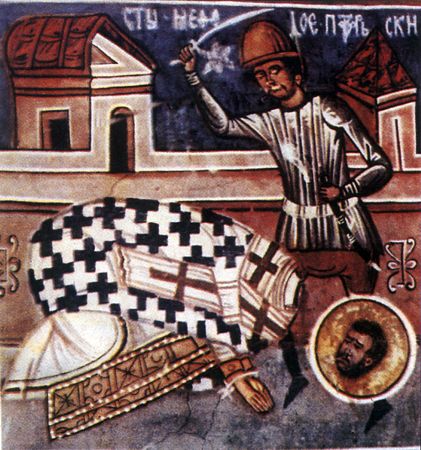
The seventeenth-century icon stored with this entry shows exactly the scene the synaxarion describes: the hierarch in the cross-covered polystavrion bowed beneath the executioner's sword, his severed head lying haloed at the foot of the composition.
Feast and commemoration
June 20 (church date; Old Calendar civil July 3). The commemoration is universal: Greek, Slavonic, Antiochian and Romanian books all keep it, and it heads the day everywhere. The service is that of a hieromartyr, sung with the six stichera and the canon of the saint.
The Roman Martyrology commemorates him on September 18, a Western date with no Orthodox usage behind it; the divergence is old and is noted here rather than resolved. June 20 lies in the window of the Apostles' Fast in most years — the fast begins on the Monday after the Sunday of All Saints and so has no fixed start, and in a year of very late Pascha it has not yet begun; its position on this day is therefore not asserted.
Hymns
Apolytikion — Tone 4
As a sharer in the ways and a successor to the thrones of the Apostles, O divinely-inspired one, thou didst find in contemplation the means to ascend to divine heights; rightly dividing the word of truth, thou didst struggle for the faith even unto blood, O hieromartyr Methodius: intercede with Christ God that our souls may be saved.
Kontakion — Tone 2
Thou didst water the Church with the streams of thy teaching, O wise Methodius, and didst cut down the tares of error with the sickle of the word; then, offering thy neck to the sword, thou didst seal thy books with thy blood. Wherefore we cry to thee: rejoice, O hierarch and martyr, unshaken pillar of the faith.
Original translation from the Greek
The
I keep myself pure for Thee, and holding a lighted torch I go out to meet Thee, O Bridegroom.
Iconography
Methodius is written as a hierarch: middle-aged, dark-haired and with a short pointed beard, in phelonion and omophorion, blessing with the right hand and holding the Gospel-book or a scroll in the left. Because his fame rests on his writing, the scroll is the more usual attribute in the Greek tradition, and it is sometimes shown open with a line from his teaching on the resurrection. As a hieromartyr he may also be given the cross.
The scene proper to him in the menologia is his beheading, and this is what the stored image shows: a Slavonic menologion composition of the seventeenth century (c. 1650), inscribed in Church Slavonic Стый Меѳодїй Патарскїй, in which the bishop kneels in a white polystavrion patterned with black crosses before a city gate while the executioner raises the sword; the martyr's haloed head lies in the lower right corner. The Menologion of Basil II, the usual first resort for such scenes, covers only September to February and contains nothing for this day.
Disputed questions
- Olympus, Patara, or Philippi? The see is genuinely unsettled. Jerome (c. 392) names Olympus in Lycia, adding a later translation to Tyre; the transfer to Tyre is found in Jerome alone and is generally doubted, since a bishop of Tyre named Tyrannion is otherwise attested for the period. A tradition of the late sixth century, followed by the Byzantine synaxaria and by all Orthodox usage since, makes him bishop of Patara, the Lycian capital — the title under which the Church commemorates him. A modern scholarly case, argued most fully by Franz Diekamp, places him instead at Philippi in Macedonia, on the ground of manuscript superscriptions and of Jerome's own statement that he died in Greece, which fits Macedonia far better than Lycia. This entry keeps the liturgical title, records the alternatives, and resolves nothing.
- Which Chalcis? Jerome's "Chalcis in Greece" is usually taken as Chalcis in Euboea; some have preferred Chalcis ad Belum in Syria, which would fit a Lycian bishop taken east under persecution. No evidence settles it.
- The date. Jerome associates the martyrdom with the persecution of Decius and Valerian in one place, which is impossibly early for a critic of Origen's mature work; elsewhere the tradition points to Diocletian, Galerius or Maximinus Daia. The last of these fits the surviving chronology best, and c. 311–312 is the standard modern date.
- The name Eubulius. Methodius calls one of his own dialogue-speakers Eubulius, and ancient readers took this as a second name of the author, as Plato's "Socrates" is Plato's mouthpiece. Some manuscripts accordingly title him Methodius Eubulius.
- The Apocalypse of Pseudo-Methodius. The immensely influential apocalyptic text of the late seventh century, composed in Syriac in the shadow of the Arab conquests and translated into Greek, Latin and Slavonic, circulated under Methodius' name and is not his; nor is the Oration on Simeon and Anna transmitted with his works. Neither may be cited as evidence of his teaching.
- Not to be confused with the other saints named Methodius: Methodius of Moravia, the Equal-to-the-Apostles and Enlightener of the Slavs (†885, April 6 and May 11); Methodius of Constantinople, the Confessor and Patriarch who restored the icons (†847, June 14 — six days before this feast, and in the same month); Methodius of Peshnosha, the Russian monastic founder (†1392, June 4 and June 14); and Methodia of Kimolos (†1908, October 5), whose name is the feminine form. Of these the confusion with the iconophile Patriarch Methodius is by far the likeliest, since both are hierarchs, both are theologians, and their feasts fall within one week of each other.