
Methodius of Constantinople
Our Father among the Saints Methodius the Confessor, Archbishop of Constantinople
Patriarch · Bishop · Confessor · b. c. 788, Syracuse in Sicily — d. June 14, 847, Constantinople
Commemorated 14 June — Repose of the confessor and patriarch
Methodius the Confessor, a Sicilian by birth and a monk of Chios, was the hierarch under whom the iconoclast controversy ended. Legate of the deposed Patriarch Nikephoros at Rome, he came home in 821 with a papal letter demanding the restoration of the holy images, and paid for it with scourging, seven years in a tomb-like cell on the island of Antigoni, and a jaw broken under the emperor Theophilus, which he carried bound in a cloth to the end of his life. Raised to the patriarchal throne in 843 by the regent Theodora, he convoked the synod that restored the icons, led the procession of the images to the Great Church on the first Sunday of Great Lent — the Sunday of Orthodoxy, kept ever since — and composed the Synodikon of Orthodoxy that is still proclaimed on that day. He brought back the relics of Nikephoros and of Theodore the Studite, wrote lives of the confessors he had known, and reposed on June 14, 847, having ruled four years.
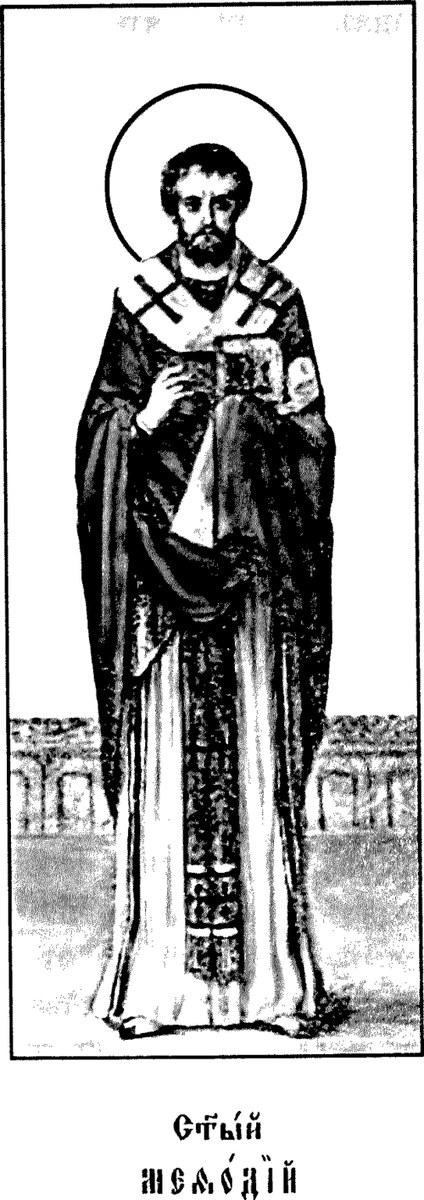
_-_икона_10142_Мефодий.png)
Sicily, Constantinople, Chios
Methodius was born at Syracuse in Sicily toward the end of the eighth century, of a family described as wealthy and of standing, and was given a thorough education. He went out to Constantinople as a young man, according to his Life with an eye to a career in the imperial service; what he found there instead was the monastic life, and he never went back to the world. He was tonsured, spent his own patrimony on the restoring — the sources say the building — of a monastery on the island of Chios, and was in time ordained to the priesthood. It is worth noticing at the outset that the man who closed the iconoclast century was a Westerner by birth: the hymnography of his feast, in a doxastikon ascribed to Photius, makes the whole point of it, "A star of piety arose from the setting of the visible sun."
His learning and steadiness brought him to the notice of the patriarch. Under Nikephoros I (806–815) he was made apokrisiarios — the patriarchate's resident legate — and was sent on embassy to Rome. He was still there when the second wave of iconoclasm broke: the emperor Leo V the Armenian (813–820) revived the persecution of the images, deposed Nikephoros in 815, and installed Theodotos Kassiteras. Methodius stayed in Rome, an exile in effect, for the rest of that reign.
Confession under Michael and Theophilus
In 821, under Michael II the Stammerer, Methodius returned to Constantinople carrying a letter from the Pope — Paschal I — which urged the emperor to restore the veneration of the icons and the lawful patriarch to his throne. He delivered it. He was seized, publicly scourged, and shut up on the little island of Antigoni in the Propontis, in a cell that the sources describe as a tomb: a pit or sealed chamber, where he was left for seven years with two condemned robbers for company, one of whom died and whose body was not taken out. The detail is preserved in the canon of his feast, which sings that "shut up in a tomb at the command of an impious emperor, thou wast kept unharmed."
Theophilus (829–842), the last iconoclast emperor, had him brought out — partly, the accounts say, because the emperor prized learned men and wanted him at hand for questions of scholarship, and Methodius was for a time about the palace. It did not last. When he would not be silent, he was flogged, and in the beating his jaw was broken and his face permanently disfigured; he bound the wound about with a cloth, and wore that binding for the rest of his life. It became his mark in the iconography. To this the Life adds a further trial: the iconoclast party brought a charge of unchastity against him before the court, which he refuted, and which his biographers record as a slander designed to destroy the credit of the one confessor the emperor could not break by argument.
Patriarch, and the restoration of the icons
Theophilus died in January 842, leaving his widow Theodora regent for their child Michael III. Theodora had venerated the icons secretly through her husband's reign, and moved as soon as she safely could. The iconoclast patriarch John VII Grammatikos was required to recant or resign, and withdrew; and Methodius — the obvious candidate, and the one man whose sufferings put him beyond challenge — was enthroned Archbishop of Constantinople in 843. He convoked a synod in the capital which reaffirmed the decrees of the Seventh Ecumenical Council of 787, restored the veneration of the holy icons, deposed the iconoclast bishops who would not submit, and rehabilitated the confessors, living and dead.
On the first Sunday of Great Lent, 11 March 843, the empress, her son, the patriarch, the clergy, the monks and the people went in procession with the icons and restored them to the Great Church, and the Liturgy was served in a city that had been at war with its own images for more than a hundred years. That day has been kept ever since as the Sunday of Orthodoxy, the "Triumph of Orthodoxy," and it is Methodius' monument: the feast is not a commemoration of a victory of one party over another but the Church's annual public act of confessing what she believes, which is why the text he compiled for it is a creed and not a chronicle.
That text is the Synodikon of Orthodoxy, the long proclamation of the faith with its acclamations of the fathers and its anathemas of the heresies, drawn up under Methodius for the synod of 843 and read from the ambo on the Sunday of Orthodoxy to this day — with the successive additions of later centuries, since every subsequent council's definitions were appended to it. Whatever else he did, the Church still speaks with his voice once a year.
The relics of the confessors, and the peace of the Church
Methodius' four years on the throne were spent gathering up what iconoclasm had scattered. He sought out and restored the relics of saints that had been hidden or dispersed; he brought the body of his own master, the Patriarch Nikephoros, back from its exile-grave on Prokonnesos and laid it in the capital — the translation kept on March 13 — and he received the relics of Theodore the Studite and of Theodore's brother Joseph of Thessalonica from Prince's Island for burial at the Studios. He restored churches and the painting of them, made appointments to the sees left vacant by the deposed, and provided liturgical texts for the reconciliation of those who came back to the Church, together with canons, hymns, an order for the reception of converts, and homilies. He was also a hagiographer of the confessors he had known and suffered with: the encomium of Euthymius of Sardis, who was flogged to death in 831, is his, and is the near-contemporary source on which the historians rest that martyrdom, and a life of Theophanes the Confessor is ascribed to him.
Not all of it went smoothly. Methodius governed the reconciliation of the repentant iconoclast clergy by economy — receiving many in their orders after penance — and the Studite monks, the rigorist conscience of the capital, held that the fallen should be deposed outright. The quarrel grew bitter enough that the patriarch excommunicated the Studite community for a time and censured certain writings circulating under Theodore's name; the breach was healed after his death, but it shows the cost of a settlement that had to hold a Church together after a persecution. It is a familiar shape in Church history — the same argument, in substance, that divided Africa after Diocletian.
Repose
He reposed at Constantinople on June 14, 847, worn out by what had been done to him, having been patriarch four years and some months. The Menaion's distich says simply: "Methodius, the luminary of the Church — the gloomy cloud of death puts out his light." His feast was kept at Constantinople from the first, and it is a mark of the honour in which the Great Church held him that two of the doxastika of his office were composed by Photius the Great, who occupied his throne within a dozen years and who names him "holy one, martyr, priest, patriarch."
Feast and commemoration
June 14 on the church calendar (Old Calendar civil June 27), kept jointly with the Prophet Elisha: the Greek Menaion heads the day with the two names together and divides the office between them, three stichera and a canon apiece, the kontakion being the prophet's. The feast is universal. In the Slavonic books June 14 also carries the second commemoration of Methodius of Peshnosha — an accident of the calendar that has caused a good deal of confusion, including in the labelling of icons.
Methodius is further commemorated with all the champions of the images on the Sunday of Orthodoxy, the first Sunday of Great Lent, whose institution is his: he is named in the Synodikon itself, in the roll of the confessors whose memory is proclaimed as eternal. Because the position of June 14 in the year's cycle depends on the date of Pascha, no fixed rule of fasting attaches to it.
Hymns
Apolytikion — Tone 8
Guide of Orthodoxy, teacher of piety and holiness, luminary of the Church, God-inspired ornament of hierarchs: O wise Methodius, by thy teachings thou hast enlightened all, O lyre of the Spirit. Intercede with Christ our God that our souls may be saved.
Kontakion — Tone 8 (common of a confessor hierarch)
Thou didst shine forth as a lamp of the true faith, and didst not fear the fire, the sword or the sealed tomb; wherefore, O father Methodius, having brought back the holy images to the Church of Christ, thou wast shown the boast of hierarchs and the pillar of Orthodoxy.
Original translation from the Greek
Doxastikon
A star of piety has risen from the setting of the visible sun: Methodius, the great one among hierarchs; and having cut through the mist of the wrongly-believing, he came to his rest in the true East, in Christ our God, the Sun of righteousness. And there, keeping company with the choirs of the bodiless powers and standing before the throne of the Trinity — as a holy one, as a martyr, as a priest, as a patriarch, in action and in contemplation — he asks great mercy for us who in faith keep his sacred memory.
Sticheron
Today the Church of God is arrayed in gladness, rejoicing and crying out: my beauty is made brighter than that of every city; for behold, the great treasure of the hierarchs, the glorious Methodius, has made his journey to heaven. Come then, lovers of the feast, you company of the Orthodox: let us stand in choir about his divine reliquary, and receiving from it a flood of healings, let us beseech Christ our God to deliver the whole world from every heresy.
Exapostilarion — Tone 2
As a sun rising from the East thou didst set in the West by thy contest; but now thou hast illumined the world by thy all-wise teachings, O God-bearing father Methodius: therefore pray for us.
Synaxarion
Methodius, the luminary of the Church — the gloomy cloud of his death puts out his light.
Iconography
Methodius is painted as a hierarch of middle age or older, in phelonion and crossed omophorion, blessing and holding the Gospel; his beard is dark and short, and his face is characteristically gaunt and drawn. His own distinguishing attribute is the cloth or band bound about the jaw and cheek, the dressing of the wound Theophilus' beating left him, which the painters of the middle Byzantine period give him and which identifies him at once where an inscription is lost. He belongs by right to two subjects: the ranks of hierarchs in the sanctuary programme, and above all the Triumph of Orthodoxy — the great composition, of which the fifteenth-century Constantinopolitan panel in the British Museum is the famous example, showing the empress Theodora and the child Michael III on one side, the patriarch and his monks on the other, and between them the icon of the Hodegetria held aloft on a stand: Methodius stands at the head of the clergy, and the whole scene is the image of the day he made. He also appears in depictions of the restoration of the images in illustrated chronicles, and the martyrdom-cycles of the iconophile confessors.
The stored image is the plate for June 14 from the illustrated Russian Lives of the Saints after St Dimitry of Rostov (published 1903–1911), captioned Стый Меѳодій: the hierarch standing full length in sakkos and omophorion before a low wall, the Gospel held at his breast in a covered hand, his right hand raised — an engraved copy of the traditional type, and here without the jaw-binding.
A second stored image is the miniature of the Madrid Skylitzes, the illustrated Synopsis of Histories of John Skylitzes (twelfth century, Norman Sicily — a fitting provenance for a Sicilian patriarch), at the point of the chronicle that narrates the restoration of the icons: a haloed, bearded figure in the dark monastic mantle seated on a stool with his hand raised in speech. The identification is the manuscript's own, by its place in the narrative sequence, and is followed by the Biblioteca Nacional de España and by Wikimedia Commons; the crop carries no legible inscription, and it is stored as a secondary image on that footing rather than as an inscription-verified likeness.
Disputed questions
- Year of repose: 846 or 847. The Greek Menaion and synaxarion give 847, and this entry follows them; the OCA life and some Slavonic calendars print 846. The difference turns on whether his patriarchate is reckoned from 842 or 843 and on how the four years of his rule are counted, and the sources are not reconcilable on the evidence.
- Year of enthronement: 842 or 843. Both are found. The synod and the procession of the icons belong securely to the spring of 843 (the first Sunday of Lent, March 11); the political change — the death of Theophilus and Theodora's regency — belongs to January 842, and calendars that date his accession to 842 are counting from that.
- Length of the imprisonment on Antigoni. Seven years is the usual figure and is what the OCA life gives; some accounts say nine, reckoning the whole of his confinement rather than the term in the sealed cell.
- The broken jaw. Whether the disfigurement was inflicted under Michael II or under Theophilus is told both ways; most accounts put it under Theophilus, and this entry follows them. It is not a legend but the explanation of a fixed iconographic type.
- Not to be confused with Methodius of Moravia, the equal-to-the-apostles and enlightener of the Slavs (April 6, and May 11 with Cyril), nor — a much easier confusion, since they fall on the same day — with Methodius of Peshnosha, the disciple of Sergius of Radonezh (†1392), whose Russian commemorations are June 4 and June 14. The abbot of Peshnosha is painted as a monk; the patriarch as a hierarch, with the cloth about his jaw. Nor, again, with Methodius of Patara, the hieromartyr of Lycia and critic of Origen (†c. 312), whose feast falls six days later on June 20 — two hierarch-theologians named Methodius within one week of the same month.