
Nicholas the Wonderworker
Our Father among the Saints Nicholas the Wonderworker, Archbishop of Myra in Lycia
Bishop · Wonderworker · b. c. 270, Patara in Lycia — d. traditionally December 6, c. 343 (some accounts c. 335), at Myra
Commemorated 9 May — Translation of his relics from Myra to Bari (1087), 6 December — Repose at Myra
Nicholas the Wonderworker (c. 270 – c. 343), Archbishop of Myra in Lycia, is among the most beloved saints of the whole Christian world, honoured East and West as the model of the good shepherd and the ready helper of all in need. A Lycian by birth, made bishop of the coastal city of Myra while still young, he is remembered as a confessor who suffered imprisonment in the last great persecution and, by tradition, as one of the Fathers of the First Ecumenical Council at Nicaea in 325, where his zeal against the heresy of Arius passed into legend. But it is his charity and his wonders that fixed his memory: the secret gift of gold that dowered three destitute daughters and saved them from ruin — the root of the whole Christian custom of gift-giving, and, by a long Dutch and American descent, of Santa Claus; the deliverance of three innocent men from the executioner's sword and of three unjustly condemned officers by a dream sent to the emperor; and the stilling of a storm at sea, for which sailors have claimed him as their patron ever since. His relics, laid in Myra, were carried in 1087 to Bari in Italy — where they still exude the fragrant "manna" of myrrh commemorated on his second feast, May 9 — and the churches raised in his honour are past counting; in Russian piety he stands, it is said, next after the Mother of God herself.

The problem of the record
Few saints are loved so universally and known so uncertainly. The historical bedrock is narrow and firm: there was a bishop Nicholas of Myra, the metropolis of the Roman province of Lycia on the southern coast of Asia Minor, in the first half of the fourth century, whose tomb at Myra became a place of pilgrimage and whose cult is attested there by the sixth century, when the emperor Justinian built a church in his honour at Constantinople. Everything richer than this — the parents, the childhood wonders, the deeds of his episcopate — reaches us through hagiography written centuries after his death: the Praxis de stratelatis ("The Deed concerning the Generals"), the oldest surviving Nicholas legend, perhaps of the sixth century; the full Life composed by Michael the Archimandrite about the year 800; and the polished tenth-century recension of Symeon Metaphrastes that became the standard Byzantine text. A further complication runs through the whole tradition: the figure of Nicholas of Myra was early confused and conflated with a distinct Nicholas of Sion, abbot of the monastery of Holy Sion near Myra and bishop of Pinara, who died in 564 and whose genuine sixth-century Life survives — so that episodes belonging to the younger man (his pilgrimages, his uprooting of a sacred cypress haunted by a demon) migrated into the dossier of the elder. The entry that follows gives the tradition as the Church has received and celebrated it, marking where the record is legend rather than history (see Disputed questions).
Origins and early life
Nicholas was born, the tradition holds, about the year 270 at Patara, a port of Lycia not far from Myra, the only child of wealthy and devout Christian parents (later accounts name them Epiphanius and Nonna, or Theophanes and Johanna). The legends dwell on the sanctity that marked him from the cradle: it was told that as a newborn he stood upright in his bath, and that even as a nursing infant he kept the Church's fasts, refusing his mother's milk on Wednesdays and Fridays. Raised in piety and lettered in the Scriptures, he turned early from the pleasures of his class to the life of the Church. His parents died while he was still young, leaving him a large inheritance, which he resolved to spend not on himself but on the poor — a resolve whose first and most famous exercise, the dowering of the three daughters (below), belongs to these years. An uncle, also named Nicholas and bishop (or abbot) of a monastery, ordained him priest and, going on pilgrimage, left the young man to govern in his stead; and thus he was formed for the pastoral charge that would be his.
Bishop of Myra
The manner of his election to the see of Myra is one of the best-loved scenes of his Life. The bishop of Myra having died, the bishops of the province gathered to choose a successor and, unable to agree, gave themselves to prayer; and one of them received in the night a divine word that the first man to enter the church at the hour of matins, bearing the name Nicholas, should be their shepherd. Nicholas — newly returned to the city, and knowing nothing of this — came at dawn to pray, as was his custom, and was met at the door, named, and led to the episcopal throne against his own protest. He was, the tradition insists, still a young man when he was thus made archbishop of the Lycian metropolis, and he governed it as the very pattern of a bishop: gentle to his flock and terrible to the enemies of the faith, unsparing of his own goods, a tireless almsgiver and a fearless defender of the wronged. It is this double note — meekness toward the humble, iron toward injustice and error — that the Church's hymns single out when they hail him as "a rule of faith and an image of gentleness."
The Great Persecution and the confession
Nicholas's episcopate opened under the shadow of the last and fiercest imperial persecution, that of Diocletian and Maximian, begun in 303. The tradition numbers him among the confessors of those years: arrested for his preaching, he was cast into prison and there endured hunger, thirst, and the sufferings of the dungeon along with a multitude of the faithful, confessing Christ without flinching, yet — unlike the martyrs of Lycia who died — he was spared to see the peace of the Church. When Constantine's victory and the Edict of Milan (313) threw open the prison doors, Nicholas returned to Myra crowned not with the martyr's death but with the confessor's endurance, and took up again the government of his city. It was this liberated and hardened Nicholas — a bishop who had suffered for the faith — who, the tradition continues, took his place a decade later among the Fathers of Nicaea.
The Council of Nicaea and the zeal against Arius
When Constantine summoned the First Ecumenical Council to Nicaea in 325 to judge the teaching of the Alexandrian presbyter Arius, who denied the full divinity of the Son and made him a creature, Nicholas of Myra was — the tradition holds — among the more than three hundred assembled Fathers. The famous scene that the tradition attaches to him is recorded honestly here as tradition, for it appears in no early account of the Council and surfaces only in the later Byzantine and Western transmission: that Nicholas, hearing Arius blaspheme the Son of God to the Council's face, was so overcome with holy indignation that he struck the heresiarch across the cheek; that the outraged Fathers, holding it unlawful for a bishop to raise his hand in the imperial presence, deprived him of the insignia of his office — his omophorion and his Gospel-book — and confined him; and that in the night Christ and the Mother of God appeared to him in his cell, the Lord restoring to him the Gospel and the Theotokos the omophorion, whereupon the Fathers, learning of the vision, acknowledged his boldness as zeal for the truth and restored him. The story is beloved and is depicted in countless icons; the sober record must add that Nicholas's very presence at Nicaea, though old and widely held, is itself uncertain — his name is absent from the earliest surviving lists of the signatory Fathers, and the slapping of Arius is a late accretion to his legend. What the tradition means by it is not in doubt: that Nicholas was, above his gentleness, a fierce and uncompromising enemy of heresy, and this the Church has never questioned.
The wonderworker: almsgiving and the deliverance of the innocent
Nicholas's cult rests less on his doctrine than on his mercy, and the oldest and most characteristic stories are of the helpless rescued and the innocent saved.
The first and most famous is the dowering of the three daughters. A once well-to-do citizen of the town had fallen into such poverty that, unable to provide his three daughters with the dowries without which they could not marry, he was on the point of giving them over to prostitution to keep them and himself alive. Nicholas, learning of it and unwilling to shame the man by open charity, came by night to the house and threw in through the window a purse of gold, enough to dower the eldest; and so again on a second night for the second daughter; and when on the third night the father, having kept watch to learn his benefactor, ran out and recognized him, Nicholas bound him to tell no one. From this quiet deed — three purses of gold given in secret to spare three girls from ruin — descends, by a long road through the medieval veneration of Nicholas as the patron of children and the Dutch feast of Sinterklaas, the whole Christian custom of the anonymous gift, and at the end of it the figure of Santa Claus; the entry treats that descent below, and holds it apart from the saint himself.
The oldest Nicholas legend of all, the Praxis de stratelatis, tells a double deliverance. Three citizens of Myra had been unjustly condemned to death by a corrupt governor, Eustathius, and were already kneeling before the sword; Nicholas, told of it, hurried to the place of execution, seized the sword from the executioner's hand, and set the innocent men free, then rebuked the governor until he confessed the bribe that had bought the sentence. Present at this scene were three imperial officers (stratelatai), passing through Lycia on the emperor's business; and when, back at Constantinople, they were themselves falsely accused of treason and thrown into prison to be executed, they remembered the bishop who had saved the men of Myra and prayed to his God for help. That night Nicholas appeared in a dream to the emperor Constantine and to the prefect Ablabius, sternly commanding the release of the three innocent officers and warning of divine wrath if they died; the shaken emperor examined the case afresh, found the men guiltless, and let them go — and they came to Myra to thank their deliverer. This story, the earliest and most firmly attested in the dossier, gave Nicholas his abiding character as the swift helper of the wrongly accused and the patron of prisoners.
To these was joined the stilling of the storm. Sailing (the accounts say) to or from the Holy Land, Nicholas was caught with the ship's company in a tempest that threatened to founder them; at his prayer the sea fell calm, and when a sailor who had gone aloft fell to the deck and was killed, the bishop raised him living by his prayer. For this, and as the helper who is called upon in every danger of the deep, sailors, merchants, and travellers took Nicholas for their special patron — a patronage as old and as wide as any in the Church, and one reason his cult spread so early along every sea-lane of the Mediterranean.
Repose
Nicholas governed Myra into old age and reposed there in peace, the tradition says on the sixth of December — the year variously given as c. 343 or a few years earlier, the sources not agreeing and no contemporary record surviving. He was buried in his cathedral city, and at once his tomb began to work the cures and deliverances that his life had promised; the myrrh (myron) that flowed from his relics became itself a byword, and pilgrims carried it away as a medicine of soul and body. So the wonderworker in life became the wonderworker in death, and Myra a place of resort for the whole Christian East.
Relics and translations: Myra, Bari, Venice
For seven centuries the relics rested at Myra. But by the eleventh century Lycia lay exposed to the raids of the Seljuk Turks, and the shrine's safety — and, the Italian sources add candidly, the glory and profit that its possession would bring — drew the merchants of the Adriatic. In the spring of 1087 a company of sailors and merchants of Bari, in Apulia, sailed to Myra, entered the church, broke open the tomb, and carried off the greater part of the bones, bringing them home to Bari, where they were enshrined with great solemnity in the crypt of the new Basilica di San Nicola built to receive them, and where they remain. The translation, though a frank act of pious theft, was received throughout the Latin and much of the Greek world as a providential rescue, and it is kept as a feast on May 9 — a feast adopted with special ardour by the Russian Church, where it ranks among the great days of the year. At Bari the relics continued their most famous wonder: to this day a clear, fragrant liquid, called the manna or myrrh of Saint Nicholas, is gathered from the tomb each year on his feast — the myrrh-streaming that the May commemoration celebrates. A decade later, during the First Crusade, Venetian sailors are said to have carried off the fragments the Bariots had left behind and enshrined them at the church of San Nicolò al Lido in Venice; and so the hierarch of Myra came to rest, divided, in the two great maritime cities of the Adriatic — a fitting harbour for the patron of the sea.
Veneration East and West
No saint of the undivided Church, save perhaps the Mother of God, is venerated so widely or so warmly. In the East Nicholas is ho Thaumatourgos, the Wonderworker, the hierarch whose icon stands in every church and almost every home; in Russia above all his cult grew to an intensity unmatched elsewhere — Nikola Ugodnik, "Nicholas the Pleaser [of God]," reckoned in the popular piety as standing, after the Theotokos, nearest of all the saints to God, so that foreign travellers sometimes thought the Russians honoured him as a fourth person of the Godhead. Churches, monasteries, and chapels past counting bear his name across the Orthodox world; he is the patron of Russia and of Greece's islands and merchant fleets, of sailors and travellers, of children, of the poor, of the falsely accused and imprisoned. In the West his veneration was already established before the translation to Bari and blazed up after it: he became one of the most popular saints of the Latin Middle Ages, patron of children and students, of sailors, merchants, pawnbrokers (whose three golden balls recall his three purses), and of many cities and nations. Out of the Western devotion — the custom of gifts left for children on his feast, the Dutch Sinterklaas carried to New Amsterdam, and the nineteenth-century American reworking of the figure — grew the modern Santa Claus, a genial folk-figure now largely severed from the fourth-century bishop who gave gold in secret; the descent is real, and the distance from the saint equally so.
Miracles and traditions
The Nicholas legend went on growing for a thousand years, and not every story that gathered to his name belongs to the Greek tradition. The most striking of the later, Western accretions is the tale of the three boys (in some versions three young clerks or scholars): benighted at an inn, they were murdered by the innkeeper, cut up, and their remains hidden — in the most lurid form, salted down in a brining-tub as meat — until Nicholas, arriving and discerning the crime, prayed over the tub and raised the three children whole and living. This resurrection of the pickled boys is a medieval Western development, unknown to the Greek Lives and first appearing in France and Lorraine from about the twelfth century; it became immensely popular in Western art and made Nicholas the patron of schoolboys, but it forms no part of the Byzantine dossier and is recorded here as the later Western legend it is. The genuine Eastern tradition, by contrast, keeps to the note struck from the beginning: the merciful deliverer, the stiller of storms, the helper who comes, often unseen and by night, to the poor and the condemned.
Feast and commemoration
Nicholas is commemorated on December 6 (church date; Old Calendar civil December 19), the day of his repose, with a full festal service — one of the great saint's-days of the Byzantine year, kept universally by Greeks, Slavs, Antiochians, and all the Orthodox, and joined in the Menaion to the forefeast that begins the day before (December 5, the forefeast of the hierarch). Because the day falls within the Nativity Fast, the fast is relaxed a degree for the feast: fish, with wine and oil, is permitted. His second feast, May 9 (Old Calendar civil May 22), commemorates the translation of his relics to Bari in 1087; it is kept throughout the Orthodox world and with particular solemnity in the Russian tradition, which adopted it soon after the event. In addition, many places keep a weekly commemoration of Nicholas on Thursdays, on which the Octoechos appoints his canon and hymns together with those of the Apostles — a distinction he shares with few saints, and a measure of the place he holds in the Church's devotion. The Greek and Slavic calendars agree on both dates; the Western churches keep December 6 as well, though the calendar reform there long since severed that day, in popular custom, from the fasting season the East preserves.
Hymns
Troparion — Tone 4
A rule of faith and an image of gentleness, a teacher of temperance, hath the truth of things revealed thee to be unto thy flock; therefore hast thou gained by humility things exalted, and by poverty things rich. O Father and Hierarch Nicholas, intercede with Christ our God that our souls may be saved.
Original translation from the Greek
Kontakion — Tone 3
In Myra, O holy one, thou wast shown to be a minister of sacred things; for having fulfilled the Gospel of Christ, O righteous Father, thou didst lay down thy life for thy people and didst save the innocent from death. Therefore wast thou sanctified, as a great initiate of the grace of God.
Original translation from the Greek
Appointed readings
Epistle — Hebrews 13:17–21
17Obey them that have the rule over you, and submit yourselves: for they watch for your souls, as they that must give account, that they may do it with joy, and not with grief: for that is unprofitable for you. 18Pray for us: for we trust we have a good conscience, in all things willing to live honestly. 19But I beseech you the rather to do this, that I may be restored to you the sooner. 20Now the God of peace, that brought again from the dead our Lord Jesus, that great shepherd of the sheep, through the blood of the everlasting covenant, 21Make you perfect in every good work to do his will, working in you that which is wellpleasing in his sight, through Jesus Christ; to whom be glory for ever and ever. Amen.
Gospel — Luke 6:17–23
17And he came down with them, and stood in the plain, and the company of his disciples, and a great multitude of people out of all Judæa and Jerusalem, and from the sea coast of Tyre and Sidon, which came to hear him, and to be healed of their diseases; 18And they that were vexed with unclean spirits: and they were healed. 19And the whole multitude sought to touch him: for there went virtue out of him, and healed them all. 20And he lifted up his eyes on his disciples, and said, Blessed be ye poor: for yours is the kingdom of God. 21Blessed are ye that hunger now: for ye shall be filled. Blessed are ye that weep now: for ye shall laugh. 22Blessed are ye, when men shall hate you, and when they shall separate you from their company, and shall reproach you, and cast out your name as evil, for the Son of man’s sake. 23Rejoice ye in that day, and leap for joy: for, behold, your reward is great in heaven: for in the like manner did their fathers unto the prophets.
Iconography
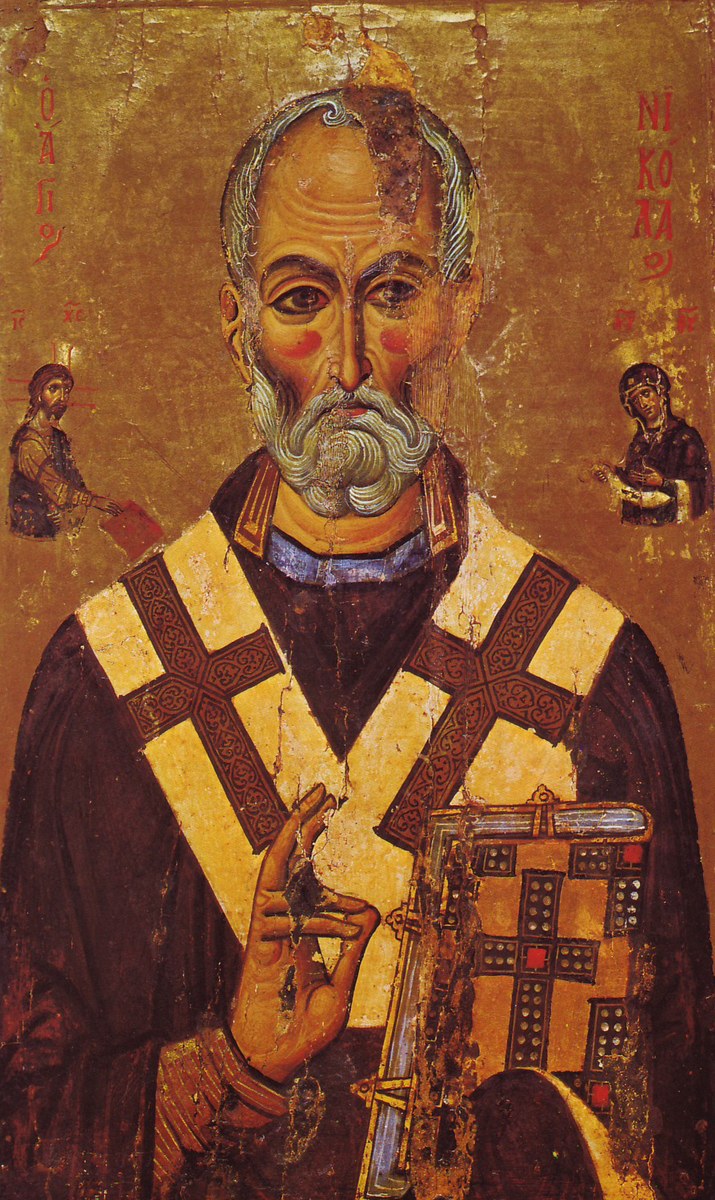
Nicholas is among the most frequently depicted of all saints, and his type is fixed and instantly recognizable: an aged bishop with a broad, high, balding forehead, a short rounded white beard, and a grave, benign, deeply-lined face; vested as a hierarch in the phelonion or the cross-figured polystavrion, wearing the omophorion, his right hand raised in blessing and his left holding the Gospel-book, often jewelled. In the fuller icons Christ and the Mother of God appear in medallions to either side of his head, offering him the Gospel and the omophorion — the visual sign of the Nicaea tradition, that what a council took from him heaven restored. He is shown both in the half-length "shoulder" icons that hang in every Orthodox church and in the great vita icons, whose border scenes narrate his life: his birth and his standing in the bath, his ordination, the three purses given by night, the staying of the executioner's sword, the dream sent to Constantine, the stilling of the storm, his repose, and the translation of his relics. So abundant are his icons — Byzantine, Cretan, Russian, and of every later school — that the wonderworker of Myra is, after Christ and the Theotokos, perhaps the most-painted figure in Orthodox art.
The stored image is one of the most celebrated of all: a half-length icon of the first half of the thirteenth century from the Monastery of Saint Catherine at Sinai, showing the hierarch in the classic frontal pose, the Gospel in his veiled left hand and his right raised in blessing, the ascetic face and high domed brow rendered with the grave humanity of the best middle-Byzantine painting (source, public domain, pd-old-work).
Disputed questions
- How much is history? The one thing certain is that a bishop Nicholas of Myra lived and was venerated in fourth-century Lycia; the details of his life survive only in hagiography written from the sixth century onward. The entry gives the tradition as the Church celebrates it, marking legend as legend.
- Conflation with Nicholas of Sion. The dossier of Nicholas of Myra absorbed episodes belonging to a distinct sixth-century Nicholas of Sion, abbot near Myra and bishop of Pinara (†564), whose genuine Life survives; some deeds (certain pilgrimages, the felling of a demon-haunted tree) probably belong to the younger man. The two are not the same person.
- Nicaea and the slapping of Arius. Nicholas's presence among the 318 Fathers of 325 is an old and cherished tradition but historically uncertain — his name is missing from the earliest signatory lists — and the striking of Arius appears only in the later transmission, not in any early account of the Council. It is recorded here as the tradition it is, true to the saint's remembered zeal for the faith whether or not the scene occurred.
- The three resurrected boys. The tale of the murdered children raised from the brining-tub is a medieval Western development (12th c., France and Lorraine), unknown to the Greek Lives; it is honestly distinguished from the Eastern tradition.
- Santa Claus. The modern gift-bringer descends by a real historical line — through the medieval patronage of children, the Dutch Sinterklaas, and its American reworking — from the bishop who dowered the three daughters in secret; the folk-figure is nonetheless not to be confused with the fourth-century hierarch and confessor.
- Not to be confused with the Greek New-Martyr Nicholas the Grocer of Karpenisi (†1672, kept September 23); with the Russian fool-for-Christ Nicholas (Salos) of Pskov (†1576, kept February 28), who bore this Wonderworker's name and invokes him in his own troparion; with Nicholas of Japan (Kasatkin, †1912); or with the many other later saints named Nicholas (of Chios, of Metsovo, and others): "the Wonderworker of Myra" is this Nicholas alone.