
Micah, Son of Imlah
The Holy Prophet Micah, Son of Imlah
Prophet · b. 9th century BC — d. 9th century BC
Commemorated 5 January — Commemoration of the prophet who withstood Ahab — kept on the Eve of the Theophany
Micah the son of Imlah (ninth century BC) — called Micaiah in the Hebrew of the narrative — is the prophet of the northern kingdom of Israel who withstood King Ahab to his face. When Ahab and Jehoshaphat of Judah went up to war for Ramoth-Gilead, and four hundred court prophets promised victory, Micah alone foretold the king's defeat and death, and for his true word was struck and imprisoned. Ahab fell in the battle exactly as the prophet had said. A contemporary of the great Elijah and reckoned among his disciples, Micah is honoured on January 5 and the tradition remembers him as dying a martyr's death. He is carefully distinguished from the later Micah of Moresheth — the writing prophet of the Book of Micah, kept on August 14 — with whom his shared name is often confused.

The one great scene of his life is told in 1 Kings 22 (in the Septuagint, 3 Kingdoms 22) and again in 2 Chronicles 18. Ahab, king of Israel, and Jehoshaphat, king of Judah, are allied for a campaign to recover Ramoth-Gilead from the Syrians. Jehoshaphat asks that they first inquire of the Lord. Ahab gathers his four hundred prophets, who with one voice promise that the king will prevail — chief among them Zedekiah son of Chenaanah, who makes himself iron horns and cries, "With these shalt thou push the Syrians." But Jehoshaphat is uneasy and asks whether there is not yet one more prophet of the Lord. There is one, Ahab answers — Micah son of Imlah — "but I hate him, for he never prophesies good concerning me, but evil."
Summoned, Micah first answers with the court's own words, in irony — "Go up and prosper" — until the king adjures him to speak truth in the name of the Lord; then he declares what he has seen: "I saw all Israel scattered upon the hills, as sheep that have not a shepherd," and the Lord saying, "These have no master; let them return every man to his house in peace." He unveils the vision behind the false prophets — a lying spirit permitted to go forth in the mouth of Ahab's prophets, that the doomed king might be enticed to his fall. Zedekiah strikes him on the cheek; Ahab orders him cast into prison, to be fed with the bread and water of affliction "until I come in peace." Micah's last word is the seal of a true prophet: "If thou return at all in peace, the Lord hath not spoken by me." Ahab went up, and though he disguised himself, a bowman drew his bow "at a venture" and struck him between the joints of the armour, and the king died at evening, and the dogs licked his blood — as the word of the Lord had been spoken.
Scripture does not record Micah's own death. The Byzantine synaxarion, which places his memory on January 5 and numbers him among the disciples of the prophet Elijah, holds that he ended his life as a martyr — put to death, in the tradition's telling, at the command of Ahab's son Joram (Ram), in vengeance for the true prophecy that had cost the dynasty its king. He is thus honoured both as prophet and as one who died for the word he would not soften.
Feast and commemoration
Micah son of Imlah is commemorated on January 5 (church date; Old Calendar civil January 18), the Eve of the Theophany, his memory kept with the Forefeast within the strict-fast vigil of the Lord's Baptism. The placing of an Old-Testament prophet on the threshold of the Theophany suits the day, which gathers the prophetic witness to the coming of the Lord to the waters.
Hymns
Troparion — Tone 2
As we keep the memory of thy Prophet Micah, O Lord, through him we entreat thee: save our souls.
Original translation from the Greek
Iconography
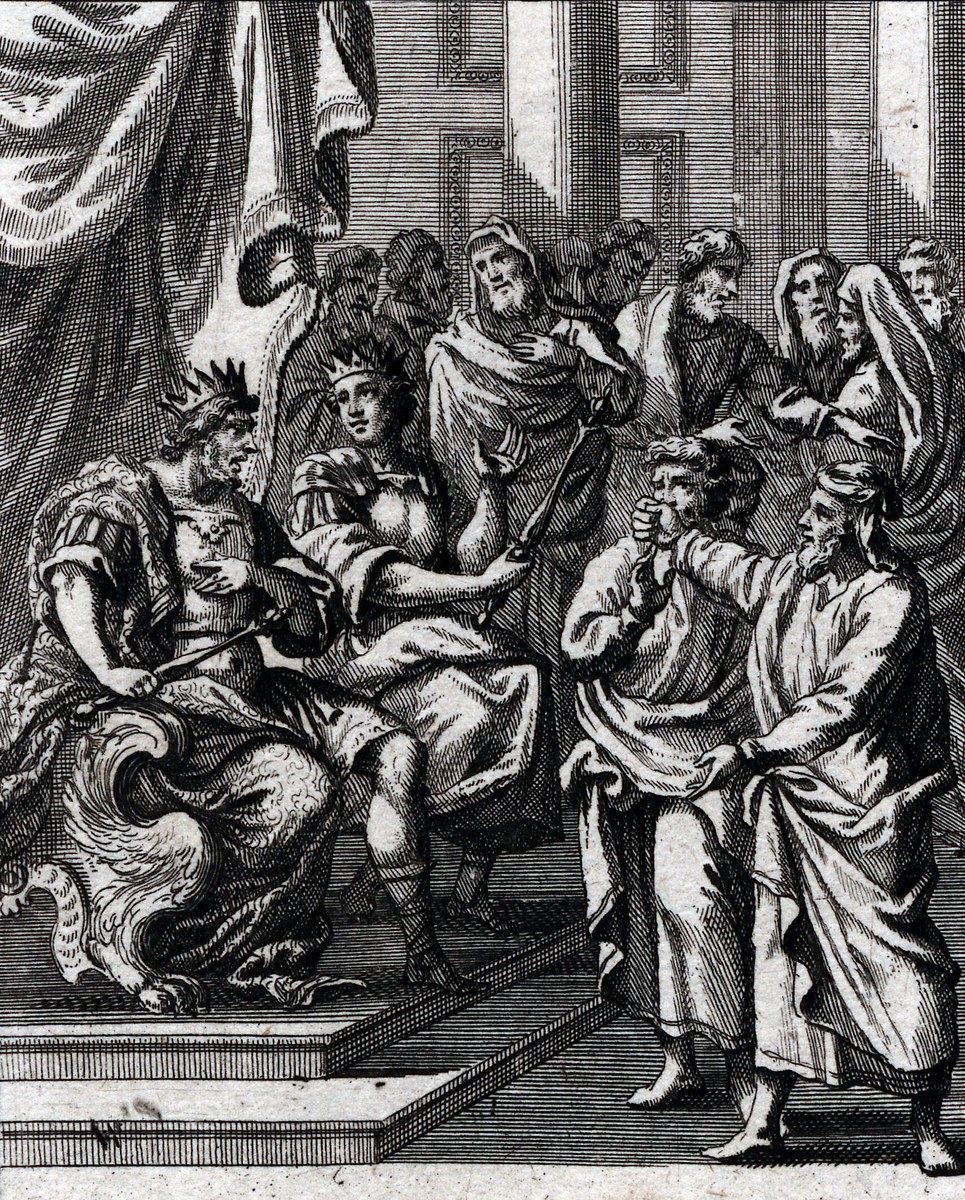
Micah is depicted in the settled type of the Old-Testament prophets: an older man in a mantle over the tunic, bearded, holding a scroll; his scroll may bear his great saying, "I saw all Israel scattered upon the hills, as sheep that have no shepherd." The Western etching below is identified to this prophet — Micaiah before Ahab and Jehoshaphat — and not to Micah of Moresheth, exactly the distinction the entry requires.
The stored image is a Western work per §34: a 1695 Dutch Bible etching of the prophet's hour: Micaiah before the two enthroned kings, prophesying the truth against the four hundred. An Eastern image remains wanted and is listed among the upgrade-wanted icons.
Disputed questions
- Two prophets named Micah. This prophet — Micaiah son of Imlah, of the ninth century BC, contemporary of Elijah, who prophesied against Ahab and wrote nothing — is a different man from Micah of Moresheth of the eighth century, one of the Twelve Minor Prophets and author of the Book of Micah (whence "Bethlehem Ephratah… out of thee shall come forth the ruler"), whom the Church keeps on August 14. The two share a name (Greek Michaias, Slavonic Mikhei) and are frequently confused, including in some calendar captions; they are kept on separate days and are here treated as separate entries. The synaxarion notice for August 14 in fact carries this prophet's martyrdom over to the Morasthite, an interference discussed under Disputed questions in that entry.
- Not to be confused with the Russian monastic saint Micah of Radonezh (†1385, May 6), the disciple of Saint Sergius, whose Slavonic name Mikhei is identical to the Slavonic form of both Old Testament prophets' names.